Recommendation Personalisation and Conversion Optimisation

£17.50

This booklet synthesises findings from: Academic Research and Peer-Reviewed Studies Dillibatcha, Suhasan Chintadripet. (2025). “Optimising User Experience and Conversion Rates Through A/B Testing in E-Commerce: A Comprehensive Framework.” World Journal of Advanced Engineering Technology and Sciences. Iyengar, Sheena S., and Mark R. Lepper. (2000). “When Choice is Demotivating: Can One Desire Too Much of a Good Thing?” (Commonly cited as the Columbia University Jam Study). Liu, Xiao, Dokyun Lee, and K. Srinivasan. (2017). “Large-Scale Cross-Category Analysis of Consumer Review Content on Sales Conversion Leveraging Deep Learning.” AAAI Workshops. Journal of Theoretical and Applied Electronic Commerce Research. (2024). “Online Reviews Meet…

Why Your “Customers Also Bought” Widget Is Quietly Losing You Sales (And What Actually Fixes It)

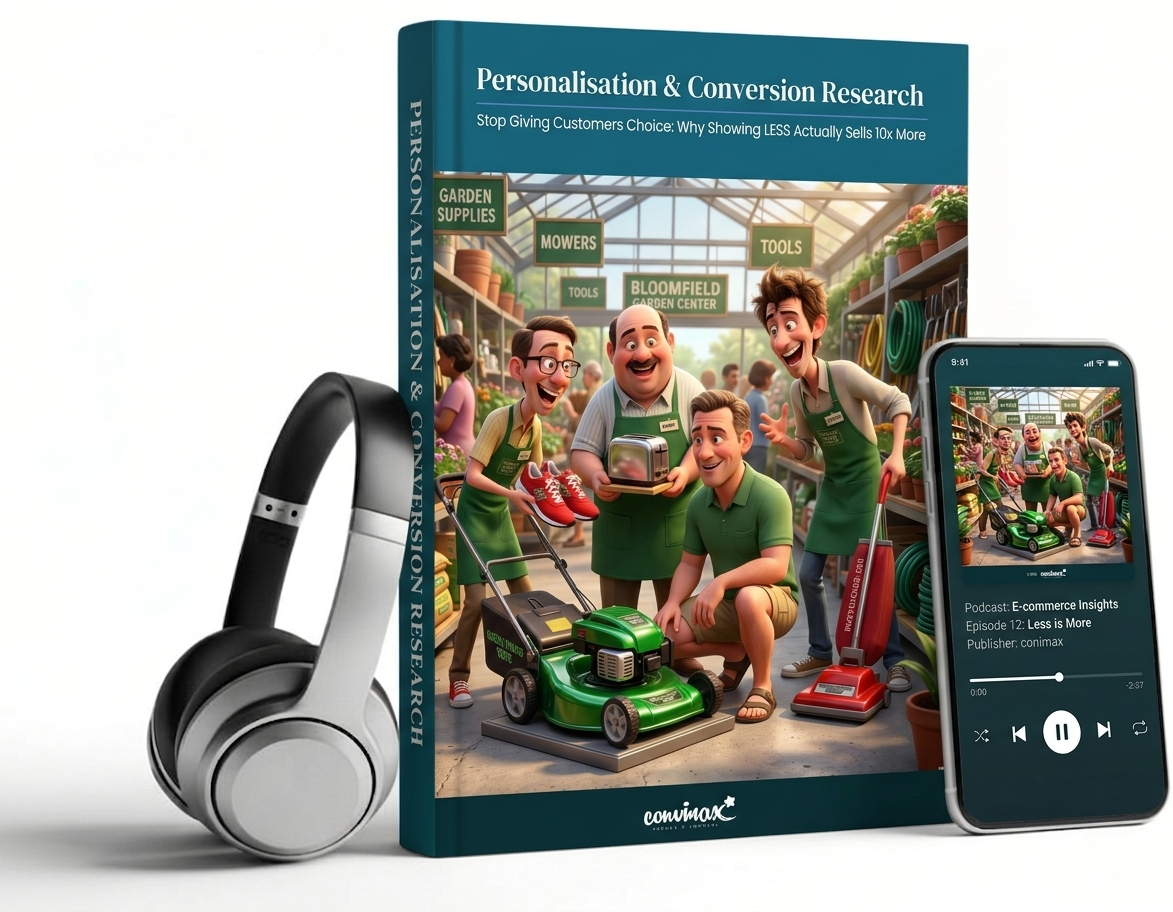
A research-backed breakdown of why more product choice is killing your conversion rate, and exactly where to place recommendations to reverse it.

You did the “right” thing. You bolted on a recommendation carousel, ticked the personalisation box, and told yourself the job was done.

Six months later, conversion is flat. Nobody in the business can quite explain why.

Here’s the uncomfortable bit: it’s probably not your algorithm. It’s not your traffic, either. It’s something far more basic that almost every store gets backwards, and it’s costing you sales every single day the widget stays live in its current form.

This isn’t another recycled “10 tips for better UX” listicle. It’s a fully-referenced research booklet, built from named, checkable sources (McKinsey, Nielsen Norman Group, Baymard Institute, peer-reviewed academic studies, and documented retail case studies), that tells you precisely what’s going wrong and what to do instead. No recycled stats. No vague advice you’ve already read a hundred times.

You get it as a research booklet PDF and a companion audio podcast, so you can read it at your desk or listen to it on the commute.

What the article reveals:

  • Why showing customers fewer products can multiply your conversion rate several times over, and the exact study that proves it
  • The precise number of product options your customer’s brain can compare before they give up and simply close the tab
  • Why the widget everyone builds first is, according to the research, barely better than doing nothing at all
  • The one page on your entire site where a single well-placed recommendation outperforms ten scattered across your homepage
  • A small, specific design choice about how many items to group together that quietly makes a widget more memorable, and one almost nobody applies deliberately
  • The real revenue uplift you should expect from personalisation done properly, according to McKinsey, and why the eye-catching numbers you’ve seen quoted elsewhere are almost always the exception, not the rule
  • What share of Amazon’s total sales its recommendation engine is widely reported to drive
  • Why the objection “we tried personalisation, and it didn’t work” is, in most cases, not actually true, and the free tool that proves it in five minutes
  • The psychological reason customers say a recommendation feels “creepy”, and it has almost nothing to do with privacy
This booklet synthesises findings from:

Academic Research and Peer-Reviewed Studies

  • Dillibatcha, Suhasan Chintadripet. (2025). “Optimising User Experience and Conversion Rates Through A/B Testing in E-Commerce: A Comprehensive Framework.” World Journal of Advanced Engineering Technology and Sciences.
  • Iyengar, Sheena S., and Mark R. Lepper. (2000). “When Choice is Demotivating: Can One Desire Too Much of a Good Thing?” (Commonly cited as the Columbia University Jam Study).
  • Liu, Xiao, Dokyun Lee, and K. Srinivasan. (2017). “Large-Scale Cross-Category Analysis of Consumer Review Content on Sales Conversion Leveraging Deep Learning.” AAAI Workshops.
  • Journal of Theoretical and Applied Electronic Commerce Research. (2024). “Online Reviews Meet Visual Attention: A Study on Consumer Patterns in Advertising, Analysing Customer Satisfaction, Visual Engagement, and Purchase Intention”.
  • Munich Business School. (2021). “Impact of Recommender Systems on Consumers’ Purchase Intention” (Study conducted in Taiwan).
  • Zhu et al.(2023). “Cognitive load and privacy information.” PubMed Central (PMC) and ScienceDirect.

Industry Reports and Professional UX Research

  • Adobe Analytics.(2023–2024). “Personalisation Report”.
  • Baymard Institute. (Ongoing). “Product Lists & Filtering and Product Page UX Research”.
  • Deloitte Digital.(2024–2025). “Personalising Growth” and “E-commerce Delivery Benchmark Report”.
  • Dynamic Yield.(2023). “Personalisation Study” (Analysis of 200 million users).
  • McKinsey & Company.(2021). “The value of getting personalisation right—or wrong—is multiplying”.
  • McKinsey & Company.(2023). “The Attention Equation: Winning the Right Battles for Consumer Attention”.
  • Nielsen Norman Group (NN/g). (Ongoing). “Individualised Recommendations” and “Recommendation Guidelines”.
  • Smart Insights.(2025). “Ecommerce Conversion Rates Benchmarks”.

Technical Tools and Methodological References

  • Miller, Evan. “A/B Testing Sample Size Calculator and Guide.” org.

Major Platform Case Studies and Benchmarks

  • com. (Multiple Years). Case studies on the “Customers who bought this item also bought” recommendation engine.
  • (Multiple Years). Case studies on personalised content consumption and recommendation algorithms.
  • (2024). “Benchmark Shopify Conversion Rates and Product Recommendation Report”.


0