1
Shipping
Where to ship it?
Your cart is currently empty.Continue shopping
Subtotal £0.00
Total £0.00 GBP

Your Information

Order Summary

Product
Total
Subtotal £0.00
Total £0.00 GBP

Payment Information

All transactions are secured and encrypted.

Your personal data will be used to process your order, support your experience throughout this website, and for other purposes described in our privacy policy.

Please note: Results may vary and are not guaranteed.
Due to the digital nature of this product, we do not offer refunds.

  • 256-Bit Bank Level Security
  • 100% Secure Payments

Who This Is For

This article will be most valuable if you:

  • Manage conversion rates for an e-commerce site or digital product
  • Design user experiences and need psychological frameworks that actually work
  • Run a small business and handle your own website optimisation
  • Work as a freelance CRO consultant and need evidence-based strategies for clients
  • Build side projects or digital products and want to maximise every visitor
  • Lead growth for a startup where every percentage point matters
ConviMax Logo

Nudge Marketing Research

Your Product Page Nudges Might Be Costing You Sales (Here’s the Evidence)
Why the same psychology that can lift conversions by 50% can also tank them below zero – and how to know which one you’re doing.
You’ve added the countdown timer. The “only 3 left in stock” banner. The little pop-up saying 14 people are viewing this item right now.
Everyone in e-commerce is running the same handful of nudges, copied from the same handful of case studies, on the assumption that psychology automatically equals persuasion.
Here’s the uncomfortable bit: it doesn’t.
The research shows nudges can lift purchase intent by as much as 50%. It also shows that badly matched nudges can perform worse than showing your customer nothing at all. Same toolkit. Opposite results. And most businesses have no reliable way of knowing which one they’re getting, because they’re testing tactics instead of understanding the psychology underneath them.
This research booklet pulls together peer-reviewed studies from journals including Electronic Commerce Research, Marketing Science and the Journal of Retailing, plus real-world A/B test data from Booking.com, Amazon, ASOS and Zappos, to answer the question most conversion content skips over entirely: not “does this nudge work”, but “why does it work here and backfire there.”
You’ll walk away knowing exactly which nudges are backed by solid evidence, which ones quietly erode customer trust, and where to focus your next round of testing so it actually moves the needle.

What You’ll Discover in This Article:
  • Why one specific type of urgency message tested on 400 real shoppers underperformed, showing no message at all– and what the messages that worked had in common
  • How much of your lost sales genuinely comes down to cognitive overload, not lack of persuasion – and the simplified-design fix that beat adding more nudges
  • Why a study of live e-commerce platforms found that two of the most popular “best practice” nudges actively reduced customer trust below baseline
  • The real reason mobile converts at roughly half the rate of desktop – and it’s not the screen size everyone blames it on
  • Why a near-perfect star rating can quietly work against you, and what rating range the evidence says actually converts best
  • The difference between scarcity that builds trust and scarcity that destroys it – and how customers can tell within seconds
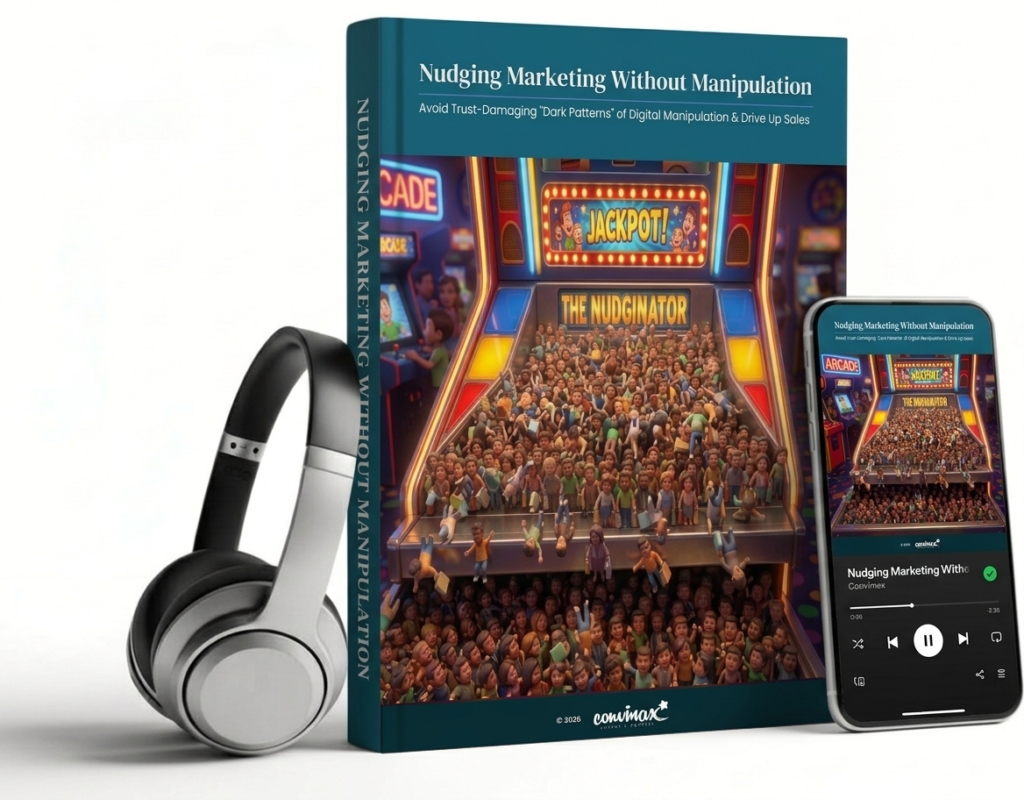
Your complete bundle includes:
  • Audio Podcast
    Listen anywhere. Perfect for learning on the go.
  • Blog Article
    A quick, engaging summary of the key ideas.
  • Detailed Booklet
    A deeper dive with examples and academic findings.

This isn’t theory. Every recommendation is backed by academic research, field studies, and real-world case studies. You’ll get the full academic citations, the industry benchmarks, and the practical frameworks you need to implement this tomorrow.

This booklet synthesises findings from:
  • Coffino, J. A., et al. (2020). “Nudging while Online Grocery Shopping.” PMC (PubMed Central).
  • Desai, S. (2023). “Assessing the Influence of Nudge Marketing on Consumer Decision Making in E-Commerce.” International Journal of Management, Public Policy and Research, 2(2).
  • Dimant, E. (2019). “Nudging and Boosting: Steering or Empowering Good Decisions.” Perspectives on Psychological Science.
  • Djurica, D., & Figl, K. (2017). “The Effect of Digital Nudging Techniques on Customers’ Product Choice and Attitudes towards E-Commerce Sites.” Twenty-third Americas Conference on Information Systems, Boston.
  • Kahneman, D., & Tversky, A. (1974). Foundational research on anchoring and cognitive bias.
  • Kim, J., & Lee, H. (2021). “Retail Environment Eye-Tracking Study.” Frontiers in Psychology.
  • Li, J., et al. (2025). “Language Barriers and Cognitive Load in E-Commerce.” Journal of Electronic Commerce Research, Vol. 26.
  • Mirbabaie, M., et al. (2021). “Conscious Commerce – Digital Nudging and Sustainable E-commerce Purchase Decisions.” Australasian Conference on Information Systems, Sydney.
  • Mirhoseini, S., et al. (2024). “EEG Study of Cognitive Load in Online Shopping.” Internet Research.
  • Peng, L., et al. (2019). “EEG Biosensor Study on Taobao Shopping Behaviour.” PMC (PubMed Central).
  • Schmutz, P., & Heinz, S. (2009). “Cognitive Load in eCommerce Applications—Measurement and Effects on User Satisfaction.” Advances in Human-Computer Interaction.
  • Valenčič, E., et al. (2022). “Digital Nudging in Online Grocery Stores.” ScienceDirect.
  • Valta, K., et al. (2025). “Digital Nudging: A Systematic Literature Review, Taxonomy.” ACM Digital Library.
  • Wang, Q., et al. (2014). “Website Complexity and Eye-Tracking Study.” Decision Support Systems.
  • Baymard Institute. (2023–2024). Product Page UX Benchmark and Cart Abandonment Rate Research.
  • Convert Cart. (2025). Cart Abandonment and Conversion Optimisation Data.
  • Dynamic Yield. (2025). Global E-commerce Conversion Benchmarks.
  • IRP Commerce. (2024–2025). Global E-commerce Conversion Rate Benchmarks.
  • Microsoft Research. (2015). Attention Span Study (2,000 participants + EEG measurements).
  • Nielsen Norman Group (NN/g). (2024). “A/B Testing 101” and related usability guides.
  • Northwestern University Spiegel Research Centre. (2023). Social Proof and Review Authenticity Studies.
  • Smart Insights. (2025). E-commerce Conversion Rate Analysis by Industry and Device.
  • Advantage Unified Commerce. (2025). “The $1 Off Cookie That Changed Everything” – Nudge Impact Score Study.
  • (2022). Psychology and Behavioural Conversion Optimisation Research.
  • (2019). Visual Clarity Assessment of Booking.com.
  • Irrational Labs. (2025) .com Behavioural Science Case Study.
  • Jungle Scout. (2024). Amazon A/B Testing and Seller Optimisation Research.
  • Srivastava, A. (2024). “User Attention Span Case Study.” Medium.
  • Tactics Convertize. (2024).Conversion Optimisation Case Studies (Zalando, Ubisoft, Adonis Clothing).
  • VWO (Visual Website Optimizer). (2022–2025).CRO Case Studies on Scarcity, Urgency, and Social Proof.

Common Objections

  • “I can just find this stuff for free.” You can find opinions for free. This booklet cites the underlying academic studies and industry data directly – the Baymard Institute, Nielsen Norman Group, Spiegel Research Centre, and peer-reviewed journals – so you’re working from evidence, not someone’s paraphrase of evidence. It would take hours to track down and cross-check these sources yourself. This does it for you.
  • “I don’t have time to read a research report.” Fair. That’s why it comes as a short audio podcast you can listen to on a commute, alongside the full written booklet for when you want to dig into a specific chapter or pull a stat for a client deck.
  • “Will this actually change what I do, or is it just theory?” Every chapter closes with the practical upshot – what the finding means for your product pages specifically. There’s a dedicated action plan for what to test first, without needing a data science team or a Booking.com-sized budget.
  • “I’ve read enough about scarcity and social proof already.” Then you’ll want to see where the evidence disagrees with the common advice – including the specific conditions under which scarcity and social proof measurably backfire. That’s the part most content leaves out.

Copyright © 2026

Privacy policy | Terms of Service