1
Shipping
Where to ship it?
Your cart is currently empty.Continue shopping
Subtotal £0.00
Total £0.00 GBP

Your Information

Order Summary

Product
Total
Subtotal £0.00
Total £0.00 GBP

Payment Information

All transactions are secured and encrypted.

Your personal data will be used to process your order, support your experience throughout this website, and for other purposes described in our privacy policy.

Please note: Results may vary and are not guaranteed.
Due to the digital nature of this product, we do not offer refunds.

  • 256-Bit Bank Level Security
  • 100% Secure Payments

Who This Is For

This article will be most valuable if you:

  • Manage conversion rates for an e-commerce site or digital product
  • Design user experiences and need psychological frameworks that actually work
  • Run a small business and handle your own website optimisation
  • Work as a freelance CRO consultant and need evidence-based strategies for clients
  • Build side projects or digital products and want to maximise every visitor
  • Lead growth for a startup where every percentage point matters
ConviMax Logo

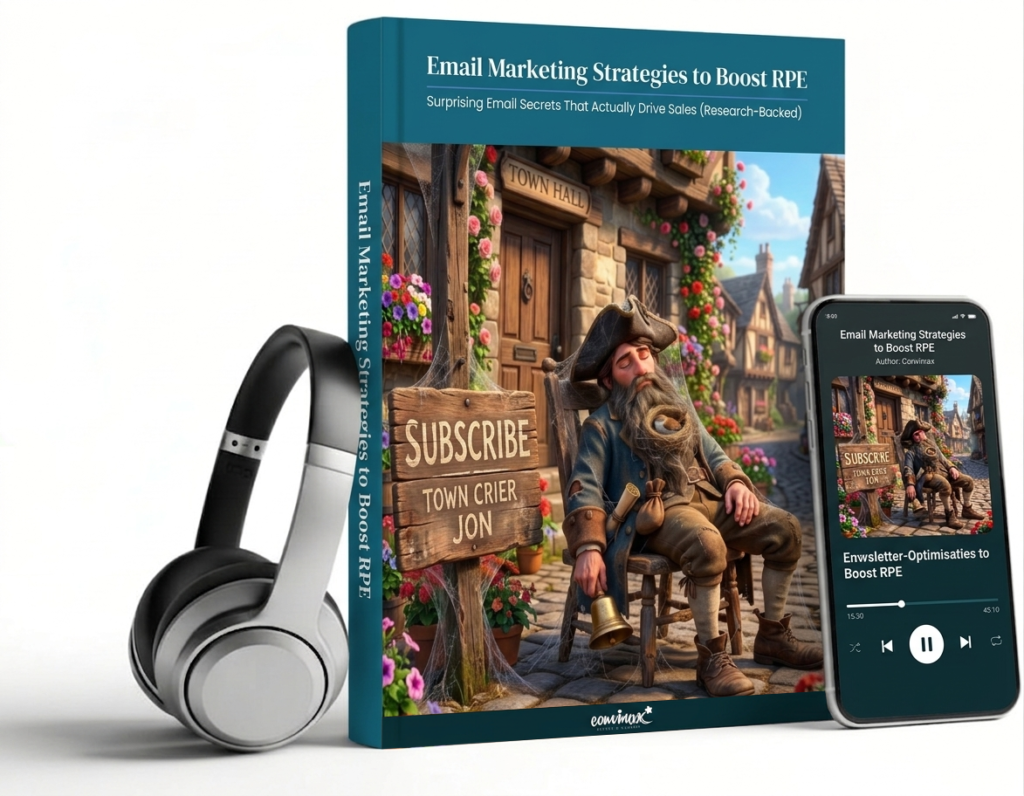
Email Marketing Strategies

You’re doing everything the courses told you to do. It isn’t working.
You personalise your subject lines. You follow the “best practice” templates. You send your welcome series once and move on to the next campaign, because that’s what the LinkedIn threads and the agency decks say to do.
And yet open rates keep sliding. Unsubscribes creep up. The newsletter that took three hours to design gets outperformed, quietly and repeatedly, by automations nobody has touched in years.
Here’s the uncomfortable possibility nobody in your feed wants to say out loud: some of the “rules” you’ve built your entire email strategy around were tested once, years ago, went viral as advice, and were never checked again. Meanwhile, the industry kept repeating them like gospel.
This booklet checks them. Properly. Against peer-reviewed field experiments, a 32-million-send benchmark study spanning 38 sectors, and a live production system built by one of the world’s largest online retailers. Not opinion. Not a vendor case study dressed up as proof. Controlled trials, control groups, statistical significance.
Some of what you believe about email will survive contact with the data. A surprising amount won’t.

What You’ll Discover in This Article:
  • The subject-line trick that made headlines in 2018 for lifting sales by 31%. It was tested again a few years ago, on a fresh audience. What happened to it will change how you write every subject line you send from now on.
  • Why one of the biggest retailers on earth quietly stopped personalising who an email is addressed to, and started personalising what shape the email takes – and exactly how much that shift moved the needle on people leaving their list.
  • The precise, tested cash value of sending the right email at the right moment, down to the pound, and the “reminder” mistake that’s quietly wasting most of your abandoned-cart flow.
  • A university ran the identical offer through two different-looking emails – one polished and “on brand,” one plain and almost boring. The gap in results wasn’t small.
  • Which unglamorous, unloved automation in your email programme is already earning up to 45 times more revenue per send than your newsletter – and why almost nobody bothers to check.
  • Why comparing your open rate to “the industry average” might be the single most misleading thing you do all quarter, and the number you should be watching instead.
Your complete bundle includes:
  • Audio Podcast
    Listen anywhere. Perfect for learning on the go.
  • Blog Article
    A quick, engaging summary of the key ideas.
  • Detailed Booklet
    A deeper dive with examples and academic findings.

This isn’t theory. Every recommendation is backed by academic research, field studies, and real-world case studies. You’ll get the full academic citations, the industry benchmarks, and the practical frameworks you need to implement this tomorrow.

This booklet synthesises findings from:
  • Chen, Y., Vankov, E., Baltrunas, L., Donovan, P., Mehta, A., Schroeder, B., & Herman, M. (2023). Contextual Multi-Armed Bandit for Email Layout Recommendation. In Seventeenth ACM Conference on Recommender Systems (RecSys ’23), September 18–22, 2023, Singapore. ACM, New York, NY, USA.
  • Chris | Visionary Marketing. (2026, May 6). Email Marketing Benchmarks by Industry 2026: 32M Sends Across 38 Sectors. Visionary Marketing.
  • Defau, L., & Zauner, A. (2023). Personalised subject lines in email marketing. Marketing Letters, 34:727–733.
  • Goic, M., Rojas, A., & Saavedra, I. (2019). Investigating the Effectiveness of Triggered Email Marketing. Department of Industrial Engineering, University of Chile.
  • Lim, K. H., Lim, E. P., Jiang, B., & Achananuparp, P. (2016). Using Online Controlled Experiments to Examine Authority Effects on User Behaviour in Email Campaigns. In Proceedings of the 27th ACM Conference on Hypertext and Social Media (HT ’16), July 10-13, 2016, Halifax, NS, Canada.
  • Lopoo, L. M., Bifulco, R., Patnaik, H., Haque, A., Ashby, C., & Theoharis, G. (2025, April 30). How Can Public Sector Employers Improve the Effectiveness of Email Recruitment? Centre for Policy Research, Policy Brief #18. Syracuse University Maxwell School of Citizenship & Public Affairs.
  • DelVecchio, D., Krishnan, H. S., & Smith, D. C. (2007). Cents or percent? The effects of promotions on price expectations and brand loyalties. Journal of Business Research, 60(12), 1582-1593.
  • Ganzach, Y., & Karsahi, N. (1995). Message Framing and Buying Behaviour: A Field Experiment. Journal of Business Research, 32(1), 11-17.
  • (2025). State of Marketing Report.
  • Kahneman, D. (2011). Thinking, Fast and Slow. Farrar, Straus and Giroux.
  • (2026). Ecommerce Email Benchmarks Guide 2024–2026.
  • Loewenstein, G. (1994). The psychology of curiosity: A review and reinterpretation. Psychological Bulletin, 116(1), 75-98.
  • Martin, S., et al. (2025). [Randomised social-proof field experiment in email reminders]. International Journal of Social Research Methodology.
  • Munz, K., Jung, M., & Alter, A. (2020). Name similarity encourages generosity: A field experiment in email personalisation. Marketing Science, 39(6), 1071–1091.
  • Sahni, N. S., Wheeler, S. C., & Chintagunta, P. (2018). Personalisation in email marketing: The role of noninformative advertising content. Marketing Science, 37(2), 236–258.
  • Thaler, R. H., & Sunstein, C. R. (2008). Nudge: Improving Decisions about Health, Wealth, and Happiness. Yale University Press.
  • Vardikou, E., et al. (2025). Authority-principle nudges in real email marketing campaigns. Electronic Commerce Research and Applications.
  • Zhu, Y., Yang, Y., & Hsee, C. K. (2018). The Mere Urgency Effect. Psychological Science, 29(9).

Common Objections

  • “I can just find this stuff for free online.” You can find opinions about email marketing for free, endlessly. What’s harder to find is the original research itself, read properly, cross-checked against contradicting studies, and translated into what to actually do about it. This booklet did that reading so you don’t have to spend a weekend chasing academic papers and industry PDFs.
  • “I’ve read enough email marketing content already.” Most of it repeats the same handful of tactics, some of which this booklet shows have quietly stopped working. If your current reading list hasn’t told you that a famous 2018 personalisation finding failed to replicate, or given you the exact revenue multiplier between your newsletter and your automations, this covers ground you haven’t seen.
  • “Will this actually apply to my size of business?” Yes. The studies cover everything from a global retailer’s production system to a 6,000-person recruitment campaign, and every chapter ends with what to do about it on an ordinary list, using tools you already have. No data science degree required.
  • “How do I know this isn’t just another guru’s opinion?” Every claim in this booklet is sourced to a specific, named, peer-reviewed study or a published industry benchmark, listed and citable, not “trust me.” You can check every figure yourself.

Copyright © 2026

Privacy policy | Terms of Service