1
Shipping
Where to ship it?
Your cart is currently empty.Continue shopping
Subtotal £0.00
Total £0.00 GBP

Your Information

Order Summary

Product
Total
Subtotal £0.00
Total £0.00 GBP

Payment Information

All transactions are secured and encrypted.

Your personal data will be used to process your order, support your experience throughout this website, and for other purposes described in our privacy policy.

Please note: Results may vary and are not guaranteed.
Due to the digital nature of this product, we do not offer refunds.

  • 256-Bit Bank Level Security
  • 100% Secure Payments

Who This Is For

This article will be most valuable if you:

  • Manage conversion rates for an e-commerce site or digital product
  • Design user experiences and need psychological frameworks that actually work
  • Run a small business and handle your own website optimisation
  • Work as a freelance CRO consultant and need evidence-based strategies for clients
  • Build side projects or digital products and want to maximise every visitor
  • Lead growth for a startup where every percentage point matters
ConviMax Logo

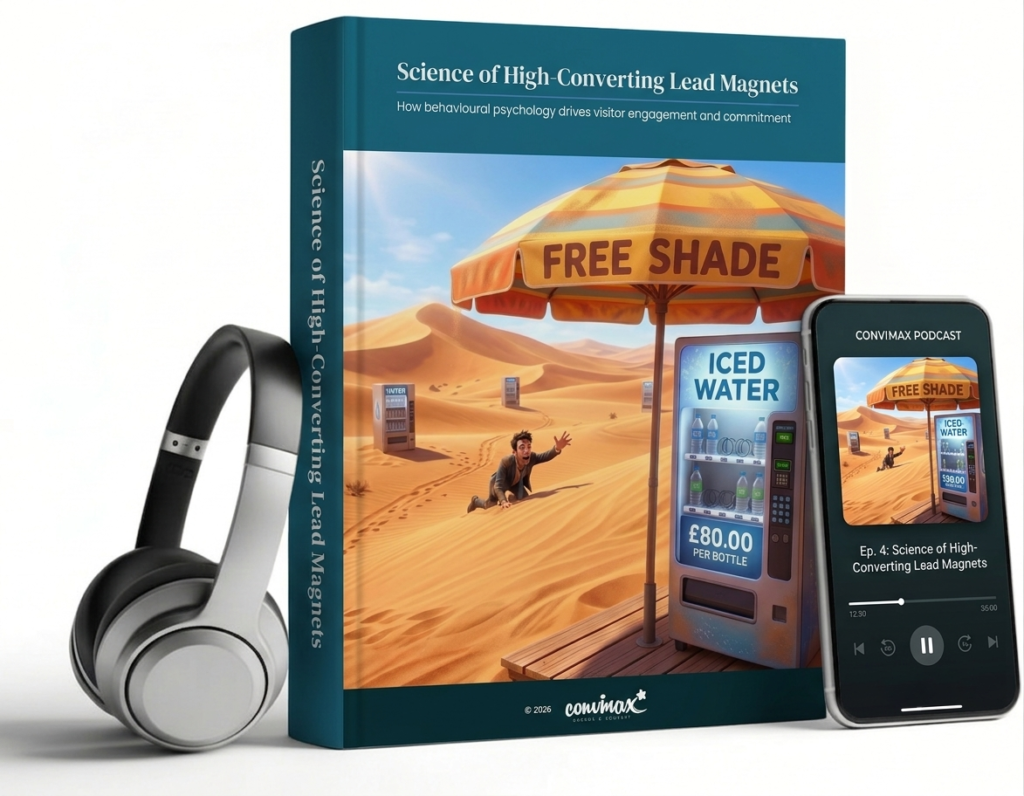
Science of High-Converting Lead Magnets

Your Pop-Up Isn’t a Lead Magnet. It’s a Coupon With Extra Steps.
You built a store. You added a pop-up. You offered 10% off.
And now your list is full of people who opened one email, unsubscribed, and never bought a thing.
Here’s the part that stings: you didn’t do anything wrong, exactly. You did what every “conversion tips” article told you to do. The problem is that everyone else did the same thing, using the same tactic, off the same advice – which means the one lever every store owner reaches for first is also, according to the data, one of the weakest.
That’s not a hunch. It’s what happens when you pull together the controlled tests, the platform benchmarks, and the documented case studies and actually compare them side by side, instead of trusting the last blog post you skimmed.
This research booklet – and the companion audio podcast – does exactly that. One place, one read (or one listen), no guesswork.

What You’ll Discover in This Article:
  • Why the offer nearly every store defaults to converts worse than a plain “join our newsletter” ask, and what quietly beats it
  • How one skincare brand made an identical discount convert 314% better, without changing the discount itself
  • Why adding a question to a signup form lifted conversions by 70%, when the standard advice says shorter always wins
  • The loyalty-card trick that got customers to finish nearly twice as many purchases using the exact same remaining effort
  • Why a countdown timer that resets on refresh could be quietly costing you customer trust, and in some places, more than that
  • The real reason free shipping beats an equivalent-value discount, and what it has to do with how people process loss
  • Which lead magnet format is generating up to 18 times more revenue per subscriber than a standard campaign, and why almost nobody talks about it
  • When “shorter form wins” is true, and when it’s the exact opposite
Your complete bundle includes:
  • Audio Podcast
    Listen anywhere. Perfect for learning on the go.
  • Blog Article
    A quick, engaging summary of the key ideas.
  • Detailed Booklet
    A deeper dive with examples and academic findings.

This isn’t theory. Every recommendation is backed by academic research, field studies, and real-world case studies. You’ll get the full academic citations, the industry benchmarks, and the practical frameworks you need to implement this tomorrow.

This booklet synthesises findings from:
  • Belli, A., O’Rourke, A. M., Carrillat, F. A., Pupovac, L., et al.(2022). “40 years of loyalty programs: How effective are they? Generalisations from a meta-analysis.” Journal of the Academy of Marketing Science.
  • Cialdini, R. B.(1984, rev. 2009). Influence: The Psychology of Persuasion.
  • DelVecchio, D., Krishnan, H. S., & Smith, D.(2007). “Cents or Percent? The Effects of Promotion Framing on Price Expectations and Choice.” Journal of Marketing.
  • Drèze, X., & Nunes, J. C.(2011). “Recurring Goals and Learning: The Impact of Successful Reward Attainment on Purchase Behaviour.” Journal of Marketing Research.
  • Frank, D. A., Folwarczny, M., et al.(2026). “Consumer Acceptance of High-Autonomy AI Assistants Is Driven by Perceived Benefits in Online Shopping Settings Characterised by Scarcity.” Psychology & Marketing.
  • Haisley, E., & Loewenstein, G.(2011). “It’s Not What You Get but When You Get It: The Effect of Gift Sequence on Deposit Balances and Customer Sentiment in a Commercial Bank.” Journal of Marketing Research.
  • Hamilton, R., Thompson, D., Bone, S., et al.(2019). “Scarcity and Consumer Decision Making: Is Scarcity a Mindset, a Threat, a Reference Point, or a Journey?” Journal of the Association for Consumer Research, 5(4).
  • Kahneman, D., & Tversky, A.(1979). “Prospect theory: An analysis of decision under risk.” Econometrica, 47(2), 263–291.
  • Kivetz, R., Urminsky, O., & Zheng, Y.(2006). “The Goal-Gradient Hypothesis Resurrected: Purchase Acceleration, Illusionary Goal Progress, and Customer Retention.” Journal of Marketing Research, 43(1), 39–58.
  • Kutzner, F., Ermark, F. K. G., Fornoff, J., & Wähke, M.(2024). “Effects of verbatim repetition of the headline message on the proceed button on click-through rates in online retail.” Frontiers in Psychology, 15, 1187798.
  • Loewenstein, G.(1994). “The Psychology of Curiosity: A Review and Reinterpretation.” Psychological Bulletin, 116(1), 75–98.
  • Meier, Y., & Krämer, N. C.(2024). “The privacy calculus revisited.” Communication Research.
  • Norton, M. I., Mochon, D., & Ariely, D.(2011). “The IKEA Effect: When Labour Leads to Love.” HBS Working Paper.
  • Nunes, J. C., & Drèze, X.(2006). “The Endowed Progress Effect: How Artificial Advancement Increases Effort.” Journal of Consumer Research, 32(4), 504–512.
  • Thaler, R.(1985). “Mental accounting and consumer choice.” Marketing Science, 4(3), 199–214.
  • Zhang, Y., & Huang, S. C.(2010). “How Endowed versus Earned Progress Affects Consumer Goal Commitment and Motivation.” Journal of Consumer Research.
  • Baymard Institute.(2023). “E-Commerce Form Usability & Checkout UX Research.”
  • (2026). “Popup Conversion Research 2026; Ecommerce Email Opt-In Benchmarks.”
  • (2026). “Quiz Conversion Rate Report: Analysis of ~80M Leads.”
  • (2023–2026). “E-Commerce Industry Benchmark Reports: Sign-Up Rates, Flow Conversions, and Revenue per Recipient.”
  • (2026). “What’s the Best Lead Magnet For Your Business? Analysis of 41,000+ signup forms.”
  • McKinsey & Company.(2023). “The value of getting personalisation right—or wrong.”
  • Nielsen Norman Group (NN/g). (2024–2026). “Pop-Ups and Overlays on Mobile and Desktop: Guidelines and Avoidable UX Pitfalls; Behavioural Economics for UX.”
  • (2026). “Referral Program Benchmarks: Free Shipping vs Percentage Discount.”
  • Shopify + BCG.(2023). “Leading Online Shoppers to the Finish Line: Analysis of >220,000 sites and 1 billion data points.”
  • (2026). “Popup Statistics 2026: 1B+ displays analysed.”
  • “Customer Spotlight: REN Skincare ‘What’s Your Skin Type’ Quiz.”
  • Chronos Agency.(2025). “The J-Beauty Pop-Up Test That Drove 2× More Revenue for Kiyoko.”
  • “Free Shipping Case Study (furniture +19% orders).”
  • “Sephora’s Beauty Insider case study.”
  • Octane AI. “Florae Beauty Case Study: 43% CAC reduction, 28% CVR lift.”
  • “Onyx Cookware: 658% lead increase using gamified capture with verification.”
  • “Backlinko content-upgrade test (Brian Dean).”
  • Visual Quiz Builder. “Function of Beauty Case Study: 80% completion.”

Common Objections

  • “I can probably find this stuff for free online.” Some of it, yes, scattered across dozens of sources of wildly varying quality. What you won’t easily find is all of it cross-checked, ranked by how reliable the evidence actually is, and turned into something you can act on this week. That’s the whole job this booklet does for you.
  • “I’m not sure the data applies to a business my size.” It covers everything from global brands to five-question quizzes built by tiny teams on a shoestring budget. Several examples show, specifically, how small stores compete with much bigger ones using the same psychology and none of the budget.
  • “I’ve read enough marketing theory already.” Fair concern. Every finding here is tied to a real test, a real number, and a real result, not vague advice dressed up as insight. You’ll finish it knowing exactly what to test first.
  • “Won’t this just tell me things I already know?” Maybe some of it. But most readers find that at least a few of their working assumptions are wrong, and even one changed assumption tends to be worth more than the cost of the booklet.
  • “Couldn’t I just work it out myself through trial and error?” You could. It’s also the slow, expensive way to arrive at the same answers this booklet hands you upfront.

Copyright © 2026

Privacy policy | Terms of Service