1
Shipping
Where to ship it?
Your cart is currently empty.Continue shopping
Subtotal £0.00
Total £0.00 GBP

Your Information

Order Summary

Product
Total
Subtotal £0.00
Total £0.00 GBP

Payment Information

All transactions are secured and encrypted.

Your personal data will be used to process your order, support your experience throughout this website, and for other purposes described in our privacy policy.

Please note: Results may vary and are not guaranteed.
Due to the digital nature of this product, we do not offer refunds.

  • 256-Bit Bank Level Security
  • 100% Secure Payments

Who This Is For

This article will be most valuable if you:

  • Manage conversion rates for an e-commerce site or digital product
  • Design user experiences and need psychological frameworks that actually work
  • Run a small business and handle your own website optimisation
  • Work as a freelance CRO consultant and need evidence-based strategies for clients
  • Build side projects or digital products and want to maximise every visitor
  • Lead growth for a startup where every percentage point matters
ConviMax Logo

Price Framing Research

Why £999 Beats £1,000 (Except When It Doesn’t): What the Pricing Research Actually Says
The number on your price tag is doing more work – or more damage – than you think. Most stores never test it.
You’ve tested your headlines. You’ve tested your product photos. You’ve probably tested three different checkout button colours this year alone.
And the whole time, the single number your customer stares at right before they decide to buy or bounce – the price itself – has been sitting there untouched. Whatever your developer typed in when the store first launched.
That’s a problem, because price framing (not the price itself, but how you show it) is one of the highest-leverage, lowest-cost levers on your entire site. Same product. Same price, mathematically. Different frame. Measurably different conversion rate, average order value, and customer trust.
This research booklet pulls together decades of peer-reviewed behavioural economics and hard commercial data to show you exactly which pricing tactics actually move the needle, which ones are overhyped nonsense from marketing blogs, and where the line sits between clever framing and the kind of “trick” that quietly erodes customer trust until it costs you far more than it ever made you.
No theory for theory’s sake. Every finding is graded on evidence strength, so you know exactly where to place your bets first.

What You’ll Discover in This Article:
  • Why a well-known discount can look bigger to your customer’s brain even when it’s mathematically worth less – and the simple threshold that tells you which frame to use, on any product, at any price point.
  • The exact digit that has to change in a price for the classic “.99 trick” to work at all – and why it silently fails on roughly half the prices stores apply it to.
  • Why “free” isn’t just a lower price. It’s a completely different psychological category, and it explains a spending behaviour that shows up in the majority of online shoppers, whether they realise it or not.
  • The real, independently measured lift that Buy Now, Pay Later delivers, versus the number most BNPL providers put in their sales decks.
  • Why charm pricing (£19.99-style endings) can actively damage a premium or luxury product, and exactly where that line sits.
  • The one pricing tactic that’s backed by a meta-analysis of 19 studies and over 12,000 data points, making it one of the most reliable levers in this entire booklet, and most stores aren’t using it at all.
  • Where “transparent” pricing tactics end, and the kind that quietly train customers to distrust you begin, with a simple test you can apply to any promotion before it goes live.
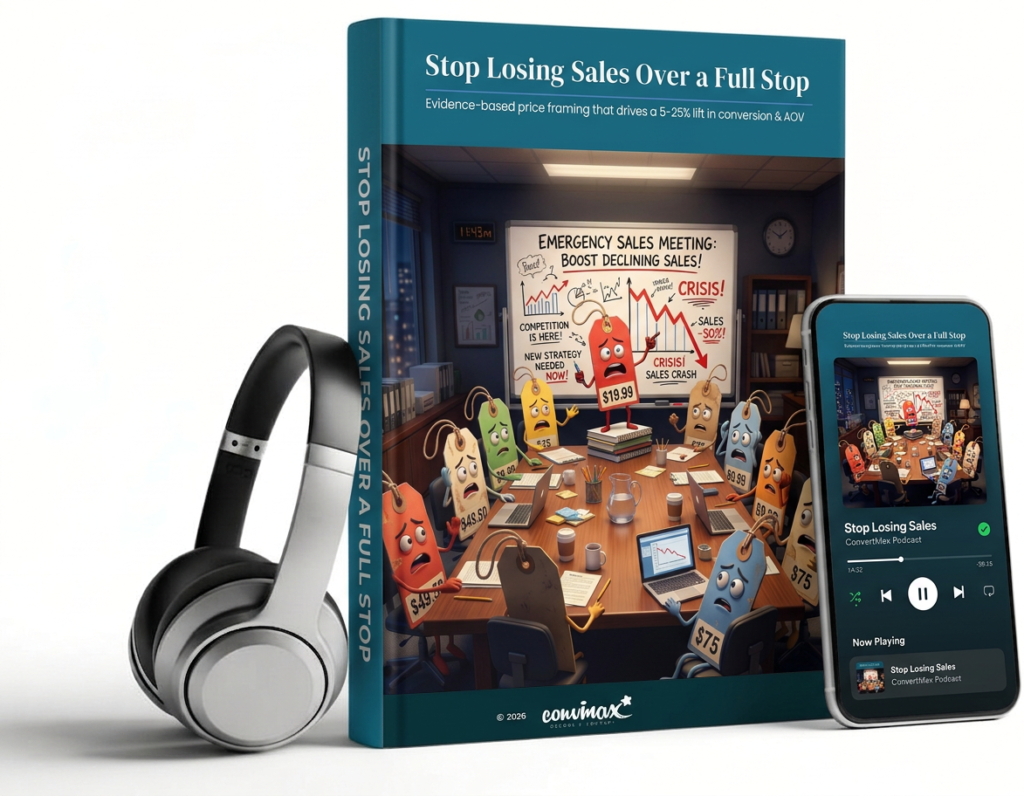
Your complete bundle includes:
  • Audio Podcast
    Listen anywhere. Perfect for learning on the go.
  • Blog Article
    A quick, engaging summary of the key ideas.
  • Detailed Booklet
    A deeper dive with examples and academic findings.

This isn’t theory. Every recommendation is backed by academic research, field studies, and real-world case studies. You’ll get the full academic citations, the industry benchmarks, and the practical frameworks you need to implement this tomorrow.

This booklet synthesises findings from:
  • Abraham, A. T., & Hamilton, R. W. (2018). When does partitioned pricing lead to more favourable consumer preferences? Meta-analytic evidence. Journal of Marketing Research, 55(5), 686–703.
  • Anderson, E. T., & Simester, D. I. (2003). Effects of $9 price endings on retail sales: Evidence from field experiments. Quantitative Marketing and Economics, 1(1), 93–110.
  • Ariely, D., Loewenstein, G., & Prelec, D. (2003). “Coherent arbitrariness”: Stable demand curves without stable preferences. Quarterly Journal of Economics, 118(1), 73–105.
  • Bayer, R., & Ke, C. (2013). Discounts and consumer search behaviour: The role of framing. Journal of Economic Psychology, 40, 11-21.
  • Biswas, A., & Blair, E. A. (1991). Contextual effects of reference prices in retail advertisements. Journal of Marketing, 55(3), 1–12.
  • Chen, S. F. S., Monroe, K. B., & Lou, Y.-C. (1998). The effects of framing price promotion messages on consumers’ perceptions and purchase intentions. Journal of Retailing, 74(3), 353–372.
  • Garbarino, E., & Lee, O. F. (2003). Dynamic pricing in internet retail: Effects on consumer trust. Psychology & Marketing, 20(6), 495–513.
  • Gourville, J. T. (1998). Pennies-a-day: The effect of temporal reframing on transaction evaluation. Journal of Consumer Research, 25(1), 395-408.
  • Greenleaf, E. A., Johnson, E. J., Morwitz, V. G., & Shalev, E. (2016). The price does not include additional taxes, fees, and surcharges: A review of research on partitioned pricing. Journal of Consumer Psychology, 26(1), 105–124.
  • Haws, K. L., & Bearden, W. O. (2006). Dynamic pricing and consumer fairness perceptions. Journal of Consumer Research, 33(3), 304–311.
  • Huber, J., Payne, J. W., & Puto, C. (1982). Adding asymmetrically dominated alternatives: Violations of regularity and the similarity hypothesis. Journal of Consumer Research, 9(1), 90–98.
  • Janiszewski, C., & Cunha, M. (2004). The influence of price discount framing on the evaluation of a product bundle. Journal of Consumer Research, 30(4), 534-546.
  • Kahneman, D., Knetsch, J. L., & Thaler, R. H. (1986). Fairness as a constraint on profit seeking: Entitlements in the market. The American Economic Review, 76(4), 728–741.
  • Kahneman, D., & Tversky, A. (1979). Prospect theory: An analysis of decision under risk. Econometrica, 47(2), 263–291.
  • Kumar, A. (2024). The effects of buy now, pay later (BNPL) on customers’ online purchase behaviour. Journal of Business Research, 180, 1–15.
  • Li, S., & Jiang, H. (2022). Impact of mixed bundling type on consumers’ value perception. International Journal of Consumer Studies, 46(6), 2167–2182.
  • Morwitz, V. G., Greenleaf, E. A., & Johnson, E. J. (1998). Divide and prosper: Consumers’ reactions to partitioned prices. Journal of Marketing Research, 35(4), 453–463.
  • Priester, A., Robbert, T., & Roth, S. (2020). A special price just for you: Effects of personalised dynamic pricing on consumer fairness perceptions. Journal of Revenue and Pricing Management, 19, 99–112.
  • Shampanier, K., Mazar, N., & Ariely, D. (2007). Zero as a special price: The true value of free products. Marketing Science, 26(6), 742–757.
  • Sokolova, T., Seenivasan, S., & Thomas, M. (2020). The left-digit bias: When and why are consumers penny wise and pound foolish? Journal of Consumer Research, 46(4), 720–732.
  • Stremersch, S., & Tellis, G. J. (2002). Strategic bundling of products and prices: A new synthesis for marketing. Journal of Marketing, 66(1), 55–72.
  • Thaler, R. H. (1985). Mental accounting and consumer choice. Marketing Science, 4(3), 199–214.
  • Thomas, M., & Morwitz, V. (2005). Penny wise and pound foolish: The left-digit effect in price cognition. Journal of Consumer Research, 32(1), 54–64.
  • Tversky, A., & Kahneman, D. (1974). Judgment under uncertainty: Heuristics and biases. Science, 185(4157), 1124–1131.
  • Wadhwa, M., & Zhang, K. (2015). This number just feels right: The impact of roundedness of price numbers on product evaluations. Journal of Consumer Research, 41(5), 1172–1185.
  • Xia, L., & Monroe, K. B. (2004). Price partitioning on the Internet. Journal of Interactive Marketing, 18(4), 63-73.
  • Yang, Y., Essegaier, S., & Bell, D. R. (2005). Free shipping and repeat buying on the internet: Theory and evidence. Journal of Marketing Research, 42(4), 437–449.

Common Objections

  • “I can probably find this stuff free on Google.” You can find fragments of it, scattered across dozens of blog posts, most of which cite each other rather than the original studies, and most of which won’t tell you when a finding is contested or has failed to replicate. This booklet does the reading for you, grades every claim honestly, and puts it in one place you can actually act on this week.
  • “Will this apply to my niche/price point?” The evidence is broken down by category and price threshold throughout, not presented as one-size-fits-all. You’ll see clearly where a tactic is strongest for your kind of product and where it’s likely to backfire.
  • “Is this just AI-generated fluff dressed up as research?” Every claim is sourced to a named, peer-reviewed study or a specific industry dataset, with a full academic bibliography at the back. You can check every reference yourself.
  • “I don’t have time to read a whole booklet.” That’s what the audio version is for. Listen while you’re doing something else, then come back to the PDF as a reference whenever you’re actually running a test.
  • “What if it doesn’t tell me anything I don’t already know?” The findings are graded from very strong to weak, precisely so you can skip past what you already know and go straight to the strategies you haven’t properly tested yet. If you walk away with even one tactic you implement this week, it pays for itself many times over.

Copyright © 2026

Privacy policy | Terms of Service