1
Shipping
Where to ship it?
Your cart is currently empty.Continue shopping
Subtotal £0.00
Total £0.00 GBP

Your Information

Order Summary

Product
Total
Subtotal £0.00
Total £0.00 GBP

Payment Information

All transactions are secured and encrypted.

Your personal data will be used to process your order, support your experience throughout this website, and for other purposes described in our privacy policy.

Please note: Results may vary and are not guaranteed.
Due to the digital nature of this product, we do not offer refunds.

  • 256-Bit Bank Level Security
  • 100% Secure Payments

Who This Is For

This article will be most valuable if you:

  • Manage conversion rates for an e-commerce site or digital product
  • Design user experiences and need psychological frameworks that actually work
  • Run a small business and handle your own website optimisation
  • Work as a freelance CRO consultant and need evidence-based strategies for clients
  • Build side projects or digital products and want to maximise every visitor
  • Lead growth for a startup where every percentage point matters
ConviMax Logo

Agentic Commerce & Your Conversion Rate

The “4x More Likely to Buy” AI Shopping Stat Everyone’s Sharing (And What It’s Not Telling You)
You’ve seen the headline somewhere this year. AI shopping assistants convert visitors up to four times more often than a normal website visit. Adobe has the numbers. Amazon has the numbers. Half the marketing press has repeated a version of it.
Here’s the part that rarely makes it into the post: that figure comes with a condition attached, and the condition changes almost everything about how you should act on it.
If you run a store, advise clients on conversion, or are building a digital product business around e-commerce, you are right now deciding where to put your limited time and budget based on an incomplete picture. Some very well-resourced companies have already tested the “obvious” AI plays with real customers and real money. At least one of them quietly pulled the whole thing.
This isn’t a case for avoiding AI. It’s the opposite. It’s a plain-English briefing on exactly where the evidence says AI genuinely earns you more sales, fewer returns, and more loyal customers, and where it’s an expensive distraction wearing an innovation badge.

What You’ll Discover in This Article:
  • Why a major US retailer built, then deliberately killed, an AI checkout feature – and what that failure tells you about where AI belongs in your funnel and where it doesn’t.
  • How much shoppers really trust AI to complete a purchase on their behalf – a number low enough to surprise most people seeing it for the first time.
  • Why giving an AI assistant more control over a sale can make people less likely to buy, not more, and what happened when researchers tested this directly.
  • Which single, widely-ignored metric predicts AI’s real commercial value better than any conversion percentage does.
  • How AI shopping tools are already deciding which products even get shown to a customer, and why your product pages might be invisible to them without you knowing it.
  • What’s quietly growing alongside every AI sales success story that almost nobody is tracking yet.
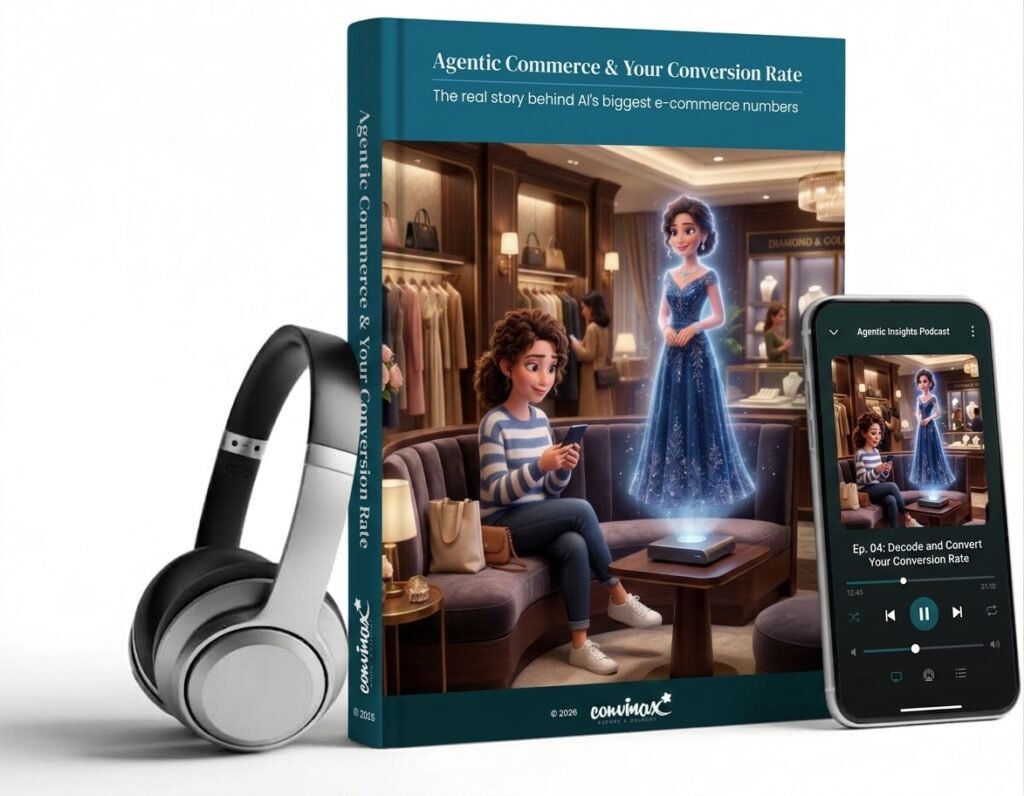
Your complete bundle includes:
  • Audio Podcast
    Listen anywhere. Perfect for learning on the go.
  • Blog Article
    A quick, engaging summary of the key ideas.
  • Detailed Booklet
    A deeper dive with examples and academic findings.

This isn’t theory. Every recommendation is backed by academic research, field studies, and real-world case studies. You’ll get the full academic citations, the industry benchmarks, and the practical frameworks you need to implement this tomorrow.

This booklet synthesises findings from:
  • Accornero, P. F. (2026). The Shopper Schism. Social Science Research Network (SSRN).
  • Allouah, A., et al. (2026). What Is Your AI Agent Buying? Evaluation, Biases, Model Dependence, & Emerging Implications of Agentic E-Commerce. ACM.
  • Balaskas, S. (2026). From recommendations to delegation: A systematic review mapping agentic AI in E-Commerce and its consumer effects. Information, 17(3), 222.
  • Balaskas, S., Komis, K., Yfantidou, I., & Skandali, D. (2026). When Interfaces “Act for You”: An Eye-Tracking Experiment on Delegation, Transparency Cues, and Trust in Agentic Shopping Assistants. Multimodal Technologies and Interaction, 10(1) [371–372].
  • Baran, Z., & Karaca, S. (2024). Factors Affecting Customer Experience, Attitude, and Repurchase Intention on Smart Tourism Applications. Current Issues in Tourism, 29, 902–920.
  • Chakraborty, D., Kumar Kar, A., Patre, S., & Gupta, S. (2024). Enhancing Trust in Online Grocery Shopping through Generative AI Chatbots. Journal of Business Research, 180, 114737.
  • Ding, Y., & Najaf, M. (2024). Interactivity, Humanness, and Trust: A Psychological Approach to AI Chatbot Adoption in e-Commerce. BMC Psychology, 12, 595.
  • Fan, Y., & Liu, X. (2022). Exploring the Role of AI Algorithmic Agents: The Impact of Algorithmic Decision Autonomy on Consumer Purchase Decisions. Frontiers in Psychology, 13, 1009173.
  • Frank, B., & Otterbring, T. (2026). Consumer acceptance of high-autonomy AI assistants is driven by perceived benefits in online shopping settings characterised by scarcity. Psychology & Marketing, Wiley.
  • Frank, D. A., & Otterbring, T. (2024). Autonomy, Power and the Special Case of Scarcity: Consumer Adoption of Highly Autonomous Artificial Intelligence. British Journal of Management, 35, 1700–1723.
  • Husairi, M. A., & Rossi, P. (2024). Delegation of purchasing tasks to AI: The role of perceived choice and decision autonomy. Decision Support Systems, 179, 114166.
  • Kim, T., Lee, O. K. D., & Kang, J. (2025). Why People Trust AI Software Robots: A Mediated Moderation Perspective on the Interaction between Their Intelligence and Appearance. Industrial Management & Data Systems, 125, 2426–2456.
  • Lee, D., & Hosanagar, K. (2016). When do Recommender Systems Work the Best? The Moderating Effects of Product Attributes and Consumer Reviews on Recommender Performance. Proceedings of the 25th International Conference on World Wide Web (WWW 2016), Montréal, Québec, Canada, 821–826.
  • Lee, D., & Hosanagar, K. (2019). How Do Recommender Systems Affect Sales Diversity? A Cross-Category Investigation via Randomised Field Experiment. Information Systems Research, 30(1), 239–259.
  • Luo, Y., Kumar, N., & Yazdanmehr, A. (2026). AI Nudging and Decision Quality: Evidence from Randomised Experiments in Online Recommendation Setting. Decision Support Systems, 200, 114565.
  • Mari, A., & Algesheimer, R. (2021). The Role of Trusting Beliefs in Voice Assistants during Voice Shopping. Proceedings of the 54th Hawaii International Conference on System Sciences (HICSS), 4073–4082.
  • Martínez Puertas, S., Illescas Manzano, M. D., Segovia López, C., & Ribeiro Cardoso, P. (2024). Purchase Intentions in a Chatbot Environment: An Examination of the Effects of Customer Experience. Oeconomia Copernicana, 15, 145–194.
  • Nie, G., et al. (2024). A Hybrid Multi-Agent Conversational Recommender System with LLM and Search Engine in E-Commerce. Proceedings of the 18th ACM Conference on Recommender Systems (RecSys 2024), New York, NY, USA, 745–747.
  • Ou, T.-Y., Chen, C.-H., & Tsai, W.-L. (2025). Establishing a Dynamic Recommendation System for E-commerce by Integrating Online Reviews, Product Feature Expansion, and Deep Learning. Applied Artificial Intelligence, 39(1), e2463723.
  • Pizzi, G., Scarpi, D., & Pantano, E. (2021). Artificial Intelligence and the New Forms of Interaction: Who Has the Control When Interacting with a Chatbot? Journal of Business Research, 129, 878–890.
  • Sadiq, M. W., Akhtar, M. W., Huo, C., & Zulfiqar, S. (2024). ChatGPT-Powered Chatbot as a Green Evangelist: An Innovative Path toward Sustainable Consumerism in E-Commerce. The Service Industries Journal, 44, 173–217.
  • Schindler, D., Maiberger, T., Koschate-Fischer, N., & Hoyer, W. D. (2024). How Speaking versus Writing to Conversational Agents Shapes Consumers’ Choice and Choice Satisfaction. Journal of the Academy of Marketing Science, 52, 634–652.
  • Singh, S., & Singh, A. (2024). The power of AI: enhancing customer loyalty through satisfaction and efficiency. Cogent Business & Management, 11(1).
  • Sun, L., et al. (2025). LLM Agent Meets Agentic AI: Can LLM Agents Simulate Customers to Evaluate Agentic-AI-based Shopping Assistants? arXiv preprint arXiv:2509.21501.
  • Adobe Digital Insights. (2026, January). Generative AI-driven retail traffic surges across industries — holiday 2025. business.adobe.com.
  • Bain & Company. (2025, November). Agentic AI in Retail: How Autonomous Shopping Is Redefining the Customer Journey. Bain & Company Publications.
  • Bain & Company / Similarweb. (2025, December). Bain estimates US agentic commerce market could reach $300–500B by 2030. digitalcommerce360.com.
  • Baymard Institute. (2025–2026). Cart abandonment rate statistics meta-analysis. baymard.com.
  • Boston Consulting Group (BCG). (2025, October). Agentic Commerce is Redefining Retail — How to Respond. bcg.com.
  • Capgemini. (2026). What matters to today’s consumer 2026. Capgemini Research Institute.
  • Constructor. (2025). How AI agents for ecommerce are changing the shopping journey. constructor.com/blog.
  • Deloitte Canada. (2025, December). Agentic Commerce: Navigating Fraud Risk and Opportunities. Deloitte Research Publications.
  • McKinsey & Company. (2025, October). The agentic commerce opportunity: How AI agents are ushering in a new era for consumers and merchants. mckinsey.com.
  • McKinsey & Company. (2026, January). The automation curve in agentic commerce. mckinsey.com.
  • Morgan Stanley. (2025, December). Agentic Commerce Impact Could Reach $385 Billion by 2030. morganstanley.com.
  • Rep AI. (2025). 2025 Ecommerce Shopper Behaviour Report. hellorep.ai.
  • Salesforce. (2025). 6th Edition Connected Shoppers Report. salesforce.com.
  • Salesforce. (2025, December). 2025 Cyber Week Results: AI and Agents Propel Global Spend to $336.6B. salesforce.com.
  • Visa Corporate. (2025). Earning Consumer Trust in the Age of Agentic Commerce. corporate.visa.com.

Common Objections

  • “I’ve already read enough about AI and shopping.” Most of what’s public is vendor marketing for a single platform, or a headline stat with no context attached. This report checks the vendor numbers against independent, peer-reviewed and platform-reported data before drawing any conclusion, so you get a version you can actually stand behind in front of a client or a board.
  • “This will be out of date in six months.” Some of the specific figures will move, and that’s expected. That’s exactly why the focus is on the pattern behind the numbers, not just a snapshot of them, so what you take away still holds as the figures shift.
  • “I’m not sure this applies to a business my size.” The data is drawn from large platforms, but the behaviour it describes belongs to shoppers, not catalogue size. Every online seller is dealing with the same customers making the same trust decisions, whatever the scale behind them.
  • “How do I know this isn’t just more AI hype?” It’s built to challenge hype, not add to it. A full section is dedicated to stress-testing the most-repeated claims in this space, including which ones hold up and which ones quietly don’t.
  • “I don’t have time to sit down and read a full report.” You don’t have to. It’s available as a podcast for your commute, a shorter written article, or the full in-depth booklet with every source attached, so you can pick whichever fits your week.

Copyright © 2026

Privacy policy | Terms of Service