1
Shipping
Where to ship it?
Your cart is currently empty.Continue shopping
Subtotal £0.00
Total £0.00 GBP

Your Information

Order Summary

Product
Total
Subtotal £0.00
Total £0.00 GBP

Payment Information

All transactions are secured and encrypted.

Your personal data will be used to process your order, support your experience throughout this website, and for other purposes described in our privacy policy.

Please note: Results may vary and are not guaranteed.
Due to the digital nature of this product, we do not offer refunds.

  • 256-Bit Bank Level Security
  • 100% Secure Payments

Who This Is For

This article will be most valuable if you:

  • Manage conversion rates for an e-commerce site or digital product
  • Design user experiences and need psychological frameworks that actually work
  • Run a small business and handle your own website optimisation
  • Work as a freelance CRO consultant and need evidence-based strategies for clients
  • Build side projects or digital products and want to maximise every visitor
  • Lead growth for a startup where every percentage point matters
ConviMax Logo

Content & Context Optimisation!

Most conversion advice falls into two camps:
Camp One: Vague platitudes about “creating value” and “building trust” that sound good in a keynote but give you nothing actionable to implement on Monday morning.
Camp Two: Hyper-technical optimisation tactics – change this button colour, test this headline – that might move the needle 0.2% if you’re lucky.
Neither approach addresses the fundamental issue: your customers are at different stages of awareness, yet you’re speaking to them all the same way.
You’re serving educational content to people ready to buy. You’re hitting browsers with aggressive sales copy. You’re asking for the sale before you’ve built trust. Or you’re building trust so long that ready-buyers get bored and leave.
The result? A conversion rate that’s mediocre at best, and haemorrhaging revenue at worst.

What You’ll Discover in This Article:
  • The Progressive Amplification Effect: Optimising different funnel stages delivers wildly different returns; one stage alone can give 2.3x better results than the others
  • The Mobile Traffic Paradox: 60-73% of traffic comes from mobile, yet converts at half the rate of desktop; device-specific strategies can close this gap
  • Mobile Users Are Already Primed: Mobile shoppers often enter the funnel at different stages than desktop users, influencing conversion strategy
  • Real Conversion Data from 90+ Studies: Exact tactics that generated 96.63% increases, 66% lifts from single changes, and consistent 25–40% improvements across implementations
  • The “Trust Blindness” Trap: Overloading pages with security logos doesn’t boost trust, research reveals what really works
  • The “Touch” Polarisation Effect: Interacting with products via touchscreen can polarise evaluations
  • The £260 Billion Friction Gap: Checkout optimisation isn’t a minor tweak; reducing cognitive load can recover massive lost revenue
  • The “Paradox of Choice” in Action: More options aren’t always better. The classic jam study shows a 30% purchase lift from simplicity
  • Educational Content vs. Hard Selling: Top-of-funnel educational articles outperform aggressive sales tactics in driving engagement
  • The “Book It Again” Phenomenon: Adding a repeat-purchase option boosts returning customer behaviour
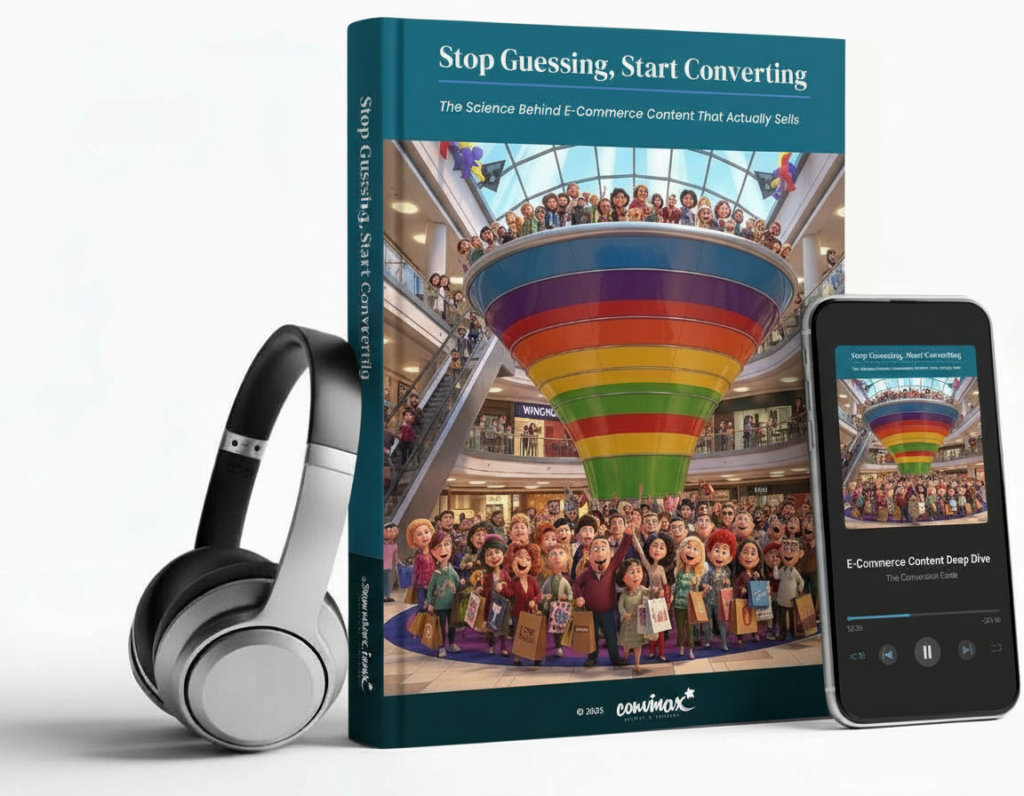
Your complete bundle includes:
  • Audio Podcast
    Listen anywhere. Perfect for learning on the go.
  • Blog Article
    A quick, engaging summary of the key ideas.
  • Detailed Booklet
    A deeper dive with examples and academic findings.
Content and Context Optimisation

This isn’t theory. Every recommendation is backed by academic research, field studies, and real-world case studies. You’ll get the full academic citations, the industry benchmarks, and the practical frameworks you need to implement this tomorrow.

This booklet synthesises findings from:
  • Cognitive Load Theory: Research by John Sweller and others is cited to explain how finite mental resources affect decision-making and task abandonment
  • Behavioral Economics: Findings from Daniel Kahneman (Thinking Fast and Slow) and Richard Thaler (Nudge Theory)
  • Neuroscientific Studies: Insights are derived from EEG biosensor research measuring brain activity to compare cognitive load in planned versus unplanned shopping
  • Specialised Journals: Data is pulled from the Journal of Marketing Research, Journal of Consumer Research, Marketing Science, and the Journal of Retailing regarding online reviews and consumer attention patterns
  • Eye-Tracking Research: Studies measuring visual attention patterns, such as the F-pattern, are used to optimise content layout and visual hierarchy
  • Baymard Institute: Sources cite over 200,000 hours of UX research and thousands of test sessions focused on checkout usability and cart abandonment.
  • Baymard Institute: Sources cite over 200,000 hours of UX research and thousands of test sessions focused on checkout usability and cart abandonment.
  • Nielsen Norman Group (NN/g): Research from this group provides the basis for guidelines on minimising cognitive load and effective navigation.
  • Global Consulting and Tech Firms: Insights from McKinsey & Company (personalisation ROI), Google (mobile speed impact), and Salesforce (conversion benchmarks) are utilised.
  • Platform-Specific Benchmarks: Data aggregated from Shopify, Klaviyo, Mailchimp, Dynamic Yield, and HubSpot provide sector-specific conversion rates and email marketing performance.
  • Statistical Meta-Analysis: Aggregate findings from platforms like Optimizely, VWO, and Unbounce document conversion lifts from changes in CTAs, page load speeds, and visual hierarchy.
  • Specific Brand Experiments: Documented A/B tests for brands like Rappi (shipping fee placement), Clarks Shoes (free shipping prominence), and SmartWool (image grid optimization) illustrate measurable revenue gains.
  • Retail Giants: The “content-driven” approaches of Amazon and Walmart are analyzed as benchmarks for high-intent conversion.
  • Specialised Platforms: Success stories from Sephora (social proof), Booking.com (urgency and context), and Mindbody (frictionless re-booking) are synthesised to show stage-specific funnel optimisation.
  • Systematic Reviews: One report specifically notes a semantic search of over 138 million academic papers to identify empirical evidence for funnel-stage interventions.

Common Objections

  • “I can find this information free online”
    You probably can, if you have 40+ hours to wade through academic journals, industry reports, and contradictory blog posts, then synthesise it into something actionable.
    This article compresses 90+ sources – peer-reviewed studies, Baymard Institute benchmarks, documented A/B tests, Nielsen Norman research – into a single, coherent, prioritised framework. Think of it as buying back your time.
  • “Will this work for my industry/business model?”
    The research covers everything from food and beverage (6.23% conversion) to luxury goods (0.95% conversion), B2C to B2B, mobile to desktop, fashion to SaaS.
    The principles – cognitive load reduction, progressive trust-building, device-specific optimisation – are universal. The implementation varies by context, which is why the article gives you the framework to adapt, not just copy-paste tactics.
  • “I’m not technical enough to implement this”
    Good news: most of the highest-impact changes require zero code. Adding product videos, restructuring content by funnel stage, simplifying checkout forms, positioning trust signals – these are content and UX decisions, not development projects.
    Where technical changes help (page speed, mobile optimisation), the article explains what to ask for, not how to build it yourself.
  • “What if I implement this and it doesn’t work?”
    Conversion optimisation is about systematic testing, not gambling. The article gives you the implementation framework, the expected impact ranges, and the measurement approach.
    But here’s the reality: if you’re currently converting at 1-3% and you implement even half of what’s covered – simplified checkout, device-specific content, trust signals, video – you will see improvement. The case studies aren’t outliers. They’re examples of what happens when you remove friction systematically.
    The bigger risk? Doing nothing and watching your competitors close the gap.
  • “I’ve tried CRO before and it didn’t move the needle”
    That’s probably because you were testing the wrong things, or testing correctly but at the wrong funnel stage.
    Most CRO efforts fail because they optimise bottom-of-funnel (checkout, CTAs) without fixing top and middle-of-funnel issues first. Or they focus on traffic when conversion is the real bottleneck.
    This article shows you why funnel stage matters (hint: BOFU changes deliver 2.3x better results than TOFU changes), and more importantly, where to start based on your current metrics.
  • “Can’t I just hire an agency to do this?”
    You absolutely can. A decent CRO agency will charge £3,000-£10,000/month and take 3-6 months to deliver results.
    This article costs less than an hour of agency time and gives you the same research-backed framework they’d use – so you can implement it yourself, or evaluate whether an agency’s recommendations are actually evidence-based or just “best practices” repackaged.

Copyright © 2026

Privacy policy | Terms of Service