1
Shipping
Where to ship it?
Your cart is currently empty.Continue shopping
Subtotal £0.00
Total £0.00 GBP

Your Information

Order Summary

Product
Total
Subtotal £0.00
Total £0.00 GBP

Payment Information

All transactions are secured and encrypted.

Your personal data will be used to process your order, support your experience throughout this website, and for other purposes described in our privacy policy.

Please note: Results may vary and are not guaranteed.
Due to the digital nature of this product, we do not offer refunds.

  • 256-Bit Bank Level Security
  • 100% Secure Payments
Who This Is For

This article will be most valuable if you:

  • Manage conversion rates for an e-commerce site or digital product
  • Design user experiences and need psychological frameworks that actually work
  • Run a small business and handle your own website optimisation
  • Work as a freelance CRO consultant and need evidence-based strategies for clients
  • Build side projects or digital products and want to maximise every visitor
  • Lead growth for a startup where every percentage point matters
ConviMax Logo

Confident Recommendation Strategy

Why Your 5.0 Rating is a Sales Killer: The Hidden Psychology of the ‘Confident’ Add-to-Cart
Most e-commerce advice tells you to optimise your checkout, tweak your button colour, or run more ads. That’s not where the problem is.
The real issue is earlier. It’s the moment a visitor faces your product page and feels – without even realising it – a quiet but powerful sense of uncertainty. Too many options. Not enough guidance. No clear signal that says: this one.
That’s a fixable problem. And fixing it doesn’t require a bigger budget, a developer, or a rebrand.

What You’ll Discover in This Article:
  • The Perfection Paradox: While most brands strive for a perfect 5.0 rating, research shows that consumers actually distrust 5.0-star products, often suspecting fake reviews or a lack of sample size. We discuss the “sweet spot” for maximising conversions, shgowing why authenticity consistently beats perfection
  • The 7–9 Rule for Cognitive Collapse: Avoid the “sampling” trap and improve purchase conversion
  • The Mobile Traffic Trap: Mobile users experience higher friction, resulting in an 83% abandonment rate for mobile carts compared to 67% on desktop
  • The “Why” is More Powerful Than the “What”: Simply showing a recommended product is often viewed with suspicion. However, adding a transparent, one-line justification significantly increases perceived competence and trust
  • Amazon’s $30 Billion Secret: We discuss curated recommendations – demonstrating “confident” suggestions
  • The “Fat Finger” Conversion Killer: Fixing the UI in pixels for the perfect mobile tap target
  • The sweet spot for Recommendations
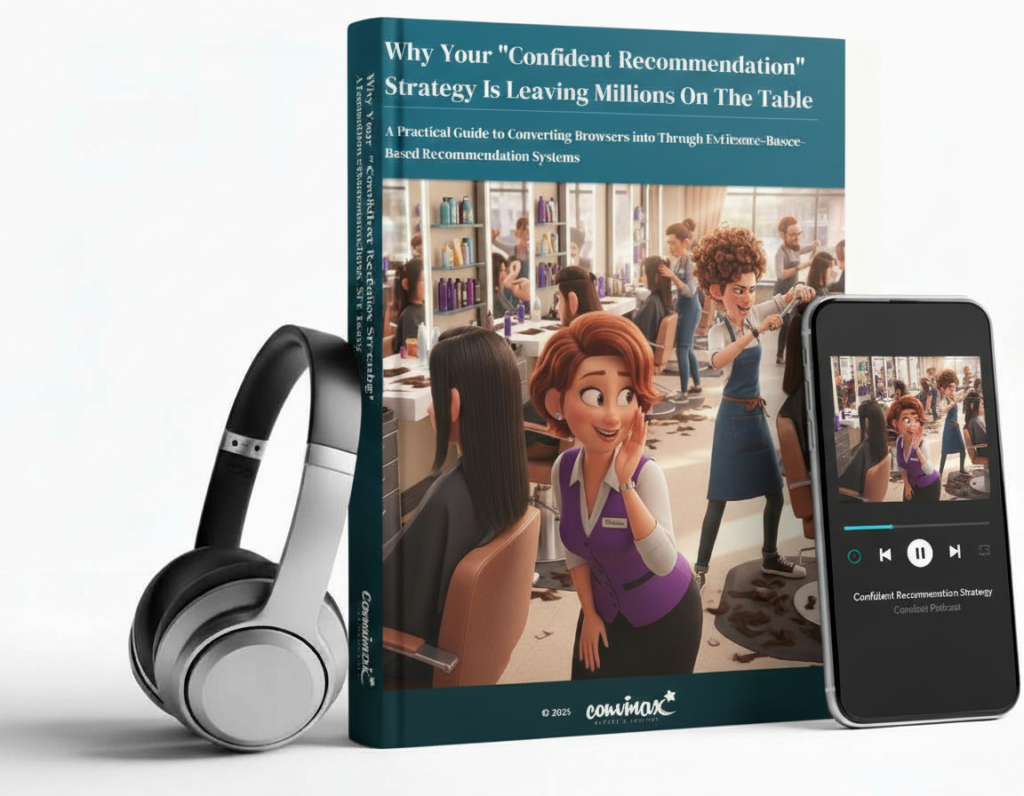
Your complete bundle includes:
  • Audio Podcast
    Listen anywhere. Perfect for learning on the go.
  • Blog Article
    A quick, engaging summary of the key ideas.
  • Detailed Booklet
    A deeper dive with examples and academic findings.
Confident Recommendation

This isn’t theory. Every recommendation is backed by academic research, field studies, and real-world case studies. You’ll get the full academic citations, the industry benchmarks, and the practical frameworks you need to implement this tomorrow.

This booklet synthesises findings from:
  • University Studies: Key insights are drawn from institutions such as Northwestern University’s Spiegel Research Centre (focusing on the 270% purchase likelihood increase from reviews), Stanford Persuasive Technology Lab, and Carnegie Mellon University
  • Peer-Reviewed Journals: Findings are sourced from high-impact journals including ScienceDirect, Psychological Science, the Journal of Consumer Research, and the Journal of Marketing Research
  • Foundational Psychological Theories: The framework is built on established principles like John Sweller’s Cognitive Load Theory, Miller’s Law regarding working memory limits, and Uncertainty Reduction Theory
  • Neuro-behavioural Research: Data is derived from studies using eye-tracking, EEG (electroencephalography), and physiological measurements such as heart rate and skin conductance to track how anxiety impacts user scanning patterns
  • Specialised Research Houses: Extensive use is made of the Baymard Institute, which contributed over 88,000 hours of usability testing and 14 years of checkout tracking, and the Nielsen Norman Group (NN/g), pioneers of the “progressive disclosure” principle
  • Platform and Benchmark Data: Quantitative benchmarks are synthesised from Dynamic Yield (Mastercard), Shopify, IRP Commerce, and Statista, covering millions of unique users and 200M+ monthly data points
  • Global Consulting Firms: Reports from McKinsey & Companyand Google Industry Benchmarks provide context on regional trust variations and mobile conversion gaps
  • Specialised A/B Testing Data: The articles reference nearly 100 trust badge tests from TrustedSite and data from CRO platforms like VWO, Optimizely, and FigPii
  • Classic Behavioural Experiments: Findings include the famous “jam stall” experiment (Columbia/Stanford) regarding choice paralysis and IBM’s early “training wheels” interface research
  • Large-Scale Meta-Analyses: One key finding aggregates data from 50 different studies to establish the global 70.22% average cart abandonment rate
  • Corporate Performance Data: Documented results from major brands include Expedia’s £12M revenue increase from a single form field fix, Sephora’s 51% lift from AR try-on tools, and Materials Market’s 28% increase in orders via checkout simplification
  • Agency and Retailer Results: Specific success stories are cited from Wiro Agency (45,239% ROI on trust messaging), Zalora (12.3% checkout rate boost), and Intertop (54.68% conversion lift through form optimisation)

Common Objections

  • “I’ve read plenty of CRO articles. What makes this different?”
    Most CRO content tells you what to change without explaining why it works. This article is built on behavioural research – cognitive load theory, decision psychology, conversion benchmarks across industries. You’ll understand the reasoning, not just follow a checklist.
  • “I don’t have time to read a long article.”
    It’s structured to be skimmed. Section headers, clear takeaways, no filler. Most readers finish it in under 20 minutes. If you’d rather listen, the audio podcast version is included – play it during a commute or while you’re working.
  • “I’m not technical. Will I actually be able to use this?”
    Yes. The article is written for people who run and manage sites, not developers. The recommendations are practical, not technical. Many can be implemented today without touching a line of code.
  • “My business is small. Is this really relevant to me?”
    Especially relevant. The psychology this covers affects every shopper on every device, regardless of whether you’re Amazon or a one-person shop. Small changes to how you present choices and build trust have an outsized impact when you’re working with limited traffic.
  • “What if it’s not useful to me?”
    That’s a fair concern. This is a focused piece on one specific strategy. If you’ve read this far and recognised your own situation in the problems described above, it’s likely relevant. If you’re unsure, the section headers and structure are visible before you purchase – so you can judge the substance for yourself.

Copyright © 2026

Privacy policy | Terms of Service