1
Shipping
Where to ship it?
Your cart is currently empty.Continue shopping
Subtotal £0.00
Total £0.00 GBP

Your Information

Order Summary

Product
Total
Subtotal £0.00
Total £0.00 GBP

Payment Information

All transactions are secured and encrypted.

Your personal data will be used to process your order, support your experience throughout this website, and for other purposes described in our privacy policy.

Please note: Results may vary and are not guaranteed.
Due to the digital nature of this product, we do not offer refunds.

  • 256-Bit Bank Level Security
  • 100% Secure Payments
Who This Is For

This article will be most valuable if you:

  • Manage conversion rates for an e-commerce site or digital product
  • Design user experiences and need psychological frameworks that actually work
  • Run a small business and handle your own website optimisation
  • Work as a freelance CRO consultant and need evidence-based strategies for clients
  • Build side projects or digital products and want to maximise every visitor
  • Lead growth for a startup where every percentage point matters
ConviMax Logo

Out-of-Stock Conversion Optimisation

Every time someone lands on your out-of-stock page and leaves, that’s money walking out the door. Not hypothetical money. Not “maybe one day” money. Real revenue you’ve already paid to acquire.

Here’s what most e-commerce sites do: Put up an “Out of Stock” message and hope the customer remembers to check back later. Spoiler: they don’t. They buy from your competitor instead.
Here’s what you should be doing: Capturing that intent and converting it when stock returns.
The difference between these two approaches? Industry data shows conversion rates of 5-22% for back-in-stock alerts. Some brands have seen 490% increases in conversion. That’s not a typo.

What You’ll Discover in This Article:
  • The “Loyalty Paradox”: Stockouts Can Be Better Than Perfection
  • The 8,695% Conversion Explosion. While standard marketing emails struggle, back-in-stock automated flows can achieve a staggering 8,695% uplift in conversion rates compared to generic campaigns
  • The “Sold Out” Language Hack. How you frame the outage matters more than you think. Research shows that framing a product with the right micro-copy triggers far fewer negative reactions and higher perceived desirability
  • The 50% Price Premium. Why consumers are often willing to pay 50% more for products they perceive as scarce
  • Which channel drives the highest conversion (hint: it’s not email)
  • The Massive 68% Implementation Gap. Despite the overwhelming data, 68% of e-commerce sites still do not allow customers to stay connected or purchase when an item is temporarily unavailable
  • The “Commit to Buy” Power Move. How to create a powerful psychological commitment that leads to near-instant conversion the second the item is restocked
  • The 24-Hour Gold Rush. Timing is everything: 78% of customers will purchase on the same day they are notified of a restock. Revealing the golden notification window
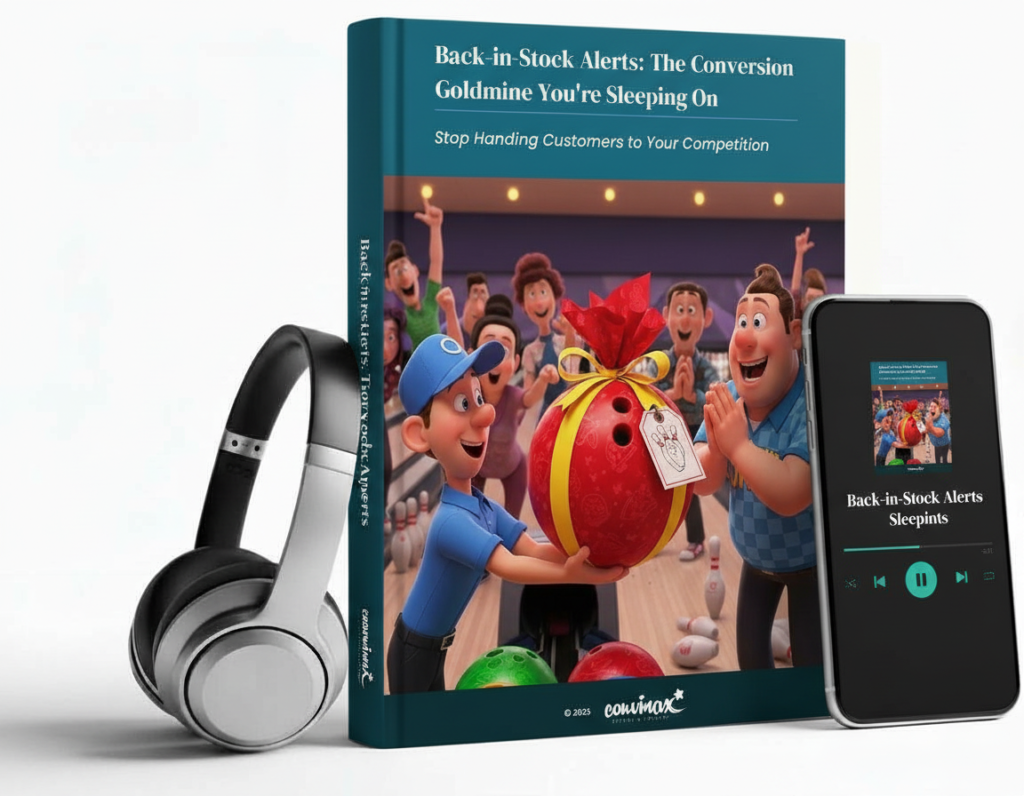
Your complete bundle includes:
  • Audio Podcast
    Listen anywhere. Perfect for learning on the go.
  • Blog Article
    A quick, engaging summary of the key ideas.
  • Detailed Booklet
    A deeper dive with examples and academic findings.
Back-In-Stock

This isn’t theory. Every recommendation is backed by academic research, field studies, and real-world case studies. You’ll get the full academic citations, the industry benchmarks, and the practical frameworks you need to implement this tomorrow.

This booklet synthesises findings from:
  • Peer-Reviewed Academic Research: The sources reference high-impact journals and repositories such as SSRN, NBER, ScienceDirect, PLOS ONE, and the Journal of Retailing. These studies often focus on economic theory, allocation mechanisms, and consumer behaviour, such as Popescu’s (2024) work on managing transient scarcity
  • Industry Benchmarks and Platform Data: Aggregated data from major e-commerce and marketing platforms like Klaviyo, Omnisend, Shopify, and Barilliance provides large-scale quantitative metrics. This includes performance data from millions of automated emails and SMS sends to establish baseline open and conversion rates
  • UX Lab and Usability Research: Practical design guidance is synthesised from large-scale usability testing and eyetracking studies conducted by organisations like the Baymard Institute (based on over 18,000 usability scores) and the Nielsen Norman Group (NN/g). These findings address how visual hierarchy and page layout affect user attention
  • Real-World Case Studies: The articles cite documented results from specific brands, including Birkenstock Central, Snow Peak, BedGear, Whisker, and ASOS, to demonstrate practical revenue lift and conversion improvements. For example, the BedGear case study shows a 490% conversion increase through integrated alerts and quizzes
  • Controlled Experiments and A/B Testing: Findings are supported by randomised field experiments and specific A/B tests (e.g., Evans Cycles or Myntra) that compare different “Notify Me” variants against control groups. Statistical frameworks from sources like Evan Miller are used to validate the significance of these tests
  • Behavioural Economics and Psychology: The research leverages established psychological principles, including Cognitive Load Theory (Sweller), Prospect Theory (Kahneman & Tversky), and Cialdini’s Scarcity Principle. These frameworks explain why stockouts act as “cognitive dead-ends” and how alerts utilise the Zeigarnik Effect to drive task completion
  • Technical Implementation and Vendor Documentation: Practitioner-focused insights come from ERP, WMS, and ESP documentation (e.g., Salesforce Commerce Cloud and Bloomreach), outlining the technical requirements for real-time inventory synchronisation
  • Global Market Reports: Data on e-commerce trends and regional adoption is gathered from Adobe Digital Economy Index, Retail Touchpoints, and Statista

Common Objections

  • “I can just Google this information for free.”
    You could. You’d spend 4-6 hours filtering through vendor marketing, contradictory advice, and outdated blog posts. This article synthesises research from seven different AI assistants, 70+ sources including peer-reviewed studies, platform benchmarks, and real case studies. It’s already been filtered, fact-checked, and structured for implementation. Your time is worth more than the price of this article.
  • “I’m not sure this applies to my business.”
    If you sell physical products online and ever experience stockouts, this applies. The research covers B2C and B2B, mobile and desktop, fashion to electronics to furniture. The case studies span multiple industries with documented results. Plus, there’s a section specifically addressing industry-specific applications.
  • “What if I read it and it doesn’t help?”
    The article includes conversion benchmarks, technical implementation guides, A/B testing frameworks, and platform-specific instructions. If you can’t find at least three actionable takeaways that apply to your business, you’re either not experiencing stockouts or you’re already implementing this perfectly (which statistically, 68% of sites aren’t).
  • “I don’t have a developer to implement this.”
    Fair concern. The article includes no-code solutions using existing platforms like Klaviyo, Omnisend, and Shopify apps. There’s also a section on vendor selection and what to look for in third-party tools. You don’t need to be technical to implement the recommendations.
  • “Is this just going to tell me to ‘add a notify button’?”
    No. It covers the psychology behind why it works, channel-specific performance data (email vs SMS vs push), optimal timing windows, message framing that converts, mobile optimisation requirements, platform integrations, ethical considerations, and product-type specific strategies. The “add a button” advice is about 2% of the content.
  • “My site doesn’t get enough traffic for this to matter.”
    If you’re getting any traffic to out-of-stock pages, you’re losing potential revenue. Even if you’re only recovering 10 sales per month at an average order value of £50, that’s £6,000 annual revenue you’re currently walking away from. The implementation effort is a one-time cost. The revenue recovery is ongoing.

Copyright © 2026

Privacy policy | Terms of Service