1
Shipping
Where to ship it?
Your cart is currently empty.Continue shopping
Subtotal £0.00
Total £0.00 GBP

Your Information

Order Summary

Product
Total
Subtotal £0.00
Total £0.00 GBP

Payment Information

All transactions are secured and encrypted.

Your personal data will be used to process your order, support your experience throughout this website, and for other purposes described in our privacy policy.

Please note: Results may vary and are not guaranteed.
Due to the digital nature of this product, we do not offer refunds.

  • 256-Bit Bank Level Security
  • 100% Secure Payments
Who This Is For

This article will be most valuable if you:
  • Manage conversion rates for an e-commerce site or digital product
  • Design user experiences and need psychological frameworks that actually work
  • Run a small business and handle your own website optimisation
  • Work as a freelance CRO consultant and need evidence-based strategies for clients
  • Build side projects or digital products and want to maximise every visitor
  • Lead growth for a startup where every percentage point matters
ConviMax Logo

Supportive vs Sales Tone

Why Telling Customers “Don’t Buy Yet” Can Skyrocket Your Sales by 349%
Here’s a question that should keep you up at night: What if the words on your site are actively pushing customers away at the exact moment they’re ready to buy?
Not because your product isn’t good enough. Not because your prices are wrong. But because the way you’re talking to people – the tone, the pressure, the urgency – is triggering every anxiety alarm in their heads.
Most e-commerce businesses operate on a dangerous assumption: that customers need convincing. That if you just push harder, create more urgency, add another countdown timer, they’ll crack and buy.
The research says you’ve got it backwards.

What You’ll Discover in This Article:
  • The Active Network case study documented a 349% increase in conversions simply by changing email tone from pushy to supportive. (Yes, that’s three hundred and forty-nine per cent. From changing words.)
  • The neuropsychology behind why certain messaging literally activates your customer’s threat response, while other messaging activates reward centres. This isn’t marketing theory – it’s brain scans
  • Specific, tested frameworks for identifying customer anxiety at each stage of your funnel and addressing it with precision. Product page. Cart. Checkout. Abandoned cart emails. The works
  • Platform-specific benchmarks showing exactly how trust signals, supportive copy, and anxiety-reduction tactics perform across mobile versus desktop, email versus on-site, and different industries
  • The proximity principle that increased one company’s conversions by 78% just by moving content to where anxiety peaks. (This one change alone could transform your product pages.)
  • Sample copy and messaging frameworks you can adapt immediately, based on what actually worked in controlled tests across thousands of e-commerce stores
  • Sales Pitch type that triggers a “Fear” Response in the Brain
  • The “Non-Binding” Add-to-Cart Hack
  • The 349% Supportive Lift: A landmark case study involving the Active Network found that replacing aggressive “Start your free trial now!” copy with a supportive tone that acknowledged user anxiety resulted in a staggering 349% increase in lead inquiries
  • Price is Rarely the Problem: Shoppers abandon carts driven mostly by anxiety and uncertainty
  • The Power of “No Pressure” Confirmations: Counter-intuitively, the most effective way to keep a customer moving toward a purchase after they add an item to their cart is to tell them to slow down
  • The Tone Type That Wins the Long Game, increasing Customer Lifetime Value by ~52%
Your complete bundle includes:
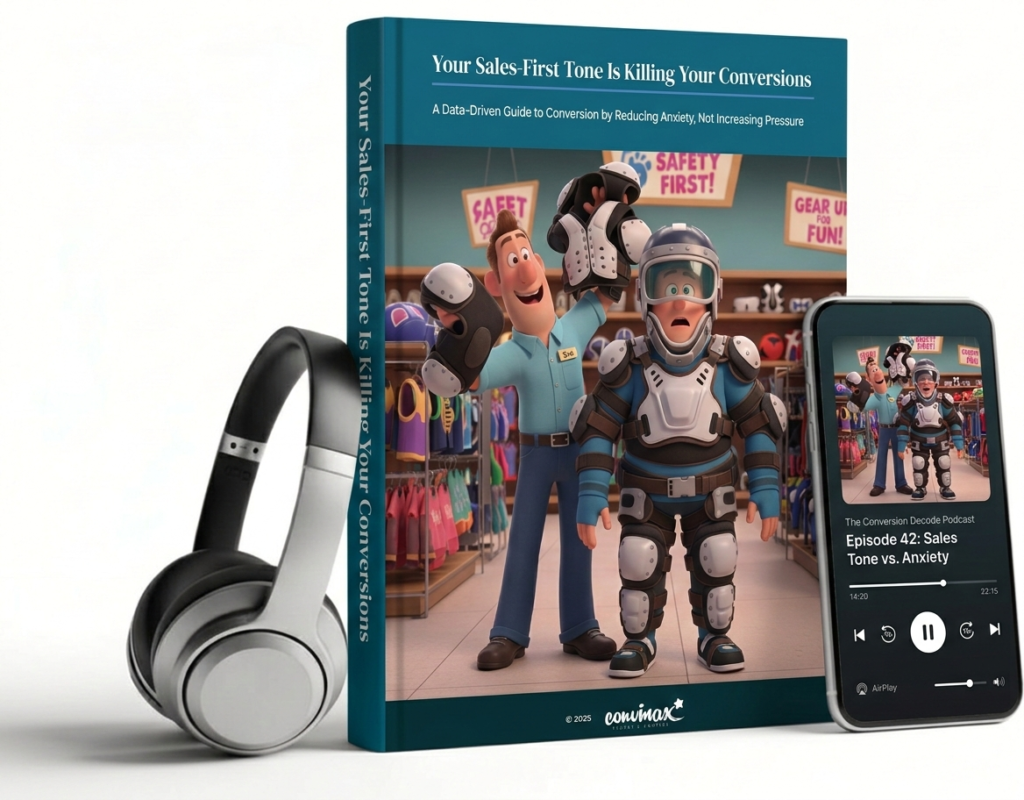
  • Audio Podcast
    Listen anywhere. Perfect for learning on the go.
  • Blog Article
    A quick, engaging summary of the key ideas.
  • Detailed Booklet
    A deeper dive with examples and academic findings.
Supportive vs Sales Tone

This isn’t theory. Every recommendation is backed by academic research, field studies, and real-world case studies. You’ll get the full academic citations, the industry benchmarks, and the practical frameworks you need to implement this tomorrow.

This booklet synthesises findings from:
  • Marketing and Consumer Journals: Insights are pulled from the Journal of Marketing Research, Journal of Consumer Research, Marketing Science, and the Journal of the Academy of Marketing Science
  • Psychology and Behavioral Science: Research is cited from Psychology & Marketing, Journal of Consumer Psychology, and the Journal of Experimental Psychology
  • Neuroscience/Neuromarketing: The sources utilise fMRI neuroimaging and EEG studies to map brain activity, such as the activation of the amygdala (threat detection) during high-pressure sales versus the ventral striatum (reward anticipation) during supportive interactions
  • Technology and E-Commerce Journals: Findings are synthesised from ScienceDirect, Electronic Commerce Research and Applications, and the Journal of Electronic Commerce Research
  • UX Research Giants: Data from the Baymard Institute (over 88,000+ hours of UX research) and the Nielsen Norman Group (NN/g) provides the foundation for findings on cart abandonment and trustworthiness
  • Platform Benchmarks: Aggregate data is pulled from e-commerce and email leaders like Shopify, Klaviyo, Mailchimp, and Campaign Monitor to establish industry-standard conversion rates and performance lifts
  • Specialised Industry Surveys: Reports from Software Advice (surveying 5,500+ consumers) and Supermetrics provide insights into consumer expectations for brand empathy
  • Practitioner Platforms: Insights from Optimizely, CXL, Dynamic Yield, and Contentsquare are used to rank “tone/copy” as a high-impact variable
  • Specific Experimental Data: The sources cite io’s experiment of 4,500 B2B emails comparing aggressive versus polite tones, and MarketingExperiments’ tests on product page anxiety
  • Statistical Validation: The research emphasises the use of minimum detectable effects (MDE), 95% confidence intervals, and randomised traffic splits to ensure findings are not anecdotal
  • The Active Network Study: A central piece of evidence showing a 349% increase in lead inquiries by shifting to an anxiety-reduction email tone
  • Security and Trust Implementations: Success stories from McAfee Secure (7.8% lift), TRUSTe (20% lift), and Norton (12.2% lift) demonstrate the power of trust signals
  • Global Brand Examples: Behavioural outcomes from major brands like Amazon, Nike, Apple, Booking.com, and IKEA are synthesised to show how supportive tones speed up product discovery

Common Objections

  • “Can’t I just figure this out through my own testing?”
    You could. But here’s the reality: most A/B tests fail because they’re testing the wrong things or testing without understanding the psychology. This research gives you the framework to test smarter – testing things that have already shown 60-75% success rates in other businesses.
  • “This sounds like it’s for big businesses with big budgets.”
    Actually, the opposite. The examples include solo founders, small Shopify stores, and bootstrapped startups. Supportive messaging costs nothing to implement – you’re just changing words. The biggest success stories often come from smaller businesses who can move fast.
  • “What if my industry is different?”
    The research covers multiple industries – B2B, B2C, SaaS, retail, health, finance, travel – and breaks down what works where. More importantly, it teaches you how to identify the specific anxieties in your industry so you can adapt the principles.
  • “I’m not a copywriter. Can I actually implement this?”
    The article includes specific messaging frameworks and examples you can adapt. You don’t need to be David Ogilvy. You need to understand what your customers are worried about and address it clearly. The research shows you how.
  • “What if I buy this and it doesn’t work for my business?”
    Fair question. Here’s the thing: this isn’t untested theory. These are documented results from controlled experiments. The Active Network 349% increase? That’s real. The 78% lift from addressing anxiety? That happened. The 22% improvement from supportive email copy? Tested and measured.
    Will you get exactly those results? Depends on your implementation. But the psychology is universal: people buy when they feel confident, not when they feel pressured.
  • “Why should I pay for this when there’s free content about conversion optimisation everywhere?”
    Two reasons. First, most free content is surface-level tactics without the research backing. “Add urgency!” “Use social proof!” Sure, but why, when, and how? This article gives you the underlying psychology so you understand when each tactic actually works.
    Second, this synthesises research from peer-reviewed journals, industry benchmarks from platforms analysing thousands of stores, and documented case studies. That research exists, but it’s scattered across academic papers, paywalled studies, and platform-specific reports. This brings it all together in one actionable piece.

Copyright © 2026

Privacy policy | Terms of Service