1
Shipping
Where to ship it?
Your cart is currently empty.Continue shopping
Subtotal £0.00
Total £0.00 GBP

Your Information

Order Summary

Product
Total
Subtotal £0.00
Total £0.00 GBP

Payment Information

All transactions are secured and encrypted.

Your personal data will be used to process your order, support your experience throughout this website, and for other purposes described in our privacy policy.

Please note: Results may vary and are not guaranteed.
Due to the digital nature of this product, we do not offer refunds.

  • 256-Bit Bank Level Security
  • 100% Secure Payments
Who This Is For

This article will be most valuable if you:

  • Manage conversion rates for an e-commerce site or digital product
  • Design user experiences and need psychological frameworks that actually work
  • Run a small business and handle your own website optimisation
  • Work as a freelance CRO consultant and need evidence-based strategies for clients
  • Build side projects or digital products and want to maximise every visitor
  • Lead growth for a startup where every percentage point matters
ConviMax Logo

Loyalty Tier Optimisation

Stop Using Points! The Controversial Truth About Why Your Loyalty Program is Failing
You’ve built the tiers. You’ve written the benefits. You’ve launched the emails.
And yet – the numbers aren’t moving the way they should.
Customers sign up, collect a few points, then carry on spending exactly as before. Your programme exists. It just isn’t working.
Here’s what most e-commerce brands get completely wrong: they confuse having a loyalty programme with running one. The structure isn’t the strategy. The tiers aren’t the tactic. And the research – drawn from three decades of peer-reviewed studies and data from hundreds of millions of sessions – confirms that the gap between a programme that generates passive costs and one that drives compounding revenue comes down to a single, overlooked mechanic.
This article explains exactly what that mechanic is, how it works psychologically, and how to implement it with the kind of rigour that produces results you can defend in a boardroom.

What You’ll Discover in This Article:
  • Why 72% of consumers buy more frequently from loyalty programmes – but only under one specific condition that most brands never meet. Are you meeting it?
  • The exact conversion rate gap between mobile and desktop that should reshape how you display tier promotions – and why fixing your desktop experience first may be the wrong priority
  • What a 13-year academic study found changes actually when customers join a loyalty programme – and it’s almost certainly not what you’re currently measuring
  • Why one of the world’s most recognisable brands scrapped points entirely, and what happened to their revenue in the five years that followed
  • The specific percentage uplift in purchase likelihood that paid loyalty tiers produce over free ones – and why most brands are leaving this lever completely untouched
  • How much of the average e-commerce conversion improvement is achievable simply by changing where and how you display tier status – no new tech required
  • Why most A/B tests run on loyalty promotions are statistically worthless – and the minimum you need to run a test that actually tells you something
  • The psychological trigger that causes customers to accelerate their spending as they approach a tier threshold – and how to design for it deliberately
  • Does The “More Tiers” Myth Sabotage Sales
  • Nike’s £700 Million “Points-Free” Strategy
  • The “Subordinate Tier” Psychological Hack
  • Do Paid Loyalty Programs Outperform Free Ones
  • The Mobile Conversion “Terror” Statistic
  • Are Discounts What Customers Actually Want
  • How Most “Loyalty Successes” are Actually Statistical Luck
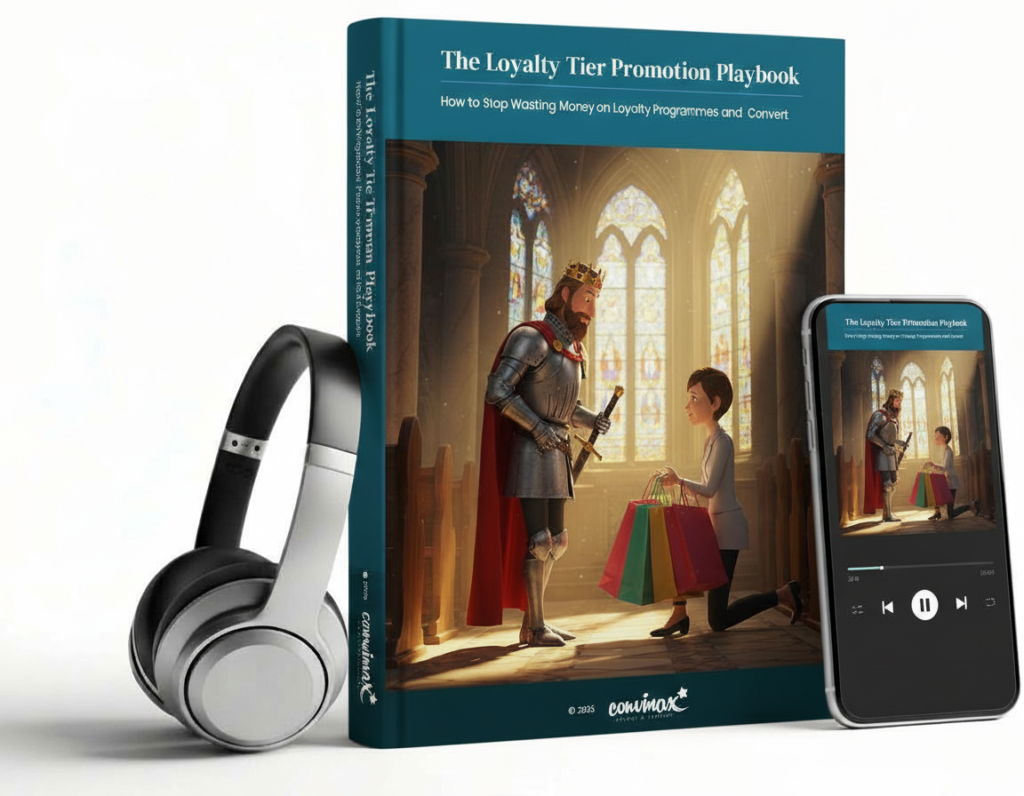
Your complete bundle includes:
  • Audio Podcast
    Listen anywhere. Perfect for learning on the go.
  • Blog Article
    A quick, engaging summary of the key ideas.
  • Detailed Booklet
    A deeper dive with examples and academic findings.
Loyalty Tier Optimisation

This isn’t theory. Every recommendation is backed by academic research, field studies, and real-world case studies. You’ll get the full academic citations, the industry benchmarks, and the practical frameworks you need to implement this tomorrow.

This booklet synthesises findings from:
  • Literature Reviews: A comprehensive 30-year systematic review of loyalty programs (Chen et al., 2021) provides the foundational evidence for program effectiveness
  • Behavioural Economics & Psychology: Sources cite studies from Columbia University on choice paralysis and cognitive load. They also reference peer-reviewed work on “Status Signalling” and the “Goal-Gradient Hypothesis” from journals like the Journal of Consumer Research and Marketing Science
  • Longitudinal Studies: One specific study from PMC (PubMed Central) tracked 31,746 purchases over 13 years to analyse the long-term impact of loyalty membership on purchase frequency
  • Global Consultancies: Reports from McKinsey & Company are used to demonstrate the superior performance of paid loyalty programs over free ones
  • Platform Data: Benchmarks from Shopify, Klaviyo, Adobe, and Dynamic Yield provide real-world conversion rates across different industry sectors and devices
  • Sector-Specific Performance: Data from IRP Commerce and Speedcommerce is used to provide the 2024–2025 conversion benchmarks for different industries, such as Food & Beverage and Fashion
  • Eye-Tracking Studies: Research from the Baymard Institute (based on 71,000+ hours of research) and the Nielsen Norman Group (NN/g) provides evidence for visual hierarchy, F-pattern reading, and the impact of cognitive load on mobile vs. desktop conversion
  • Heatmap Analysis: The sources reference heatmap data to show that areas with high “fixation density” see 3x higher engagement
  • Brand Performance: Investor releases and case studies from Starbucks, Nike, and Sephora are used to illustrate how simplified tiers (Starbucks) or points-free models (Nike) lead to massive revenue growth
  • Cultural Comparisons: A comparative study of Starbucks Rewards in the UK and China is cited to show how program effectiveness can vary across different geographic markets
  • Statistical Standards: The sources define the “Statistical Significance Standard” required for credible testing, citing a need for a 95% confidence level and 80–90% statistical power
  • Testing Methodologies: Strategies for randomised and stratified A/B testing are synthesised from professional testing resources like CXL, VWO, and AB Tasty

Common Objections

  • “I can find this kind of content for free online.”
    You can find fragments of it. What you won’t find for free is a synthesis of peer-reviewed academic research, UX benchmarking data, cross-platform analysis, and a tested implementation framework – all in one place, written for practitioners rather than academics. The value here isn’t the raw information. It’s the hours of work saved pulling it together, and the clarity of how it connects.
  • “I’m not sure it’s relevant to my business size.”
    The psychological principles covered – status signalling, cognitive load, goal gradient mechanics – apply whether you’re running a Shopify store with 500 customers or an e-commerce operation with half a million. The benchmarks cover everything from early-stage businesses to enterprise-level programmes. The framework scales down as well as up.
  • “I’ve read articles like this before and they’re always vague.”
    This one comes with specific numbers, named academic sources, a 90-day implementation roadmap, and a testing protocol with sample size calculations. If it reads like a consultant’s slide deck dressed up as a blog post, ask for a refund. It won’t.
  • “I don’t have time to read a long article.”
    That’s exactly why the audio version is included. Listen in your own time, at your own pace. And the article itself is structured to be skimmable – every chapter leads with its core finding, so you can extract value quickly even if you never read every word.
  • “What if my loyalty programme is already performing well?”
    Then this article will either confirm you’re doing the right things – or show you the specific levers you haven’t pulled yet. Either way, you’ll know exactly where you stand relative to the research.

Copyright © 2026

Privacy policy | Terms of Service