1
Shipping
Where to ship it?

Your cart is currently empty.Continue shopping
Subtotal £0.00
Total £0.00 GBP

Your Information

Order Summary

Product
Total
Subtotal £0.00
Total £0.00 GBP

Payment Information

All transactions are secured and encrypted.

Your personal data will be used to process your order, support your experience throughout this website, and for other purposes described in our privacy policy.

Please note: Results may vary and are not guaranteed.
Due to the digital nature of this product, we do not offer refunds.

  • 256-Bit Bank Level Security
  • 100% Secure Payments
Who This Is For

This article will be most valuable if you:

  • Manage conversion rates for an e-commerce site or digital product
  • Design user experiences and need psychological frameworks that actually work
  • Run a small business and handle your own website optimisation
  • Work as a freelance CRO consultant and need evidence-based strategies for clients
  • Build side projects or digital products and want to maximise every visitor
  • Lead growth for a startup where every percentage point matters
ConviMax Logo

Conversational Filters

Most e-commerce sites use the same product filtering approach that’s been around since 2005. Categories. Checkboxes. Price sliders. Dropdown menus. It looks professional. It feels comprehensive.
But it’s overwhelming your customers – and research proves it’s costing you conversions.

What You’ll Discover in This Article:
  • The cognitive psychology behind why customers abandon: The exact moment decision paralysis kicks in, backed by studies from the Journal of Marketing Research and Journal of Consumer Psychology. You’ll understand why showing more options actually kills conversions
  • The filtering approach that’s delivering 4-6x conversion improvements: Real case studies from supplement brands, grocery retailers, and beauty companies – including specific numbers like 11.46% conversion rates (vs industry average of 2%) and 112% conversion increases
  • Why mobile users are abandoning at even higher rates: With 75% of traffic coming from mobile devices, your desktop-first filtering system is actively pushing customers away. You’ll learn what’s broken and how to fix it
  • The behavioural economics principle Amazon uses to increase both conversion AND order values: Yes, Amazon ran A/B tests and deliberately reduced filtering options. Here’s why it worked and how you can apply the same approach
  • The Massive “In-Store vs. Online” Conversion Gap
    A little-known but staggering fact is the disparity in success between physical and digital retail. While traditional e-commerce converts at a “pathetic” 2–3%, physical retail stores achieve conversion rates of 15–40%. Experts argue this gap exists because physical stores provide a “sales assistant” who uses a conversational approach to guide customers, rather than forcing them to navigate a wall of 47 different filters
  • The Brain Fatigue Rule: In a shopping context, consumers experience measurable cognitive fatigue after comparing just seven to nine product options. This fatigue leads to “anticipated regret,” where the shopper becomes so afraid of making the “wrong” choice that they abandon the site entirely
  • If discovery takes too long, the cognitive load spikes, and the likelihood of a purchase drops exponentially. The article discusses that conversational filters aim to cut this time significantly
  • Your Phone is Killing Your Conversions
    While 75–80% of e-commerce traffic is now mobile, conversion rates on smartphones are significantly lower than on desktops (2.85% vs. 3.85%). The “surprising” reason is that traditional faceted filters (dropdowns and tiny checkboxes) are almost unusable on small screens. This article investigates conversational interface best practices for the mobile interface
  • It’s Not Just About Sales; It’s About Returns
    One of the most surprising benefits of conversational filters is their impact on post-purchase behaviour. For example, Sephora’s virtual assistant didn’t just increase conversions by 112%; it also reduced product return rates by 28–30%
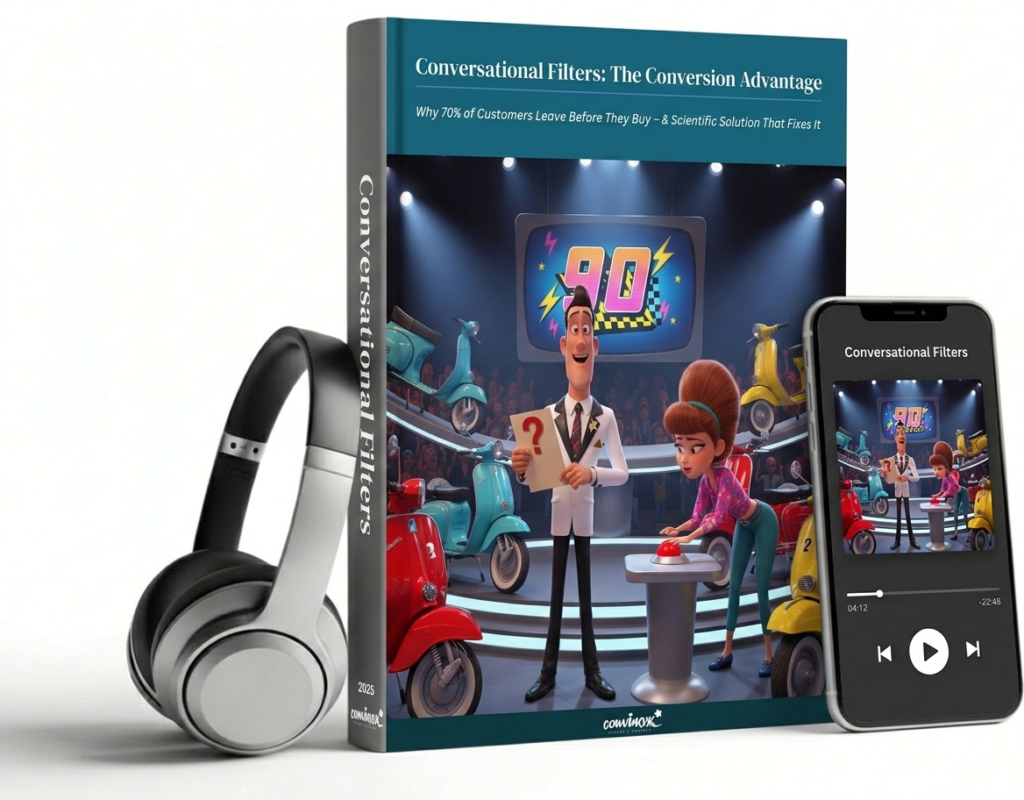
Your complete bundle includes:
  • Audio Podcast
    Listen anywhere. Perfect for learning on the go.
  • Blog Article
    A quick, engaging summary of the key ideas.
  • Detailed Booklet
    A deeper dive with examples and academic findings.
Conversational Filters

This isn’t theory. Every recommendation is backed by academic research, field studies, and real-world case studies. You’ll get the full academic citations, the industry benchmarks, and the practical frameworks you need to implement this tomorrow.

This booklet synthesises findings from:
  • Cognitive Psychology & Theory: Findings are based on Cognitive Load Theory (John Sweller), Dual Process Theory (Kahneman), and the Paradox of Choice
  • Behavioural Economics: Findings incorporate research from MIT, Harvard, and UCLA regarding choice architecture and decision-making
  • Marketing & Retail Journals: Findings cite the Journal of Marketing Research, Journal of Consumer Psychology, Journal of Retailing, and the Journal of Personality and Social Psychology
  • UX Research Institutes: Significant evidence comes from Baymard Institute (based on over 150,000 hours of UX research and 71,000+ user tests) and Nielsen Norman Group (over 25 years of usability studies)
  • E-commerce Benchmarks: Data is synthesised from industry leaders like Shopify, BigCommerce, Dynamic Yield, and Smart Insights, covering thousands of sites and billions of monthly interactions
  • Classic Behavioural Experiments: The famous Iyengar & Lepper “jam study” (2000) is used as a foundational example of choice overload
  • Modern A/B Testing: Results from large-scale site tests are cited, including Amazon’s A/B tests using simulated shopping agents and Alibaba’s field study involving 1.6 million consumers
  • User Simulations: Research utilising conversational search simulators (CoSearcher) to measure the effectiveness of search refinement
  • Retail Giants: Case studies include Nike (Shoe Finder), Wayfair (Style Finder), ASOS, Best Buy, and Albertsons
  • Niche Verticals: Detailed results are provided for NutraBio Labs (supplements), Bergzeit (mountain sports), and Sephora (beauty)
  • Biometric Research: Some sources reference Electroencephalogram (EEG) data measuring cognitive workload and eye-tracking studies to map visual attention patterns on retail homepages
  • Technological Documentation: Research synthesises documentation from Google Cloud (Vertex AI) and Salesforce Commerce Cloud regarding guided selling and AI integration
  • Meta-Analytic Reviews: Findings include comprehensive reviews of “choice overload” (Scheibehenne, 2010) and systematic reviews of Conversational Recommender Systems (2023)
  • Semantic Search: One source utilised a semantic search of over 138 million academic papers to attempt to find evidence of conversational filter effectiveness

Common Objections

  • “Can’t I just search for this information myself?”
    You could spend 20-30 hours reading academic papers, industry reports, and case studies – then another 10 hours trying to piece together what actually matters for your business. Or you could read this synthesised analysis in 15 minutes and start implementing tomorrow. Your choice is really about whether your time is worth more than the cost of this article.
  • “Will this work for my specific industry/product type?”
    The article includes performance data across multiple verticals (supplements, beauty, grocery, fashion) and explains which product characteristics benefit most from this approach. You’ll be able to assess fit for your business within the first few sections. If it’s not relevant, you’ve lost 5 minutes. If it is relevant and you implement it, you could see 30-50% conversion improvements.
  • “I’m not technical – will I be able to implement this?”
    The article includes a non-technical implementation roadmap that anyone running an e-commerce store can follow. You don’t need to code anything yourself. The focus is on understanding what to ask your developer or which platforms support this functionality. If you can install a Shopify app, you can implement this.
  • “What if I try it and it doesn’t work?”
    The article walks you through proper A/B testing methodology so you’ll know within 30 days whether it’s working for your business. You’ll measure conversion rate, add-to-cart rate, and session duration – clear metrics that tell you if you’re moving in the right direction. The implementation is reversible, so there’s no permanent commitment.
  • “Is this just hype about the latest trend?”
    The research cited spans from foundational psychology studies (some decades old) to 2025 industry data. This isn’t about chasing trends – it’s about understanding why customers abandon purchases and applying proven psychological principles. The specific technology may evolve, but the underlying psychology won’t.
  • “I’ve already tried improving my filters and it didn’t help.”
    That’s actually addressed in the article – most “improved filtering” still uses the same cognitive-overload approach, just with better design. The research shows that optimization of traditional filters only reduces abandonment from 90% to 33%. This article covers a fundamentally different approach that tackles the root psychological problem.

Copyright © 2026

Privacy policy | Terms of Service