1
Shipping
Where to ship it?
Your cart is currently empty.Continue shopping
Subtotal £0.00
Total £0.00 GBP

Your Information

Order Summary

Product
Total
Subtotal £0.00
Total £0.00 GBP

Payment Information

All transactions are secured and encrypted.

Your personal data will be used to process your order, support your experience throughout this website, and for other purposes described in our privacy policy.

Please note: Results may vary and are not guaranteed.
Due to the digital nature of this product, we do not offer refunds.

  • 256-Bit Bank Level Security
  • 100% Secure Payments
Who This Is For

This article will be most valuable if you:

  • Manage conversion rates for an e-commerce site or digital product
  • Design user experiences and need psychological frameworks that actually work
  • Run a small business and handle your own website optimisation
  • Work as a freelance CRO consultant and need evidence-based strategies for clients
  • Build side projects or digital products and want to maximise every visitor
  • Lead growth for a startup where every percentage point matters
ConviMax Logo

Multi-Criteria Search Optimisation

The Search Secret to Winning visitors Back!
There’s one part of your site that’s probably costing you more conversions than everything else combined – and it rarely makes the agenda.
Your search functionality.
Not your pricing. Not your photography. Not your copy.
Your search box.
This article – backed by research spanning more than 200 million transactions, peer-reviewed academic studies, and real-world case studies from global retailers – makes a single, uncomfortable argument: the most underinvested feature on most e-commerce sites is also its highest-potential conversion lever.

This Article Reveals:
  • What percentage of your visitors go straight to the search bar – and why that number should completely change your optimisation priorities
  • What global cart abandonment data actually tells us about wherecustomers are dropping off – and why most businesses are misdiagnosing the problem entirely
  • The specific cognitive threshold at which shoppers stop making good decisions – and how your current search results page may be pushing customers past it on every visit
  • Why simply adding filters to your results page is not the same as multi-criteria search – and what the difference means for conversion rates in practice
  • How one major retailer achieved a documented uplift that has become a benchmark case study in mobile search design – and the single change that drove the most dramatic result
  • What percentage of e-commerce sites still fail a basic search usability test that takes under five minutes to run – and how to check your own site right now
  • The precise response time threshold below which search starts costing you conversions, and above which it actively helps – the number may surprise you
  • Why sequential filtering is not just slower than simultaneous multi-criteria search – it’s fundamentally worse for your customers’ decision-making quality, and what that means for returns and satisfaction
  • A conservative revenue calculation showing what a 15% improvement in search conversion is worth to a business generating £5 million in search-driven revenue annually
  • Most mobile search experiences are “conversion graveyards” that fail to account for the constraints of smaller screens and touch interactions
  • AI Chatbots are the New Conversion Kings
  • Faceted Search is Often “Lipstick on a Pig”: Real advanced search must process simultaneous parameters
  • The Sub-Two-Second Mandate: Speed is not just a technical metric; it is a conversion requirement.
  • Major Brands are Still Failing: In a surprising “best-in-class” failure, 32% of top e-commerce sites still do not allow users to select multiple values for the same filter type
  • The Search Bar is a “Digital Dead End”: Approximately 43% of retail customers head straight to the search box, yet nearly half of them never make it to a product page because the functionality is too primitive to understand their intent
  • The “View Details” Paradox: A case study of Walmart Canada on unavailable items
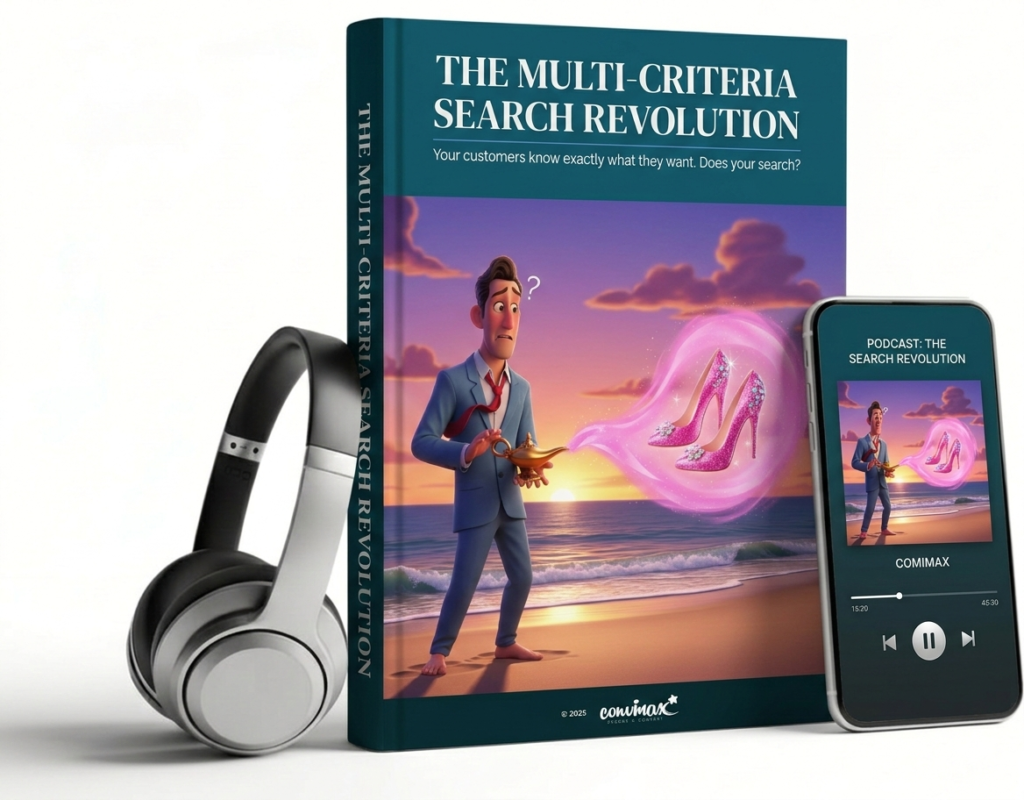
Your complete bundle includes:
  • Audio Podcast
    Listen anywhere. Perfect for learning on the go.
  • Blog Article
    A quick, engaging summary of the key ideas.
  • Detailed Booklet
    A deeper dive with examples and academic findings.
Advanced Search

This isn’t theory. Every recommendation is backed by academic research, field studies, and real-world case studies. You’ll get the full academic citations, the industry benchmarks, and the practical frameworks you need to implement this tomorrow.

This booklet synthesises findings from:
  • Academic and Peer-Reviewed Studies: The articles draw on numerous peer-reviewed journals such as the Journal of Electronic Commerce Research, Journal of Retailing, and ScienceDirect. These include systematic literature reviews and theses, such as a study from Jumia Kenya that confirms a statistically significant relationship between user attention and conversion rates
  • Industry Research and Benchmark Reports: Findings are heavily supported by industry giants and platform data, including reports from Adobe Digital Economy Index, Algolia, Unbounce, and Shopify. These reports provide benchmarks for conversion rates, mobile vs. desktop performance, and the impact of AI-driven traffic
  • Controlled Experiments and A/B Testing: Much of the data comes from randomised controlled trials and A/B testing with 95% confidence levels. The sources mention testing frameworks that analyse specific variables like “actionable grids” and “mobile-optimised faceted trays” to measure their impact on discovery speed and add-to-cart rates
  • Specialised UX Research: Data is frequently cited from leading user experience (UX) institutes, specifically the Baymard Institute and the Nielsen Norman Group. These organisations conduct large-scale usability audits—such as Baymard’s analysis of 123 top e-commerce sites—to identify “Best-in-Class” search features
  • Real-World Case Studies: The sources document specific implementation results from major retailers like Walmart Canada, which saw a 98% increase in mobile orders after a responsive redesign, as well as Lacoste, Decathlon, and Sur La Table
  • Neurophysiological and Psychological Research: To understand the “why” behind user behaviour, the articles reference studies on Cognitive Load Theory (CLT)and neurophysiological experiments, including EEG studies that measure mental workload during shopping tasks
  • Attention Economics and Behavioural Science: Findings are also synthesised from economic working papers, such as those from the National Bureau of Economic Research (NBER), which explore how stable human attention patterns interact with exponentially increasing digital choices

Common Objections

  • “I already know my search needs work – I don’t need an article to tell me that.”
    Knowing something needs improving and knowing what to fix, why it matters, and how to make the case for investment are three different things. This article gives you the evidence, the benchmarks, and the language to turn “our search is a bit rubbish” into a properly costed business case with documented ROI comparisons. That’s the part most people are missing.
  • “This sounds like it’s only relevant to large retailers.”
    The principles apply regardless of catalogue size. In fact, some of the most immediate wins documented in the research come from mid-market and smaller sites – precisely because the baseline is lower and the improvement gap is larger. If you sell more than a handful of products online, this is relevant to you.
  • “I’m not technical enough to implement what’s in the article.”
    The article is not a development manual. It’s a strategic and commercial case for prioritising search, written for people who make decisions – not people who write code. The implementation principles are clear enough to hand to a developer or agency as a brief.
  • “Can’t I find this information for free?”
    You can find fragments of it scattered across dozens of blog posts, vendor whitepapers, and UX guideline pages – if you have the time to read and cross-reference all of them. This article synthesises research from Baymard Institute, Nielsen Norman Group, peer-reviewed academic studies, and documented case studies into a single, coherent argument. The time you’d spend finding and evaluating the sources yourself is worth considerably more than the cost of access.
  • “I’m not sure it’s relevant to my specific sector.”
    The article covers sector-specific differences in detail, including which product categories see the largest uplift from improved search, which see more modest gains, and why. If you’re in fashion, electronics, home goods, food, or beauty – there’s specific data for your context.
  • “What if I read it and it’s not useful?”
    That’s a fair concern. The article is based on evidence, not opinion. If your site has a search function and customers use it, the research applies to you. If you read it and genuinely don’t find a single actionable insight, get in touch.

Copyright © 2026

Privacy policy | Terms of Service