1
Shipping
Where to ship it?

Your cart is currently empty.Continue shopping
Subtotal £0.00
Total £0.00 GBP

Your Information

Order Summary

Product
Total
Subtotal £0.00
Total £0.00 GBP

Payment Information

All transactions are secured and encrypted.

Your personal data will be used to process your order, support your experience throughout this website, and for other purposes described in our privacy policy.

Please note: Results may vary and are not guaranteed.
Due to the digital nature of this product, we do not offer refunds.

  • 256-Bit Bank Level Security
  • 100% Secure Payments
Who This Is For

This article will be most valuable if you:

  • Manage conversion rates for an e-commerce site or digital product
  • Design user experiences and need psychological frameworks that actually work
  • Run a small business and handle your own website optimisation
  • Work as a freelance CRO consultant and need evidence-based strategies for clients
  • Build side projects or digital products and want to maximise every visitor
  • Lead growth for a startup where every percentage point matters
ConviMax Logo

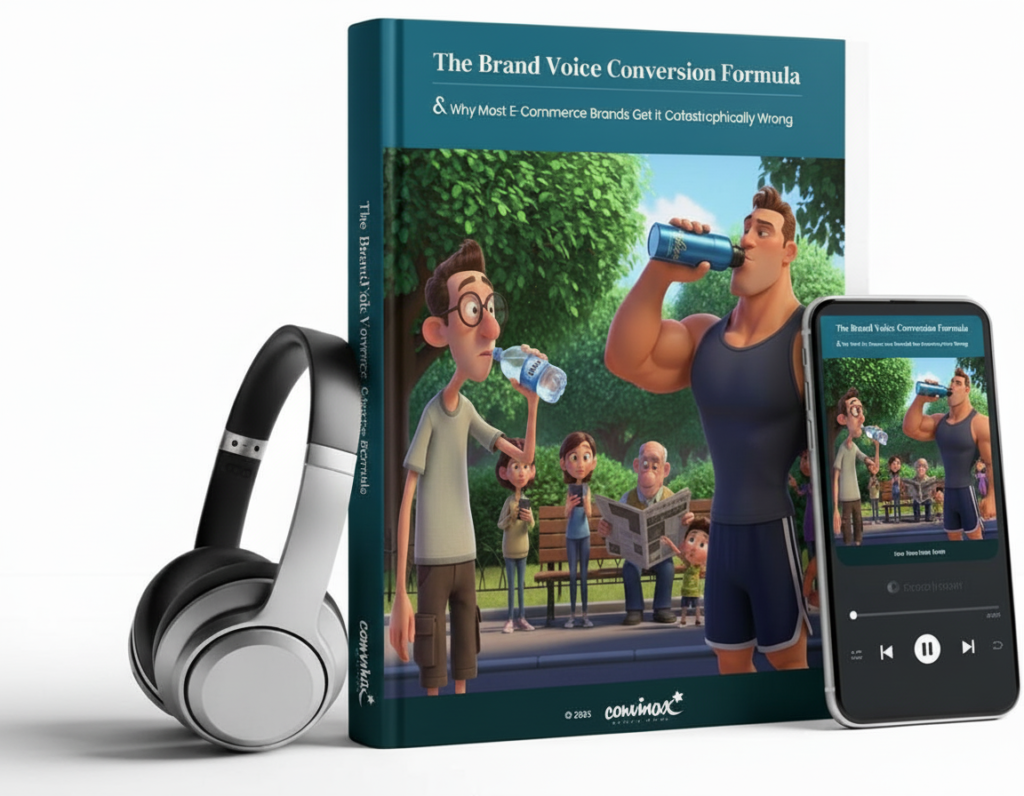
Brand Voice Conversion Formula

Your brand voice is either making you money or losing it. There’s no middle ground.

What You’ll Discover in This Article:
  • Discover how brand voice taps into behavioural science, triggering real physiological responses that increase perceived value and willingness to pay
  • See why a consistent brand voice, “The Amazon Effect”, reduces friction, builds trust, and quietly drives higher conversions across every touchpoint
  • Learn how to adapt your brand voice for mobile, where you have less than a quarter of a second to capture attention and communicate value
  • Uncover the messaging patterns at checkout that reduce hesitation and help recover otherwise lost purchases
  • Explore how language style impacts conversion, from sensory descriptions to simplicity and tone, and how to match it to your category
  • Find out why high-income audiences are often harder to reach online, and how to optimise your messaging for limited attention
  • Get ready-to-use voice variations across CTAs, product descriptions, and emails that are designed to be tested and refined
  • Understand how to run clean, reliable experiments on your messaging, so you can measure what actually drives results and scale with confidence
Your complete bundle includes:
  • Audio Podcast
    Listen anywhere. Perfect for learning on the go.
  • Blog Article
    A quick, engaging summary of the key ideas.
  • Detailed Booklet
    A deeper dive with examples and academic findings.
Brand Voice Conversion Formula

This isn’t theory. Every recommendation is backed by academic research, field studies, and real-world case studies. You’ll get the full academic citations, the industry benchmarks, and the practical frameworks you need to implement this tomorrow.

This booklet synthesises findings from:
  • Targeted Journals: Key insights are extracted from publications such as the Journal of Consumer Research, Journal of Marketing Research, Journal of Retailing, and the International Journal of Research in Marketing
  • Foundational Theories: Research synthesises concepts like Cognitive Load Theory, Grounded Cognition, and Social Presence Theory to explain how brand voice affects the human brain
  • Specialised UX Research: Extensive use is made of the Baymard Institute for checkout and findability benchmarks, and the Nielsen Norman Group for quantifying the impact of tone on trust and desirability
  • Industry Trends: Reports from organisations like McKinsey & Company on personalisation, Adobe on digital trends, and Shopify on conversion benchmarks are central to the analysis
  • Brand Consistency Data: Surveys from firms like Marq (formerly Lucidpress) and Demand Metric quantify the “consistency dividend” in terms of revenue growth
  • Water Labelling Experiments: Multiple studies, including the “AquaCharge” placebo study published in PLOS ONE and representational shift research in BMC Public Health, demonstrate that brand messaging can trigger measurable physiological and psychological responses
  • Linguistic Sound Symbolism: Research into how phonetic structures (voiced vs. voiceless consonants) on labels influence perceptions of carbonation and purity
  • Retail Giants: The synthesis analyses Amazon’s conversion-optimised structure, Nike’s member-first digital voice, and Sephora’s A/B testing on notification messaging
  • Conversion Optimisation Agencies: Data is pulled from compilations by Optimizely, VWO, and SaleCycle, showing specific uplifts from CTA word swaps and abandoned cart recovery campaigns
  • Neuroscience: The reports cite fMRI studies (e.g., the Max Planck Institute’s cola experiment) and EEG measurements to track reward processing and cognitive load during shopping tasks
  • Attention Economics: Research from the National Bureau of Economic Research (NBER) provides an economic modelling framework for how households allocate limited online attention
  • Eye-Tracking: Visual attention patterns, such as the F-shaped and Z-shaped reading patterns, are synthesised from lab studies to determine which textual elements (bullets, titles) users actually read

Common Objections

  • “I’m not sure this will work for my specific niche”
    The solution: The article includes context-dependent frameworks showing how voice strategy varies by category – luxury goods, consumables, electronics, fashion, B2B services. You’ll see which principles apply universally and which require category-specific adaptation. Plus, you’ll get the exact testing methodology to validate what works for YOUR audience.
  • “I don’t have time to read another long-form guide”
    The solution: The article uses bolded subheadings, bulleted key points, and scannable formatting. You can extract the relevant sections for your role (e.g., mobile optimisation for designers, testing protocols for CRO managers) and implement those first. Most readers report finding 2-3 quick wins they can test within a week.
  • “I don’t have budget for extensive A/B testing tools”
    The solution: Many winning tests documented in the article require nothing more than changing button text, rewriting product descriptions, or adapting email copy – no expensive tools needed. Google Optimize (free), Shopify’s native testing, or even manual split testing with UTM parameters can validate these changes.
  • “My boss/client won’t prioritise ‘brand voice’ work”
    The solution: The article provides the business case in hard numbers – £260 billion in recoverable revenue, 23-33% revenue increases, 35% conversion rate improvements. You’ll have the peer-reviewed research citations and documented case studies to justify prioritisation in planning meetings.
  • “What if I pay and it’s not relevant to my situation?”
    The solution: The article covers mobile vs desktop, different product categories, B2C and B2B contexts, checkout optimisation, email marketing, product descriptions, and CTA testing. If you have customers reading words before buying, it’s relevant. If you’re still unsure after reading, contact us within 14 days for a full refund – no questions asked.
  • “I’m just starting out – is this too advanced?”
    The solution: The article includes a phased implementation plan (Week 1-2 audit, Week 3-4 define, Week 5-12 test high-impact changes). Early-stage founders often see the biggest lifts because they haven’t optimised voice at all yet. You don’t need a large team or big budget – just systematic implementation of proven principles.
  • “Can’t I just find this research myself for free?”
    The solution: You could spend 40+ hours tracking down studies across JSTOR, ScienceDirect, PubMed Central, Baymard Institute, Nielsen Norman Group, and McKinsey reports, then synthesising findings into actionable e-commerce tactics. Or you could access the distilled, ready-to-implement version now and start testing this week. Your time has value.

Copyright © 2026

Privacy policy | Terms of Service