1
Shipping
Where to ship it?
Your cart is currently empty.Continue shopping
Subtotal £0.00
Total £0.00 GBP

Your Information

Order Summary

Product
Total
Subtotal £0.00
Total £0.00 GBP

Payment Information

All transactions are secured and encrypted.

Your personal data will be used to process your order, support your experience throughout this website, and for other purposes described in our privacy policy.

Please note: Results may vary and are not guaranteed.
Due to the digital nature of this product, we do not offer refunds.

  • 256-Bit Bank Level Security
  • 100% Secure Payments
Who This Is For

This article will be most valuable if you:

  • Manage conversion rates for an e-commerce site or digital product
  • Design user experiences and need psychological frameworks that actually work
  • Run a small business and handle your own website optimisation
  • Work as a freelance CRO consultant and need evidence-based strategies for clients
  • Build side projects or digital products and want to maximise every visitor
  • Lead growth for a startup where every percentage point matters
ConviMax Logo

The Endowed Progress Effect

You’re optimising the wrong thing. While you’re polishing the interface, your customers are making split-second psychological calculations you can’t see. They’re weighing effort against reward, and right now, the effort feels too high.
The real friction isn’t in your checkout flow. It’s in your customer’s head.

What You’ll Discover in This Article:
  • Discover why giving users a head start can increase completion rates, even when the total effort required stays exactly the same
  • Learn where the “too much progress” tipping point lies, and how exceeding it can trigger scepticism instead of motivation
  • See how reframing existing actions as completed steps can create instant momentum and reduce drop-off before the process even begins
  • Uncover why progress indicators are essential for mobile users, helping reduce friction and keep distracted users moving forward
  • Understand how progress taps into reward systems in the brain, creating a natural drive to finish what’s already been started
  • Find out how pre-filled data can act as perceived progress, making users feel like the process is already underway
  • Explore why progress needs a clear justification, and how the right explanation can turn a simple tactic into a trust-building moment
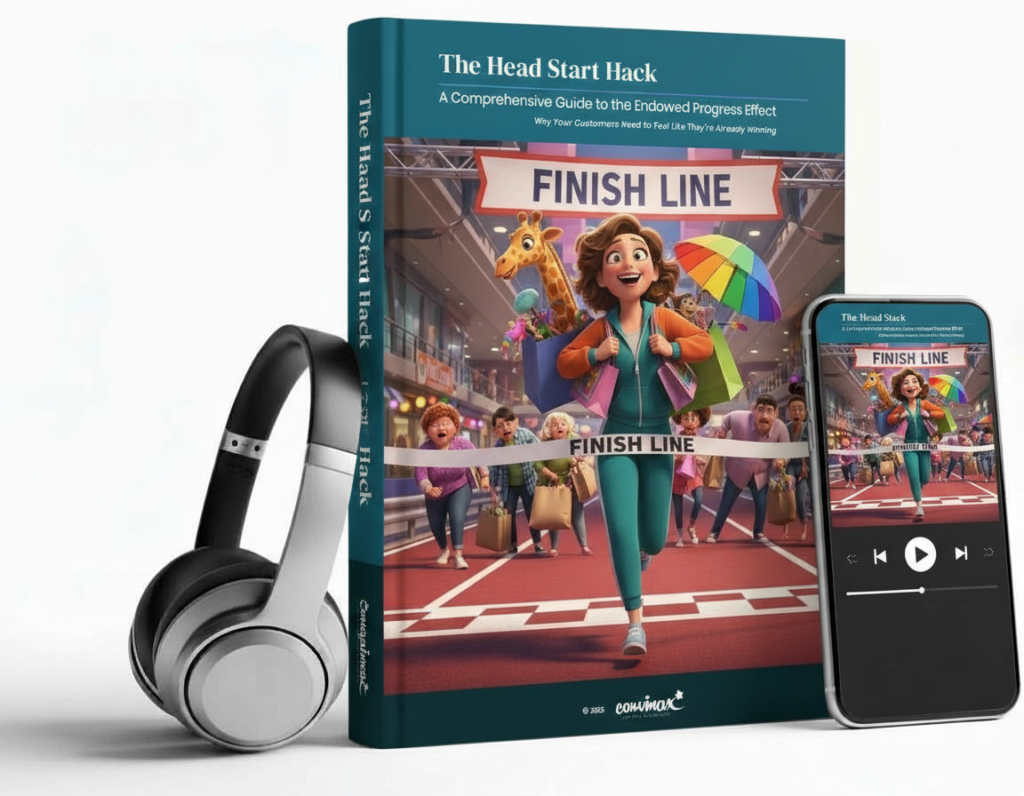
Your complete bundle includes:
  • Audio Podcast
    Listen anywhere. Perfect for learning on the go.
  • Blog Article
    A quick, engaging summary of the key ideas.
  • Detailed Booklet
    A deeper dive with examples and academic findings.
Comprehensive Guide to the Endowed Progress Effect

This isn’t theory. Every recommendation is backed by academic research, field studies, and real-world case studies. You’ll get the full academic citations, the industry benchmarks, and the practical frameworks you need to implement this tomorrow.

This booklet synthesises findings from:
  • The Original Theory: The foundational 2006 study by professors Nunes and Drèze is cited extensively as the core evidence for the effect
  • Broad Scientific Database: Insights are drawn from major academic databases, including ScienceDirect, JSTOR, and Google Scholar
  • Canonical Field Experiment: The most cited example is a field experiment involving 300 car wash customers, which used a “10-stamp vs. 8-stamp” loyalty card system to prove that artificial progress increases completion rates
  • Laboratory Tests: Findings include data from lab studies and eyetracking experiments used to determine how users scan pages (e.g., F-patterns and Z-patterns) and where they focus their visual attention
  • Statistical Synthesis: One analysis reviewed 51 experimental studies, finding a consistent and significant “effect size” (ranging from 0.683 to 1.052), which indicates the practical power of the effect is scientifically reliable
  • Psychological Reviews: The sources cite meta-analyses like Harkin et al. (2016), which examined the impact of progress monitoring on goal attainment
  • Expert UX Heuristics: Research from the Nielsen Norman Group (NN/g) and the Baymard Institute provides the basis for guidelines on cognitive load, visual hierarchy, and checkout friction
  • Performance Benchmarks: The articles incorporate industry-specific conversion data (e.g., Smart Insights or McKinsey) to contrast performance across sectors like Fashion, Electronics, and Food & Beverage
  • E-commerce Giants: Specific implementations and success stories are cited from companies like Starbucks (loyalty stars), Netflix (progress bars for content), Booking.com (funnel optimisation), and Amazon
  • Platform Data: Results from platforms like Shopify and BigCommerce illustrate how smaller retailers achieved conversion lifts (often 15-20%) by applying these principles
  • Neuroscience: Research confirms that progress indicators activate dopamine reward pathways in the brain, providing a biological explanation for increased persistence
  • Attention Economics: Data on “heat maps” and “attention span metrics” (noting users often evaluate a site’s worth in just 1.4 seconds) are used to justify the placement of progress cues
  • Methodological Rigour: Guidance is drawn from statistical experts like Evan Miller and tools from Adobe or Optimizely to define how long tests should run (minimum 2 weeks) and the sample sizes required (at least 1,000 users per variant) to ensure results are not flukes

Common Objections

  • “I’ve read conversion articles before. They never work for my business.”
    Fair point. Most conversion advice is generic rubbish – oversimplified tactics that ignore context, industry, and user psychology.
    This article includes specific implementation guidance for different platforms (mobile, desktop, tablet), industries (fashion, B2B, travel, luxury), and business models (B2C, B2B, SaaS). You’ll know exactly how to adapt the principles to your situation, not just copy what worked for someone else.
  • “I don’t have time to wade through academic research.”
    You don’t have to. We’ve done that part.
    This article synthesises research from multiple academic studies, industry benchmarks, and real-world implementations. You get the findings, the citations (if you want them), and the practical frameworks – without reading 200 pages of academic papers yourself.
  • “I can’t afford expensive testing tools or consultants.”
    The implementation frameworks here are designed for execution, not just theory. You’ll get specific A/B test templates, sample size guidance, and measurement frameworks you can run with standard analytics tools. No enterprise software required.
  • “What if I implement this wrong and it backfires?”
    That’s exactly why this article exists.
    Most implementations of the Endowed Progress Effect fail because people treat it like a trick rather than understanding the psychology. You’ll learn the critical mistakes that turn this powerful principle into user manipulation, and exactly how to implement it authentically – the way that builds trust rather than eroding it.
  • “How do I know this will work for my conversion rate?”
    You don’t. Not yet.
    But you’ll learn the proper testing methodology to find out – including sample size calculators, duration guidelines, and metric selection frameworks. No guessing. No vanity metrics. Just proper scientific validation of what actually moves your numbers.

Copyright © 2026

Privacy policy | Terms of Service