1
Shipping
Where to ship it?
Your cart is currently empty.Continue shopping
Subtotal £0.00
Total £0.00 GBP

Your Information

Order Summary

Product
Total
Subtotal £0.00
Total £0.00 GBP

Payment Information

All transactions are secured and encrypted.

Your personal data will be used to process your order, support your experience throughout this website, and for other purposes described in our privacy policy.

Please note: Results may vary and are not guaranteed.
Due to the digital nature of this product, we do not offer refunds.

Please note: Results may vary and are not guaranteed.
Due to the digital nature of this product, we do not offer refunds.

  • 256-Bit Bank Level Security
  • 100% Secure Payments
Who This Is For

This article will be most valuable if you:

  • Manage conversion rates for an e-commerce site or digital product
  • Design user experiences and need psychological frameworks that actually work
  • Run a small business and handle your own website optimisation
  • Work as a freelance CRO consultant and need evidence-based strategies for clients
  • Build side projects or digital products and want to maximise every visitor
  • Lead growth for a startup where every percentage point matters
ConviMax Logo

Ancillary Placement for Conversion and Order Value

Why Your Upsell Timing Is Killing Conversions (And the Research-Backed Fix Nobody Talks About)
Most e-commerce teams are locked in a debate: show upsells early and risk overwhelming customers, or hold them back until checkout and risk losing the sale altogether.
Both sides argue their case confidently. Both sides cite their own tests. And both sides keep leaving money on the table.
The problem isn’t your timing. It’s that you’re optimising for the wrong thing entirely.
This article – backed by peer-reviewed academic research, benchmarks from 400+ brands, and real-world case studies – reveals the actual reason your ancillary offers underperform. More importantly, it gives you a practical, layered framework you can start using this week.

What You’ll Discover in This Article:
  • The real conversion bottleneck – it’s not your checkout flow, your product range, or your copy. The article reveals what it actually is, and why most teams never address it.
  • A placement strategy that consistently converts at 4-12% – compared to the industry average of 1.9-2.9%. The article reveals where this placement sits and why almost everyone ignores it
  • Why a single interface change increased post-order sales by 20% – no redesign, no new product, no paid media. The article reveals what was changed and the psychological reason it works
  • The device divide that’s costing you revenue – mobile makes up 75% of e-commerce traffic. The article reveals why the gap between mobile and desktop conversion isn’t a design problem, and what’s really going on
  • How reducing options by 75% can increase conversions by 10x – a well-known study proves this, yet most product pages still get it catastrophically wrong. The article reveals the number that separates helpful curation from decision paralysis
  • Why 51% of leading e-commerce sites are actively harming their own UX – the article reveals the specific design pattern responsible, and it’s probably on your site right now
  • The B2B timing mistake that’s uniquely damaging – if you sell to businesses, the article reveals why copying B2C upsell strategies doesn’t just underperform – it actively damages your relationships
  • The “Paradox of Choice”: Why Less is Literally 10x More
  • The “Continuing Journey” Trick: How to Boost Sales by 20% Post-Purchase
  • The “Mindset Split”: Mobile Users are Psychologically Different People
  • The “Horizontal Tab” Blindness: A UX Error Hiding in Plain Sight
  • The “Magic Number” for Working Memory
  • The “B2B Blindspot”: Why Transactional Tactics Kill Relational Sales
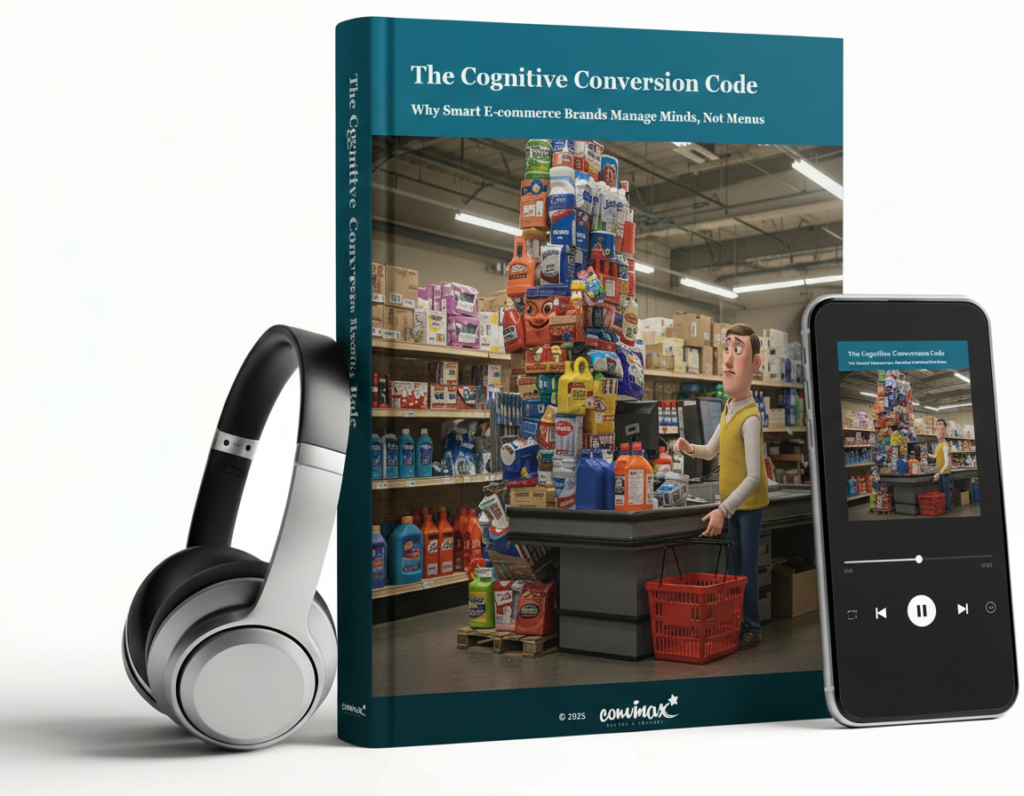
Your complete bundle includes:
  • Audio Podcast
    Listen anywhere. Perfect for learning on the go.
  • Blog Article
    A quick, engaging summary of the key ideas.
  • Detailed Booklet
    A deeper dive with examples and academic findings.
Ancillary Options Placement

This isn’t theory. Every recommendation is backed by academic research, field studies, and real-world case studies. You’ll get the full academic citations, the industry benchmarks, and the practical frameworks you need to implement this tomorrow.

This booklet synthesises findings from:
  • Cognitive Load Theory (CLT): The sources rely heavily on the foundational work of John Sweller, citing over 30 years of empirical studies in educational psychology and e-commerce applications
  • Behavioural Economics and Psychology: Research into the “Paradox of Choice” (specifically the 24-variety vs. 6-variety jam study) and “Decision Fatigue” is central to the articles’ arguments
  • Peer-Reviewed Journals: Findings are drawn from high-impact journals such as the Journal of Marketing Research, ScienceDirect, MDPI Education Sciences, and the National Bureau of Economic Research (NBER)
  • Massive Transactional Data: The articles utilise 2025 benchmarks from Dynamic Yield, which analysed over 200 million monthly users across 400+ global brands
  • Industry Reporting Bodies: Data on global conversion rates and device performance is synthesised from Smart Insights, IRP Commerce, Adobe Digital Economy Index, and McKinsey & Company
  • Platform-Specific Metrics: Performance data is derived from major e-commerce platforms like Shopify, as well as specialised apps like ReConvert, Zipify, and CartHook
  • The Baymard Institute: A primary source for the articles is the Baymard Institute’s database, which includes 150,000+ hours of large-scale UX testing regarding visual hierarchy and product page performance
  • Visual Attention Studies: The research incorporates eye-tracking literature and usability findings from the Nielsen Norman Group to understand how users perceive horizontal tabs versus vertical sections
  • Global Brand Analysis: The articles synthesise the success (and failure) of tactics used by major retailers like Amazon (specifically their “Frequently Bought Together” algorithm), Walmart, and Guosto
  • Controlled A/B Testing Results: Specific case studies are cited from brands like Obvi, Metals4U, and Kaplan, showcasing quantitative boosts in conversion from simplifying choices or adding urgency
  • Rigorous Testing Frameworks: The sources provide practical guidance based on standard statistical tools, such as Evan Miller’s A/B tools, emphasising the need for 95% significance and 80% power in experiments

Common Objections

  • “I can find this kind of advice for free online.”
    You can find opinions for free. What you’ll find here is a synthesis of peer-reviewed academic studies, large-scale industry benchmarks, and real case studies – cross-referenced and distilled into a practical framework. The difference between generic advice and evidence-backed strategy is the difference between guessing and knowing.
  • “I don’t have time to read a long article.”
    The article is designed to be skimmable. Key findings are clearly signposted. There’s an audio version if you’d rather listen. Most readers get the core framework in under 15 minutes.
  • “I’ve read plenty of conversion articles and nothing ever changes.”
    Most conversion content tells you what to test. This article tells you why certain placements work, grounded in cognitive science. When you understand the mechanism, not just the tactic, you make better decisions across every campaign – not just this one.
  • “I’m not sure it applies to my business.”
    The framework covers B2C and B2B, mobile and desktop, physical products and digital goods. There’s an industry-specific section that addresses fashion, beauty, electronics, home goods, food and SaaS separately. If you sell online, it applies.
  • “What if it’s not worth it?”
    If a single insight from this article improves your average order value by even a fraction of a percent, the purchase pays for itself many times over. That’s not a promise – it’s basic maths.

Copyright © 2026

Privacy policy | Terms of Service