1
Shipping
Where to ship it?
Your cart is currently empty.Continue shopping
Subtotal £0.00
Total £0.00 GBP

Your Information

Order Summary

Product
Total
Subtotal £0.00
Total £0.00 GBP

Payment Information

All transactions are secured and encrypted.

Your personal data will be used to process your order, support your experience throughout this website, and for other purposes described in our privacy policy.

Please note: Results may vary and are not guaranteed.
Due to the digital nature of this product, we do not offer refunds.

  • 256-Bit Bank Level Security
  • 100% Secure Payments
Who This Is For

This article will be most valuable if you:

  • Manage conversion rates for an e-commerce site or digital product
  • Design user experiences and need psychological frameworks that actually work
  • Run a small business and handle your own website optimisation
  • Work as a freelance CRO consultant and need evidence-based strategies for clients
  • Build side projects or digital products and want to maximise every visitor
  • Lead growth for a startup where every percentage point matters
ConviMax Logo

Buy-Now-Pay-Later Optimisation

Your Brain Is Being Hacked: The Surprising Science of Why “Add to Cart” No Longer Feels Like Spending
Your conversion rate is stuck. You’ve optimised headlines, tested button colours, streamlined checkout – and you’re still watching 70% of carts abandon.
Meanwhile, brands in your sector are seeing 20-30% conversion lifts and 30-50% higher order values. Same products. Same traffic sources. Different checkout experience.
The difference? They’re using Buy Now, Pay Later as a psychological conversion tool, not just a payment option. And they’re implementing it based on research most marketing teams will never see.

What You’ll Discover in This Article:
  • Why BNPL reduces the “pain of paying” (backed by fMRI brain scans)
  • How temporal discounting makes future payments feel less real
  • The cognitive load theory that explains mobile conversion gaps
  • Which reference points actually shift purchase behaviour
  • Stripe’s controlled experiments across 150,000+ checkout sessions
  • Journal of Consumer Research pre-registered studies
  • Klarna merchant case studies with real revenue numbers
  • Academic difference-in-differences analysis from large US retailers
  • Federal Reserve consumer behaviour research
  • Three-variant testing protocol (with statistical significance requirements)
  • Where to display BNPL messaging for maximum impact (hint: not just checkout)
  • Mobile vs desktop strategy differences
  • Metrics that matter (and guardrails that protect margin)
  • Real conversion and AOV benchmarks by industry
  • Consumer debt concentration data
  • Return rate impacts
  • When BNPL actually cannibalises existing payments (and when it doesn’t)
  • Regulatory considerations you need to know
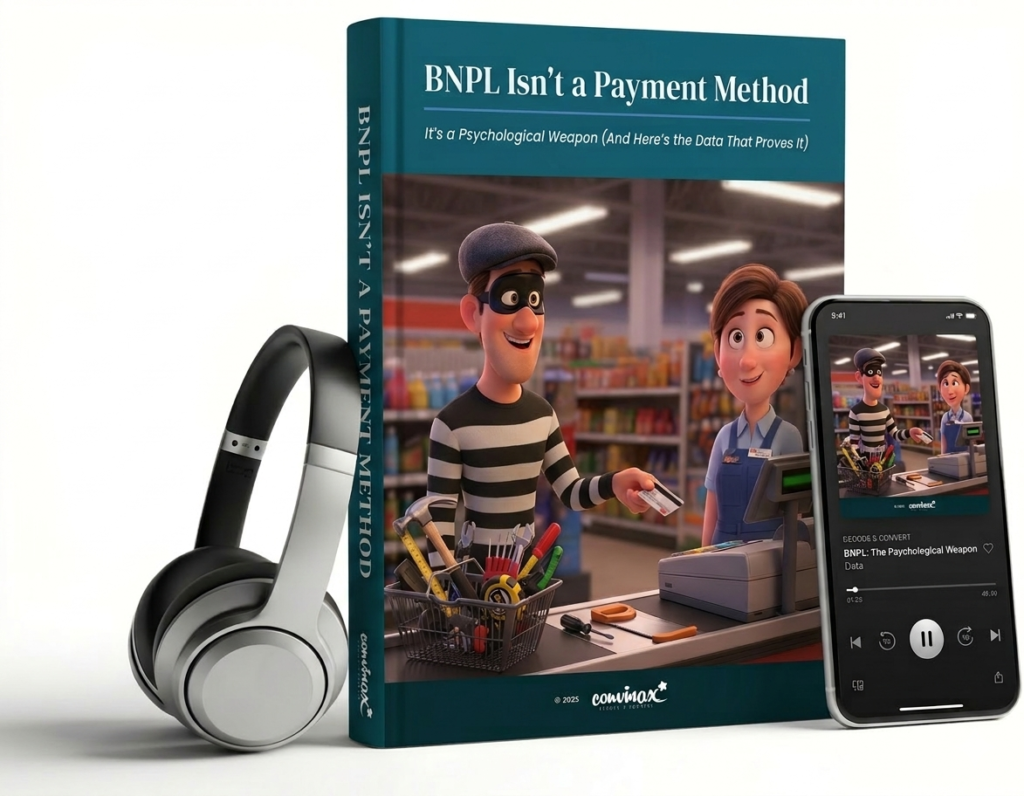
Your complete bundle includes:
  • Audio Podcast
    Listen anywhere. Perfect for learning on the go.
  • Blog Article
    A quick, engaging summary of the key ideas.
  • Detailed Booklet
    A deeper dive with examples and academic findings.
Buy Now Pay Later

This isn’t theory. Every recommendation is backed by academic research, field studies, and real-world case studies. You’ll get the full academic citations, the industry benchmarks, and the practical frameworks you need to implement this tomorrow.

This booklet synthesises findings from:
  • Causal Inference & Transaction Logs: Researchers use difference-in-differences (DiD) models to analyse multi-year retailer transaction logs, proving a direct link between BNPL adoption and increased purchase frequency
  • Neuroscience Research: Findings are supported by fMRI brain imaging studies that measure activation in the parietal cortex and right insula to track the physical “pain of paying”
  • Cognitive Load & Eye-Tracking: Controlled laboratory experiments use eye-tracking to observe how instalment pricing acts as a visual anchor and reduces decision fatigue
  • Working Papers: Economic insights are sourced from institutions like the National Bureau of Economic Research (NBER) and Harvard Business School
  • Major Payment Gateways: Analysis of over 150,000 checkout sessions from Stripe and data from platforms like Shopify and BigCommerce
  • Market Analysis Firms: Reports from McKinsey, Accenture, and RBC Capital Markets track global adoption trends and merchant performance
  • UX Research Institutes: Usability benchmarks from the Baymard Institute and Nielsen Norman Group regarding cart abandonment and checkout friction
  • Timing Experiments: Studies testing the difference between showing BNPL pricing early (on Product Detail Pages) versus only at checkout
  • Multi-Variant Tests: Three-arm experiments (control vs. badge-only vs. full integration) measuring immediate metrics like Add-to-Cart (ATC) rates and long-term Customer Lifetime Value (LTV)
  • The Federal Reserve: Research from the Richmond, Kansas City, and Boston Feds, including the Survey of Household Economics and Decisionmaking (SHED)
  • Regulatory Audits: Policy briefs and design audits from the Consumer Financial Protection Bureau (CFPB) and the Financial Conduct Authority (FCA)
  • Fashion & Beauty: Metrics from brands like ASOS, Zara, Sephora, and MAC Cosmetics
  • High-Ticket Items: Implementations by Amazon, Apple, Best Buy, and Expedia to evaluate BNPL’s impact on expensive categories
  • Niche Markets: Performance results from smaller specialised retailers like Ninepine and Ditur

Common Objections

  • “Can’t I just Google this for free?”
    You can spend 40+ hours reading through academic journals, industry reports, Federal Reserve briefs, and provider case studies – then another 20 hours validating what’s credible versus marketing fluff. Or you can read our synthesis in 18 minutes. Your hourly rate makes this decision obvious.
  • “I’m not sure BNPL applies to my business”
    The research covers fashion, electronics, home goods, travel, SaaS, and more. The psychological principles (pain of paying, temporal discounting, cognitive load) apply across categories. The implementation chapter shows you how to adapt the strategy to your specific context.
  • “What if I read it and it doesn’t work for me?”
    Fair question. The article includes the exact testing protocol used by Stripe and validated by academic researchers. You’ll know within 2-4 weeks whether BNPL lifts your conversions. If the research doesn’t give you a clear go/no-go decision framework, we’ve failed. (Spoiler: it will.)
  • “I can’t justify spending on a single article right now”
    If a 20% conversion lift sounds useful, this article pays for itself with approximately 2-3 additional orders. The case studies section alone includes revenue-per-visitor uplifts worth thousands. You’re not buying an article – you’re buying the shortcut to a decision that could reshape your checkout performance.
  • “I’m worried about overwhelming my customers with debt”
    Good. The research includes Federal Reserve data on consumer financial vulnerability and BNPL usage patterns. There’s an entire section on responsible implementation, including which customer segments show elevated risk and how to monitor downstream impacts. Making an informed, ethical decision requires understanding both the upside and the risks.
  • “My current payment provider doesn’t offer BNPL”
    The article explains the difference between provider-agnostic strategy (which psychology to leverage, where to message, what to test) and provider-specific tactics. You’ll understand what matters before you choose a provider – which means you’ll negotiate better terms and implement smarter.

Copyright © 2026

Privacy policy | Terms of Service