1
Shipping
Where to ship it?
Your cart is currently empty.Continue shopping
Subtotal £0.00
Total £0.00 GBP

Your Information

Order Summary

Product
Total
Subtotal £0.00
Total £0.00 GBP

Payment Information

All transactions are secured and encrypted.

Your personal data will be used to process your order, support your experience throughout this website, and for other purposes described in our privacy policy.

Please note: Results may vary and are not guaranteed.
Due to the digital nature of this product, we do not offer refunds.

  • 256-Bit Bank Level Security
  • 100% Secure Payments
Who This Is For

This article will be most valuable if you:

  • Manage conversion rates for an e-commerce site or digital product
  • Design user experiences and need psychological frameworks that actually work
  • Run a small business and handle your own website optimisation
  • Work as a freelance CRO consultant and need evidence-based strategies for clients
  • Build side projects or digital products and want to maximise every visitor
  • Lead growth for a startup where every percentage point matters
ConviMax Logo

Complementary Upsell Strategies

The “Post-Purchase Dopamine” Secret:
You’re hitting customers with modal popups during checkout – when their cognitive load is already maxed out. You’re asking them to make more decisions when they’re mentally exhausted from filling out forms and reviewing their order.
Or worse: you’re not presenting complementary offers at all because you’ve heard they “hurt conversion rates.”
Both approaches are costing you money. Real money. The kind that compounds month after month.

The truth? There’s a specific moment in the customer journey where upsells convert at 5-6 times the typical rate. Where acceptance rates hit 28% instead of 5%. Where you can increase Average Order Value by 30-50% without touching your primary conversion rate.
Most brands never find it. Most marketing advice on upselling is either outdated, anecdotal, or flat-out wrong.

What You’ll Discover in This Article:
  • The exact psychological window: where upsells convert at 5-6x normal rates (with the neuroscience explaining why)
  • Why desktop and mobile require completely different upsell strategies: And what to do on each
  • The cognitive load research: Shows why your current checkout upsells are probably killing conversions
  • Platform-specific implementation plans: desktop e-commerce, mobile web, apps, SaaS/subscriptions
  • The pricing and relevance thresholds that determine whether customers say yes or bounce
  • Real numbers: conversion rates, acceptance rates, and AOV impacts from documented tests
  • Bundle strategies that reduced decision complexity while increasing revenue by 55-86%
  • The modal overlay timing framework: When they work vs when they destroy trust
  • Device-specific conversion data and what it means for your upsell placement
  • The “Dopamine Window” is Real: Revealing neurological research and where the sweet spot should be
  • When and where do you get to profound “modal fatigue”
  • The “Asymmetry” Rule: A little-known technical secret used by giants like Amazon is asymmetric complementarity
  • Data suggests there is a specific pricing “sweet spot” for upsells, shown to achieve a 16.2% conversion rate with a 31.4% revenue lift, outperforming both cheaper and more expensive items
  • More Choice = Less Money
  • Form Fields are Deadlier than Steps
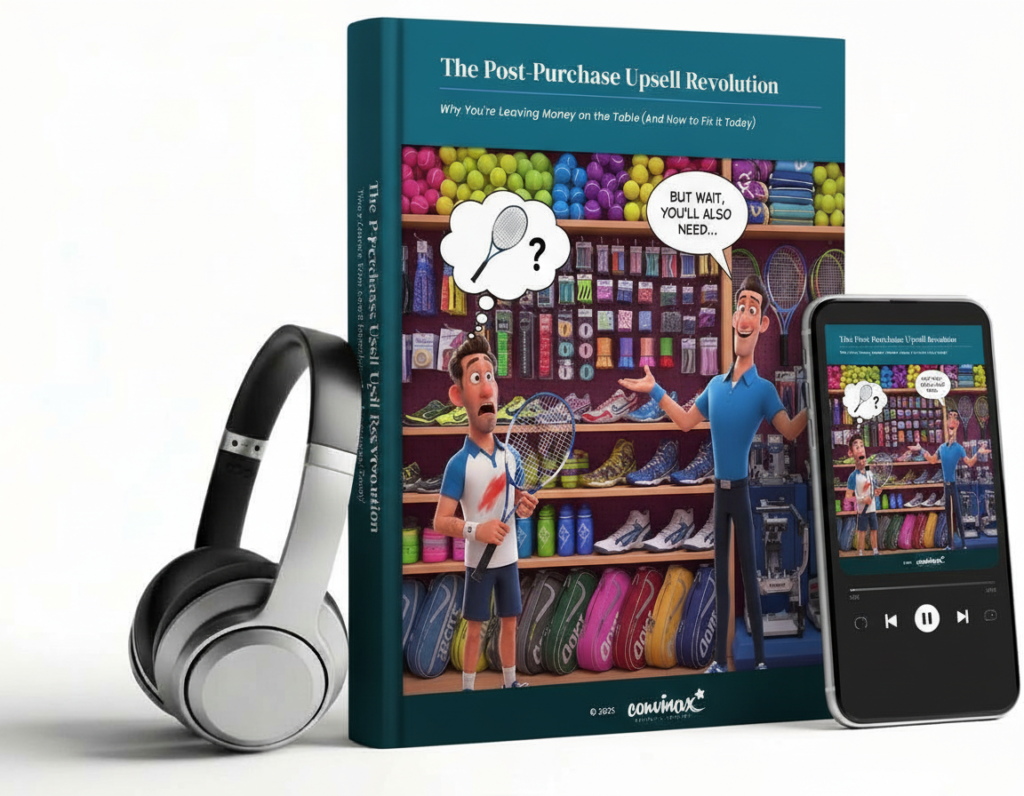
Your complete bundle includes:
  • Audio Podcast
    Listen anywhere. Perfect for learning on the go.
  • Blog Article
    A quick, engaging summary of the key ideas.
  • Detailed Booklet
    A deeper dive with examples and academic findings.
Complementary Upsell

This isn’t theory. Every recommendation is backed by academic research, field studies, and real-world case studies. You’ll get the full academic citations, the industry benchmarks, and the practical frameworks you need to implement this tomorrow.

This booklet synthesises findings from:
  • Meta-Analyses: Comprehensive reviews of existing research, such as the Chernev, Böckenholt & Goodman meta-analysis of 99 observations regarding choice overload
  • Behavioural Economics and Psychology: Studies in journals like the Journal of Consumer Research and the Journal of Marketing Research explore principles like Nudge Theory, Ego Depletion, and Commitment Bias
  • Cognitive Science: Research into Cognitive Load Theory, including studies utilising electroencephalography (EEG) to measure brain activity during shopping scenarios
  • Technical Papers: Systematic reviews from arXiv analysing over 142 million products to model recommendation algorithms via graph neural networks
  • UX Research Labs: Extensive data from the Baymard Institute (based on over 200,000 hours of testing) and the Nielsen Norman Group regarding modal fatigue and checkout friction
  • Market Intelligence Firms: Reports and benchmarks from Forrester Research, Gartner, McKinsey & Company, and Statista provide global e-commerce statistics and conversion benchmarks
  • Platform-Specific Data: Aggregated analytics from Shopify, BigCommerce, and Salesforce
  • App and Vendor Reports: Real-world performance data from specialised tools like ReConvert, Zipify, and Klaviyo, which report on millions of actual transactions to establish “one-click” conversion benchmarks
  • Experimental Frameworks: Randomised controlled trials (RCTs) and A/B tests with a 95% confidence level gold standard
  • Variant Testing: Comparative analyses between different presentation methods, such as modal vs. on-page displays or monthly vs. annual plan nudges
  • Retail Giants: The “Amazon Playbook” is frequently cited, noting that 35% of their revenue stems from recommendation engines
  • Global Corporations: Documented results from Apple, Nike, Walmart, Booking.com, and Alaska Airlines
  • DTC and Niche Brands: Quantifiable ROI increases from brands like DockATot (55% AOV lift), Toy Shades, and Just Sunnies
  • SaaS/Subscription Services: Implementation data from Netflix, Spotify, and Slack

Common Objections

  • “I’ve tried upsells before and they didn’t work.”
    Most upsells fail because of poor timing and placement – not because the concept doesn’t work. The research in this article shows exactly why timing matters and where the high-conversion window actually is. You’ll learn what you got wrong and how to fix it.
  • “I don’t want to seem pushy or harm my brand.”
    The article specifically addresses this. You’ll learn the difference between value-adding complementary offers (which customers appreciate) and aggressive sales tactics (which destroy lifetime value). There’s actual psychological and usability research on where this line sits.
  • “I’m worried it will hurt my conversion rate.”
    This is the most common objection, and it’s covered extensively. You’ll see the data on which upsell placements carry zero risk to primary conversion (because the transaction is already complete) and which ones add friction. The framework helps you avoid the tactics that harm conversion.
  • “I don’t have the technical skills to implement this.”
    The action plan includes specific app recommendations for major platforms (Shopify, WooCommerce, etc.) that make this plug-and-play. You don’t need to code. You need to understand the strategy and configure the tools correctly.
  • “This seems expensive for one article.”
    Consider what a 10% increase in Average Order Value means for your business. If you process £50,000/month, that’s £5,000 in additional monthly revenue. £60,000 annually. This article costs less than you’ll spend on coffee this month – and it could fundamentally change how you monetise your existing traffic.
  • “I can probably find this information for free.”
    You could spend 40+ hours researching cognitive psychology papers, usability studies, platform data, and case studies across multiple sources. Or you could get the synthesis, framework, and action plan in one evidence-based article written by someone who’s already done that work. Your time has value.
  • “What if it doesn’t work for my specific business?”
    The article covers multiple verticals (physical products, digital products, SaaS, subscriptions) and provides device-specific strategies (desktop, mobile web, apps). The psychological principles are universal. The implementation tactics are adaptable. If you have an e-commerce checkout, these principles apply.
  • “I’m just one person – can I really implement this?”
    The 48-hour action plan is designed for exactly this scenario. You don’t need a team. You need clarity on what to do first, which apps to use, and how to measure results. That’s what you’re getting.

Copyright © 2026

Privacy policy | Terms of Service