1
Shipping
Where to ship it?
Your cart is currently empty.Continue shopping
Subtotal £0.00
Total £0.00 GBP

Your Information

Order Summary

Product
Total
Subtotal £0.00
Total £0.00 GBP

Payment Information

All transactions are secured and encrypted.

Your personal data will be used to process your order, support your experience throughout this website, and for other purposes described in our privacy policy.

Please note: Results may vary and are not guaranteed.
Due to the digital nature of this product, we do not offer refunds.

  • 256-Bit Bank Level Security
  • 100% Secure Payments
Who This Is For

This article will be most valuable if you:

  • Manage conversion rates for an e-commerce site or digital product
  • Design user experiences and need psychological frameworks that actually work
  • Run a small business and handle your own website optimisation
  • Work as a freelance CRO consultant and need evidence-based strategies for clients
  • Build side projects or digital products and want to maximise every visitor
  • Lead growth for a startup where every percentage point matters
ConviMax Logo

Free Shipping Progress Optimisation

Why Your Brain Makes You Buy More to Get “FREE” Shipping
This is a research-backed breakdown of one specific tactic – the free shipping progress bar – examined through the lens of behavioural economics, real-world A/B testing data, and cross-platform performance analysis.
The article draws on more than 50 academic studies, 14 years of cart abandonment data from the Baymard Institute, and controlled case studies from real e-commerce brands. Then it tells you exactly what to do with all of it.

What You’ll Discover in This Article:
  • How much additional monthly revenue a single UI change generated for one UK fashion brand – and why the mechanism had nothing to do with design
  • Why customers will voluntarily spend more money to avoid a fee that costs less than what they’re spending – and the Nobel Prize-winning science that explains it
  • The precise percentage above your current average order value where your free shipping threshold should sit – and why most brands set it in completely the wrong place
  • What happened when one supplement brand raised its threshold above its product price point – and why the result was the opposite of what common sense would predict
  • Why mobile shoppers behave so differently at the cart stage, and what that means for where and how you display this particular element
  • The psychological effect – backed by a 2006 Journal of Marketing Research study – that causes customers to accelerate their buying behaviour the closer they get to a goal
  • Why one brand tested multiple free shipping bar placements and saw zero improvement – and the specific conditions under which this tactic doesn’t work
  • How a car wash loyalty card experiment from a university research team directly predicts your cart conversion rate
  • The “Head Start” Illusion: The Endowed Progress Effect reveals a controversial but effective tactic: people are significantly more likely to finish a goal if they believe they have already started it
  • The 84% Rule: The Magic of Proximity
    The Goal-Gradient Effect proves that human motivation is not constant; it accelerates as we get closer to a reward. However, this motivation is fragile if the threshold is set too high. This article guides with real-world examples
  • Loss Aversion: The “Pain of Paying” A little-known fact is that the brain processes financial losses roughly twice as intensely as equivalent gains. When a customer sees a shipping fee, their amygdala registers a “loss” or a “tax” for nothing. A progress bar reframes the purchase
  • The Mobile Conversion Trap: EEG research shows mobile users under time pressure have shorter attention spans and are less attentive. Because 50% of a mobile screen often disappears behind a keyboard, mental arithmetic becomes a major conversion killer
  • Don’t Set the Threshold at Your AOV
    A common mistake is setting the free shipping threshold exactly at your current Average Order Value
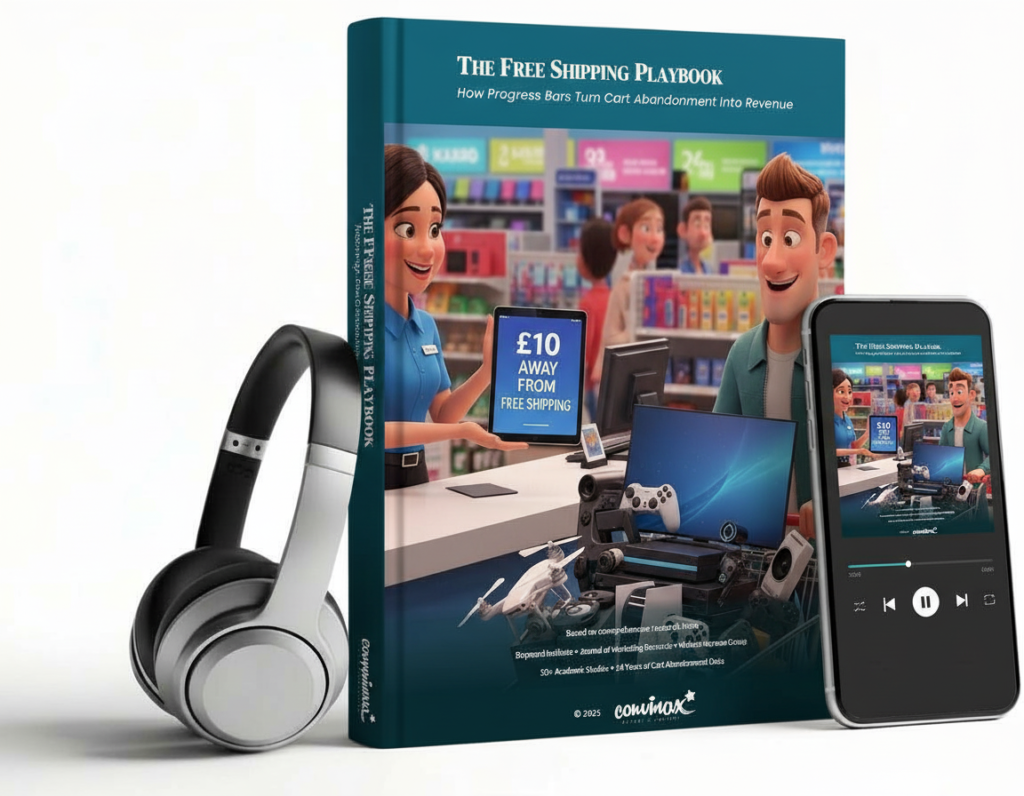
Your complete bundle includes:
  • Audio Podcast
    Listen anywhere. Perfect for learning on the go.
  • Blog Article
    A quick, engaging summary of the key ideas.
  • Detailed Booklet
    A deeper dive with examples and academic findings.
Progress to Free Shipping

This isn’t theory. Every recommendation is backed by academic research, field studies, and real-world case studies. You’ll get the full academic citations, the industry benchmarks, and the practical frameworks you need to implement this tomorrow.

This booklet synthesises findings from:
  • The Goal-Gradient Hypothesis: Research published in the Journal of Marketing Research by Kivetz, Urminsky, and Zheng (2006) provides the primary theoretical basis, proving that consumers accelerate their efforts as they approach a reward
  • The Endowed Progress Effect: Findings from the Journal of Consumer Research (Nunes & Drèze, 2006) demonstrate that perceived “head starts” increase the likelihood of goal completion
  • Cognitive Load and Decision Science: Studies from the Journal of Consumer Psychology and ScienceDirect examine how information overload and decision fatigue impact e-commerce conversions
  • Behavioural Economics: The sources draw on Nobel-prize-winning research from Richard Thaler and Kahneman & Tversky regarding Loss Aversion and the Zero Price Effect
  • Usability Testing: The Baymard Institute is cited extensively for its 14-year meta-analysis of checkout usability, which involved over 272 test subjects and 50 aggregated studies
  • User Experience (UX) Standards: Research from the Nielsen Norman Group (NNg) is used to establish best practices for visual hierarchy and “visibility of system status”
  • Consumer Expectations: Large-scale surveys such as the UPS “Pulse of the Online Shopper” and the National Retail Federation (NRF) Consumer View report provide data on shopper behaviour and shipping expectations
  • Platform Data: Statistics from e-commerce giants and service providers like Shopify, BigCommerce, Klaviyo, and Adobe Analytics are used to establish industry conversion and AOV benchmarks
  • Swanky Agency: Conducted 14-day A/B tests on dynamic banners, reporting a 32% improvement in net profit and specific AOV uplifts across devices
  • Invisible Prime: A controlled A/B test for a mid-size brand documented an 5% lift in AOV specifically due to the addition of a dynamic progress bar
  • Growth Rock (NuFACE Case Study): An A/B test resulting in a 90% increase in orders after implementing a free shipping threshold
  • Eye-Tracking Research: Used to confirm that progress bars capture the most attention when positioned immediately below the header
  • EEG Biosensors: Research using brain-sensing technology reveals how cognitive load increases and attention spans decrease for mobile users under time pressure
  • Brands Analysed: Strategies from companies like Amazon, ASOS, Gymshark, Huel, Nike, and Sephora are cited to illustrate high-impact implementations across different retail verticals
  • Sector-Specific Benchmarks: Data is stratified across industries, including Fashion, Tech, Beauty, and Food/Delivery, to show how progress bar efficacy varies by product type

Common Objections

  • “I already know free shipping increases conversions. Why do I need this?”
    Knowing that it works and knowing why it works, where to set the threshold, how to position the bar, and when it will fail are four entirely different things. This article covers all four with data you can act on, including the conditions under which the tactic backfires and what to do instead.
  • “I can find this kind of information for free.”
    Some of it, yes. But aggregating 50 academic studies, cross-referencing them against real A/B test outcomes, and translating the findings into a clear implementation framework takes hours. This article does that work for you in a single, structured read. Your time has a cost too.
  • “How do I know the research is credible?”
    The article cites primary sources throughout – the Baymard Institute, the Journal of Marketing Research, and the work of behavioural economists including Kahneman and Tversky. It also distinguishes clearly between Tier 1 academic evidence and practitioner case studies, so you always know the weight to give each finding.
  • “My store is different. This might not apply to me.”
    The article addresses this directly. It identifies the specific business types, product categories, and price points where this tactic performs strongly – and the scenarios where it doesn’t. You’ll know within the first few pages whether it applies to your situation.
  • “I don’t have time to read a long article.”
    It’s structured to be skimmable. Key findings are called out clearly. There’s a concise takeaways section if you need the headlines fast, and a full implementation checklist if you’re ready to act. Read it in 15 minutes or go deep in 30. Either way, you leave with something useful.
  • “I’m not sure the price is worth it.”
    If the article helps you increase your average order value by even a modest percentage, or reduces cart abandonment enough to recover a handful of lost sales per week, it pays for itself quickly. The research cited in the article includes documented revenue uplifts from a single implementation. The question isn’t whether the information has value – it’s whether you’ll use it.

Copyright © 2026

Privacy policy | Terms of Service