1
Shipping
Where to ship it?
Your cart is currently empty.Continue shopping
Subtotal £0.00
Total £0.00 GBP

Your Information

Order Summary

Product
Total
Subtotal £0.00
Total £0.00 GBP

Payment Information

All transactions are secured and encrypted.

Your personal data will be used to process your order, support your experience throughout this website, and for other purposes described in our privacy policy.

Please note: Results may vary and are not guaranteed.
Due to the digital nature of this product, we do not offer refunds.

  • 256-Bit Bank Level Security
  • 100% Secure Payments
Who This Is For

This article will be most valuable if you:

  • Manage conversion rates for an e-commerce site or digital product
  • Design user experiences and need psychological frameworks that actually work
  • Run a small business and handle your own website optimisation
  • Work as a freelance CRO consultant and need evidence-based strategies for clients
  • Build side projects or digital products and want to maximise every visitor
  • Lead growth for a startup where every percentage point matters
ConviMax Logo

Personalised Cross-Selling

Intro paragrapg.

What You’ll Discover in This Article:
  • A specific case study shows a 259% increase in AOV within a single month. The article reveals why this result had almost nothing to do with the technology used – and everything to do with one fundamental shift in approach
  • One metric that most CRO teams obsess over is essentially meaningless as a measure of cross-sell performance. The article reveals which metric to track instead, and why the popular alternative is leading teams to the wrong conclusions
  • A landmark study of 184,375 users found that a specific type of cross-selling algorithm produced a 192.9% increase in cross-sell conversion rate. The article reveals what that algorithm did differently – and how smaller sites can apply the same logic without enterprise-level budgets
  • There is a precise moment in the customer journey where a cross-sell suggestion costs you zero friction. The article reveals exactly when it is, why it works psychologically, and why the majority of e-commerce sites skip it entirely
  • Desktop versus mobile conversion rates are not as far apart as most industry benchmarks suggest – but the behaviour patterns are dramatically different. The article reveals what that means for how, where and when you should be showing recommendations on each device
  • Cognitive psychology research establishes a specific threshold for how many recommendations you should ever show at once. The article reveals the number, why exceeding it actively harms conversions, and the neuroscience behind it
  • A study of 243,000 consumers found a content-based intervention that outperformed a direct price reduction. The article reveals what that intervention was, why it works, and how to apply it to your own product pages
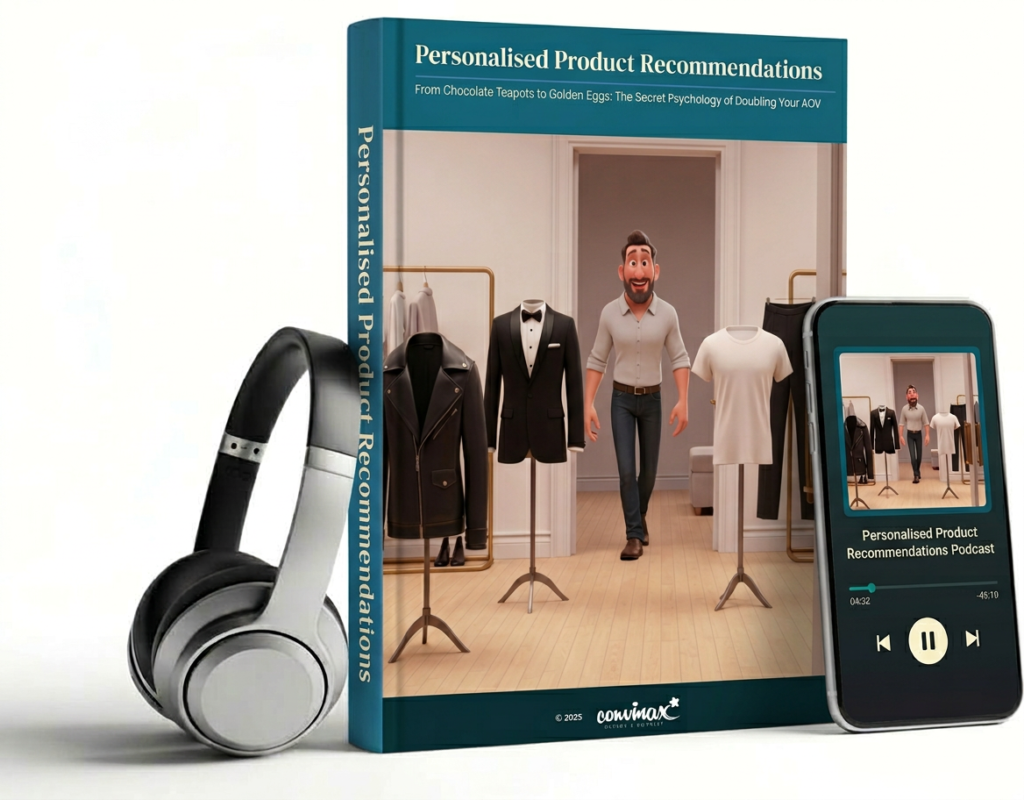
Your complete bundle includes:
  • Audio Podcast
    Listen anywhere. Perfect for learning on the go.
  • Blog Article
    A quick, engaging summary of the key ideas.
  • Detailed Booklet
    A deeper dive with examples and academic findings.
Personalised Cross-Selling

This isn’t theory. Every recommendation is backed by academic research, field studies, and real-world case studies. You’ll get the full academic citations, the industry benchmarks, and the practical frameworks you need to implement this tomorrow.

This booklet synthesises findings from:
  • Cognitive Psychology & Behavioural Economics: Findings on Cognitive Load Theory and Decision Fatigue are based on foundational research by John Sweller and meta-analyses of choice overload from sources like ScienceDirect and Oxford Academic
  • Attention Economics: Research from the National Bureau of Economic Research (NBER) is used to define attention as a scarce resource for which firms compete
  • Specific University Studies: A Carnegie Mellon University randomised field experiment (published in Management Science) involving 184,375 users provided data on how recommender systems increase conversion rates by 7.5%
  • Large-Scale Observational Data: The Liu et al. (2017) study synthesised data from 243,000 UK consumers across 600 categories to measure the impact of content reordering on sales
  • The Baymard Institute: Provides large-scale UX benchmarking and usability testing across thousands of pages to determine optimal placement for cross-sell widgets
  • Nielsen Norman Group (NN/g): Used for eye-tracking lab studies that established the “1.4-second scan rule” and the effectiveness of above-the-fold recommendations
  • McKinsey & Company: Cited for industry-wide benchmarks, such as the finding that 35% of Amazon’s purchases are driven by its recommendation engine
  • Meta-Analysis of Experiments: Data from Growth Rock synthesised results from over 200 A/B experiments, revealing an average £55 increase in AOV with 90-95% statistical significance
  • A/B Testing Frameworks: Best practices are synthesised from testing platform documentation, including Optimizely, AB Tasty, and CXL, focusing on Minimum Detectable Effect (MDE) and sample size calculations
  • Retail Giants: The Adidas case study (via Emarsys/SAP) shows a 259% AOV increase within one month
  • Streaming Services: The Netflix model is used to demonstrate how 80% of consumption can be driven by personalisation
  • E-Commerce Platforms: Aggregated data from Shopify, Klaviyo, and Barilliance provides benchmarks for device-specific performance, such as tablet conversion rates peaking at 3.1%
  • Performance Benchmarking: Data from EMARKETER, Statista, and Adobe Analytics are used to contrast desktop and mobile conversion behaviours
  • Mobile-First Research: Studies on the “cross-device journey” highlight that 77% of users search on mobile while in-store, even if they finish the purchase on a desktop

Common Objections

  • “I can find this kind of thing free on Google.” You can find fragments of it. What you won’t find – in one place, synthesised coherently and grounded in peer-reviewed research rather than vendor marketing – is a framework that connects cognitive psychology, device behaviour, placement strategy and testing methodology into something actionable. This isn’t a round-up of tips. It’s a structured argument, with evidence.
  • “I’m not sure it’s relevant to my specific industry or product type.” The research drawn upon covers 600 product categories across 243,000 consumers. The psychological principles at the core – cognitive load, decision fatigue, attention economics – apply regardless of whether you sell software, fashion, electronics, homeware or anything in between. The framework is transferable. You apply it to your context.
  • “I’ve read about cross-selling before. I probably know most of this.” Most cross-sell content covers the same surface-level advice – “show complementary products,” “use social proof,” “test your placements.” This article goes deeper. It covers the specific cognitive thresholds that determine how many products to show, the precise moments in the customer journey where recommendations work and where they backfire, and the statistical requirements for knowing whether your tests are telling you anything real. If you’ve already read the standard content, the chances are this fills in the gaps it left.
  • “I’m not sure it’s worth paying for an article.” If one insight from this article leads you to adjust a single cross-sell placement, change the number of recommendations you show, or fix the way you’re measuring test results – the return will be multiples of the cost. The question isn’t whether the information is worth money. The question is whether your current approach is already costing you more than you realise.
  • “I don’t have time to read a long article right now.” That’s what the audio overview is for. Start with the podcast on your commute. Come back to the article when you’re ready to go deeper. You have both, and neither is going anywhere.

Copyright © 2026

Privacy policy | Terms of Service