
| Subtotal | £0.00 |
|---|---|
| Total | £0.00 GBP |
Please note: Results may vary and are not guaranteed.
Due to the digital nature of this product, we do not offer refunds.


Who This Is For
This article will be most valuable if you:

Price Framing Research
Why £999 Beats £1,000 (Except When It Doesn’t): What the Pricing Research Actually Says
The number on your price tag is doing more work – or more damage – than you think. Most stores never test it.
You’ve tested your headlines. You’ve tested your product photos. You’ve probably tested three different checkout button colours this year alone.
And the whole time, the single number your customer stares at right before they decide to buy or bounce – the price itself – has been sitting there untouched. Whatever your developer typed in when the store first launched.
That’s a problem, because price framing (not the price itself, but how you show it) is one of the highest-leverage, lowest-cost levers on your entire site. Same product. Same price, mathematically. Different frame. Measurably different conversion rate, average order value, and customer trust.
This research booklet pulls together decades of peer-reviewed behavioural economics and hard commercial data to show you exactly which pricing tactics actually move the needle, which ones are overhyped nonsense from marketing blogs, and where the line sits between clever framing and the kind of “trick” that quietly erodes customer trust until it costs you far more than it ever made you.
No theory for theory’s sake. Every finding is graded on evidence strength, so you know exactly where to place your bets first.
What You’ll Discover in This Article:
Your complete bundle includes:
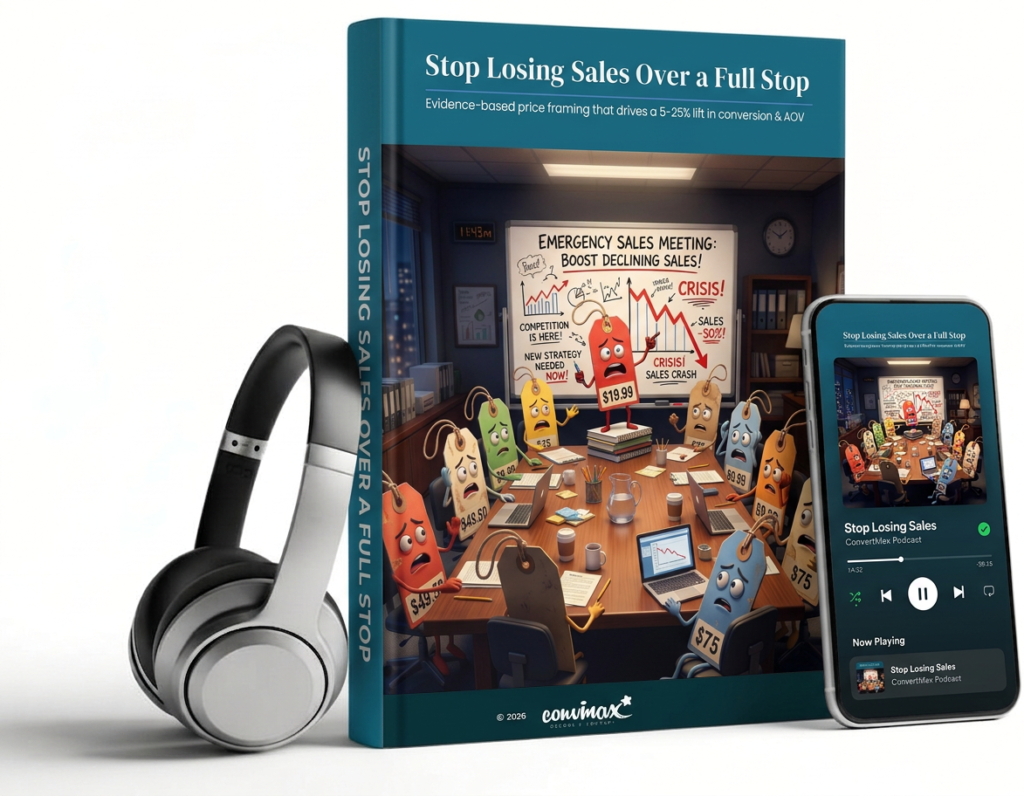
This isn’t theory. Every recommendation is backed by academic research, field studies, and real-world case studies. You’ll get the full academic citations, the industry benchmarks, and the practical frameworks you need to implement this tomorrow.
This booklet synthesises findings from:
Common Objections
Copyright © 2026