1
Shipping
Where to ship it?
Your cart is currently empty.Continue shopping
Subtotal £0.00
Total £0.00 GBP

Your Information

Order Summary

Product
Total
Subtotal £0.00
Total £0.00 GBP

Payment Information

All transactions are secured and encrypted.

Your personal data will be used to process your order, support your experience throughout this website, and for other purposes described in our privacy policy.

Please note: Results may vary and are not guaranteed.
Due to the digital nature of this product, we do not offer refunds.

  • 256-Bit Bank Level Security
  • 100% Secure Payments

Who This Is For

This article will be most valuable if you:

  • Manage conversion rates for an e-commerce site or digital product
  • Design user experiences and need psychological frameworks that actually work
  • Run a small business and handle your own website optimisation
  • Work as a freelance CRO consultant and need evidence-based strategies for clients
  • Build side projects or digital products and want to maximise every visitor
  • Lead growth for a startup where every percentage point matters
ConviMax Logo

The Art of Progressive Bundling

Your “Add to Cart” Button Is Lying to You (Here’s What Actually Happens in Your Customer’s Brain 3 Seconds Later)
Why the moment right after checkout begins is worth more than the moment before it – and why almost every store gets it backwards.
You’ve optimised your product pages. You’ve A/B tested your headlines. You’ve shaved milliseconds off your load times.
And then, right at the one moment your customer has already said “yes” – the second they click Add to Cart – you stop selling completely.
Most stores treat that click as the finish line. It isn’t. It’s the start of a second decision your customer is fully willing to make, and almost nobody is asking them to make it properly.
The result: money left in carts that were already won.
This research booklet breaks down exactly what happens in a customer’s mind in the moments after they commit to buying – and how a small number of well-timed, well-chosen suggestions can lift average order value without a single extra visitor, ad pound, or discount.
No bigger budget. No more traffic. Just paying proper attention to a moment you’re already earning.
It’s built from peer-reviewed cognitive science, neuroscience research, large-scale UX benchmarking, and documented case studies – triangulated into one clear, testable framework you can put to work this week.
What the article reveals:

What You’ll Discover in This Article:
  • The article reveals what actually happens to your customer’s decision-making ability the instant they click “Add to Cart” – and why it’s the opposite of what most CRO advice assumes.
  • It reveals the precise range of average order value lift that independently documented case studies keep landing on, and the one variable that determines whether you hit the top or bottom of that range.
  • It reveals the single mistake – made by a huge share of stores – that doesn’t just cost you one lost upsell, but quietly trains customers to ignore every suggestion you ever show them again.
  • It reveals why one specific, popular checkout tactic backfires more often than it works, and which retailers are quietly walking away from it.
  • It reveals how much lower mobile conversion really runs compared to desktop, why the gap has nothing to do with intent, and what to change about your mobile approach specifically.
  • It reveals what share of A/B tests being acted on in e-commerce today aren’t statistically reliable at all – and the three-phase testing framework that keeps you out of that group.
  • It reveals where the real ceiling on upsell conversion rates sits when the offer is done properly, and how far most stores fall short of it.
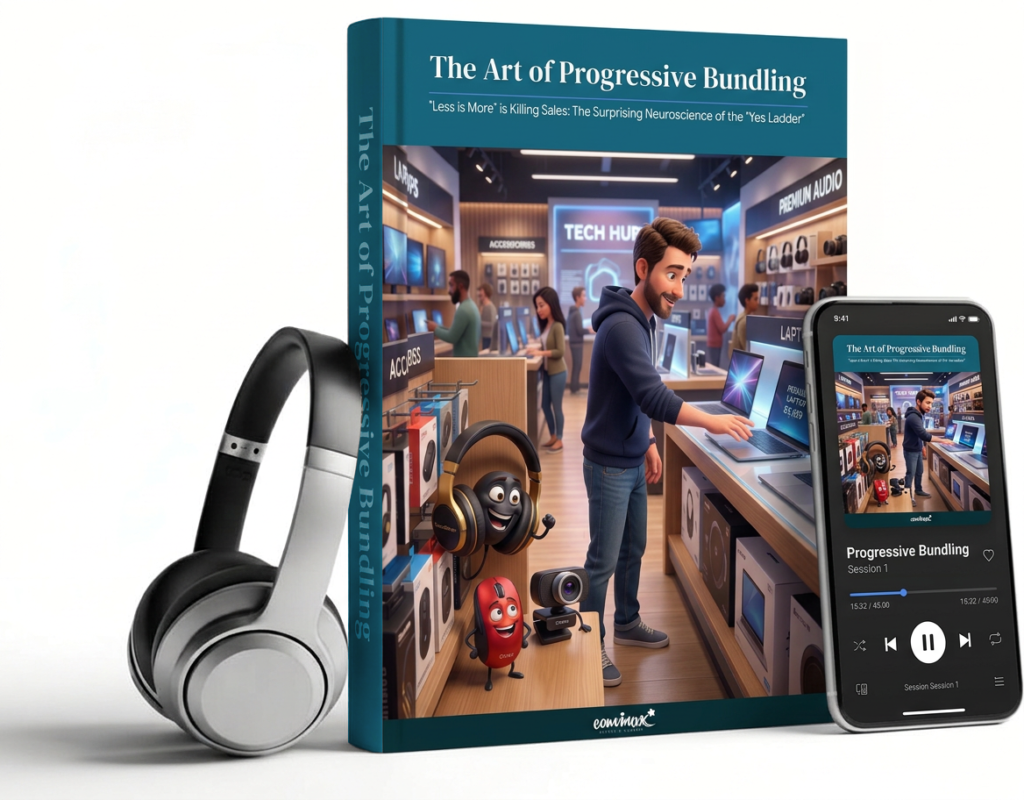
Your complete bundle includes:
  • Audio Podcast
    Listen anywhere. Perfect for learning on the go.
  • Blog Article
    A quick, engaging summary of the key ideas.
  • Detailed Booklet
    A deeper dive with examples and academic findings.

This isn’t theory. Every recommendation is backed by academic research, field studies, and real-world case studies. You’ll get the full academic citations, the industry benchmarks, and the practical frameworks you need to implement this tomorrow.

This booklet synthesises findings from:
  • Chernev, A., Böckenholt, U., & Goodman, J. (2015). “Choice overload: A conceptual review and meta-analysis.” Journal of Consumer Psychology.
  • Hindawi Journal (2009). “Cognitive Load in eCommerce Applications – Measurement and Effects on User Satisfaction.” Advances in Human-Computer Interaction.
  • International Journal of Information Management (2023). “Cognitive load during planned and unplanned virtual shopping: Perspective of self-regulatory depletion.”
  • Journal of Electronic Commerce Research (2025). “An Analysis of Consumer Purchase Behaviour Following Cart Addition in E-Commerce Utilising Explainable Artificial Intelligence.”
  • Journal of Neuroscience (June 2025). “The Neurobiology of Cognitive Fatigue and Its Influence on Effort-Based Choice.”
  • Journal of Retailing and Consumer Services (2018). “The determinants of conversion rates in SME e-commerce websites.”
  • Karmarkar, U. (2021). Study on matched vs. mismatched display items. Frontiers in Neuroscience / UC San Diego.
  • Kumar, V., & Derdenger, T. “Dynamic Bundling.” Harvard Business School and Marketing Science.
  • MDPI (2024). Various empirical studies and reviews on recommender systems and personalised search behaviour.
  • Baymard Institute (2021). “6 Ways to Improve the Relevance of Cross-Sells in the Cart” and comprehensive checkout usability research.
  • Carlson School of Management (2016). “Decision Fatigue, Choosing for Others, and Self-Construal.”
  • Forrester Research. Industry analysis on the revenue contributions of upselling and cross-selling.
  • McKinsey & Company. Global analysis of product recommendation impacts on Amazon and general profit increases from cross-selling.
  • Nielsen Norman Group (NN/g). UX research and guidelines for e-commerce recommendation systems.
  • Smart Insights (2025). “E-commerce conversion rate benchmarks – 2025 update.”
  • The Decision Lab (2024). Analysis on decision fatigue and its impact on cart abandonment.
  • “What is the Conversion Rate for Post-Purchase Upsell?” Benchmarking report.
  • Envive (2025). “50 E-commerce Conversion Rate Statistics for 2025.”
  • Salesforce (2024). “Average Order Value: 10 Practical Ways to Increase Cart Size.”
  • Shopify Retail. “How Post-Purchase Upsells Boost Revenue & AOV.”
  • Swanky Agency (2022). Case study on A/B testing and FMCG retailer AOV increases.
  • Vogue Business. Report on industry trends in post-purchase technology investment.
  • WisePops (2025). “A/B Testing on Shopify: Examples, Tools & How to Get Started.”

Common Objections

  • “I’ve read plenty of AOV articles already – what’s different here?” Most articles give you a tactic. This gives you the evidence behind the tactic – the actual cognitive research, the real numbers from documented case studies, and the conditions under which each finding holds or falls apart. You’ll finish it able to explain why it works, not just repeat that it does.
  • “I don’t have time to read a full research booklet.” That’s exactly why it comes with an audio version. Listen on a commute or a dog walk, then keep the PDF as a reference for when you’re ready to implement.
  • “How do I know this will actually work for my store?” The booklet doesn’t ask you to take anything on faith. Chapter 4 is a complete, ready-to-run A/B testing framework, built specifically so you validate every recommendation against your own data before you commit to it.
  • “Is this just going to tell me to add more upsells and hope?” No – and the booklet is explicit about this. It draws a hard line between genuinely helpful, relevant suggestions and the kind of pushy upselling that damages trust, and shows you exactly where that line sits.
  • “It’s a paid download – how do I know it’s worth it? It’s priced as a one-off download, not a subscription, and it’s built to pay for itself with a single implemented recommendation. If your AOV moves even a few percentage points, it’s covered its cost many times over.

Copyright © 2026

Privacy policy | Terms of Service