1
Shipping
Where to ship it?
Your cart is currently empty.Continue shopping
Subtotal £0.00
Total £0.00 GBP

Your Information

Order Summary

Product
Total
Subtotal £0.00
Total £0.00 GBP

Payment Information

All transactions are secured and encrypted.

Your personal data will be used to process your order, support your experience throughout this website, and for other purposes described in our privacy policy.

Please note: Results may vary and are not guaranteed.
Due to the digital nature of this product, we do not offer refunds.

  • 256-Bit Bank Level Security
  • 100% Secure Payments
Who This Is For

This article will be most valuable if you:

  • Manage conversion rates for an e-commerce site or digital product
  • Design user experiences and need psychological frameworks that actually work
  • Run a small business and handle your own website optimisation
  • Work as a freelance CRO consultant and need evidence-based strategies for clients
  • Build side projects or digital products and want to maximise every visitor
  • Lead growth for a startup where every percentage point matters
ConviMax Logo

Psychological Triggers

The “Add to Cart” Lie: Why Slowing Down Your Shopping Is Actually a Retailer’s Secret Weapon
Most e-commerce advice talks about what people do – where they click, how long they scroll, and when they drop off. Very little of it explains why – the subconscious mechanics that happen before a person ever reaches for their card.
This article changes that.

This is a deep, practical breakdown of the psychological triggers that sit behind every buying decision – the ones your competitors are already using, consciously or not.
You’ll understand how to design for the way your customers genuinely think – not how you’d like them to think. You’ll see which triggers to use, when to use them, and critically, which combinations to avoid (because some actively cancel each other out and quietly destroy conversions).
There’s no fluff. No 101-level advice you’ve already read ten times. This is the kind of material that shifts how you approach your entire site – from the first product page someone lands on to the moment they hit “place order.”

What You’ll Discover in This Article:
  • The Arousal Paradox: Fast Music Kills Conversions: While retailers often try to “excite” users into buying, studies show that combining high interactivity with high arousal can drop add-to-cart rates to 32%, whereas keeping arousal levels low to moderate while providing high interactivity (examples in article) can boost those rates to over 50%
  • The “Conscious Pause”: Why Friction is Profitable: Contrary to the “one-click buy” obsession, a surprising strategy for 2026 is Ethical Friction, or “The Conscious Pause”
  • The Peak-End Rule: Confetti as a Memory Hack: Retailers use celebratory animations (like confetti or “achievement unlocked” graphics) at the end of a transaction, not just for fun, but to exploit the Peak-End Rule
  • Algorithmic Scarcity: Making You “Hunt” for the Prize: A little-known but highly effective tip for increasing perceived value is Algorithmic Scarcity, leveraging the Ikea Effect, and the Endowment Effect
  • The “Ownership” Trap of the Cart: The simple act of adding an item to a cart triggers the Endowment Effect, creating a sense of psychological ownership before any money has changed hands
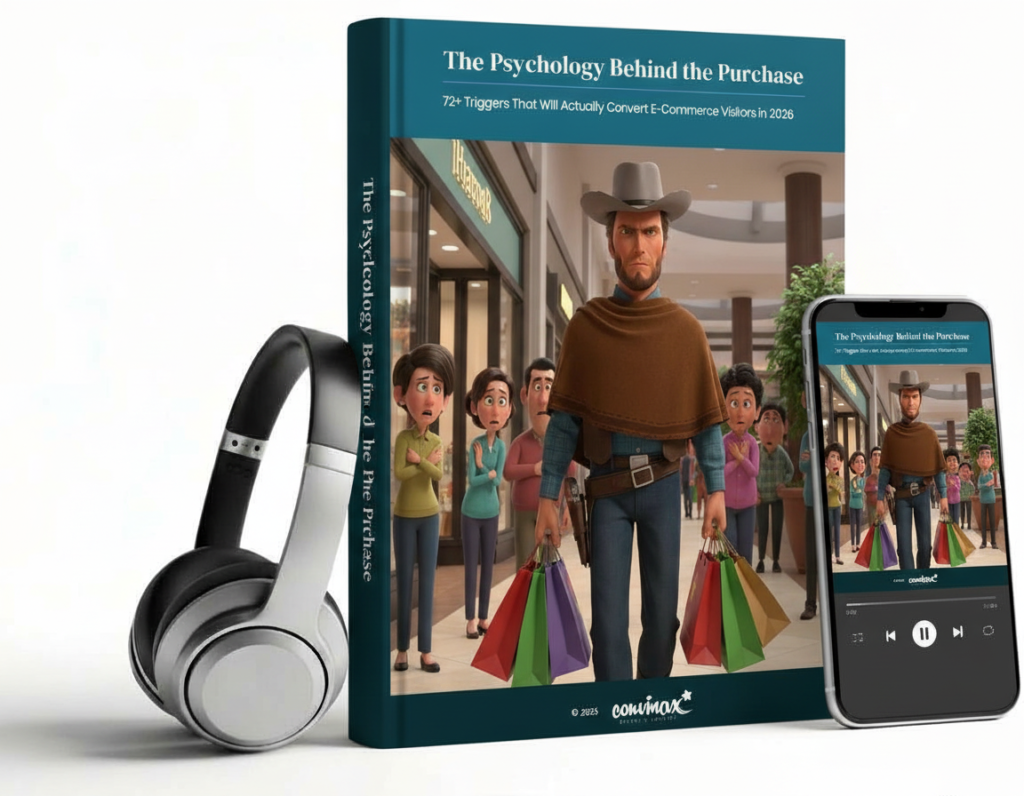
Your complete bundle includes:
  • Audio Podcast
    Listen anywhere. Perfect for learning on the go.
  • Blog Article
    A quick, engaging summary of the key ideas.
  • Detailed Booklet
    A deeper dive with examples and academic findings.
Psychological Triggers

This isn’t theory. Every recommendation is backed by academic research, field studies, and real-world case studies. You’ll get the full academic citations, the industry benchmarks, and the practical frameworks you need to implement this tomorrow.

This booklet synthesises findings from:
  • Peer-Reviewed Journals: The sources cite specific systematic reviews and experimental studies from journals such as Decision Support Systems and Communication Research
  • Systematic Reviews: One source analysed findings from a semantic search of over 138 million academic papers through the Elicit search engine, which includes databases like Semantic Scholar and OpenAlex
  • Foundational Behavioural Economics: The articles draw on the work of Nobel-prize-winning researchers like Daniel Kahneman and Amos Tversky, who identified core biases like loss aversion and anchoring. They also reference Robert Cialdini’s research on the principle of consistency
  • Randomised Controlled Trials (RCTs): The findings include data from large-scale field experiments, such as an onboarding study involving 475,495 participants
  • Laboratory Experiments: Some data come from controlled “between-participants” experiments, such as a study on interactivity and arousal involving university students
  • A/B Testing: Many of the conversion metrics, such as the finding that high interactivity can lead to 85% add-to-cart rates, are derived from controlled A/B testing
  • Market Research Firms: The sources cite data from major firms like NielsenIQ, McKinsey, and Salesforce to track consumer outlooks and experience optimisation trends for 2025-2026
  • Specialised E-commerce Platforms: Research and best practices are drawn from major industry players like Shopify, Amazon, and Booking.com
  • Conversion Optimisation Databases: Insights are synthesised from specialised conversion tools and databases like ConvertCart, Nudgify, and Crazy Egg
  • Global Brands: The articles analyse specific strategies used by successful companies, including Nike’s customisation tools (Ikea Effect), Apple’s minimalist design (Cognitive Ease), Warby Parker’s home try-on program (Endowment Effect), and Dollar Shave Club’s subscription funnels (Progressive Commitment)
  • Behavioural Economics Portals: Findings are gathered from platforms dedicated to applying behavioural science to business, such as InsideBE and Neuroscience Marketing
  • Expert Marketing Insights: Strategies are informed by veteran digital marketers and platforms like Neil Patel and Martech Zone

Common Objections

  • “I can find this kind of thing for free online.”
    You can find fragments of it, yes. What you won’t find for free is a single, coherent resource that maps the full picture – across every stage of the customer journey, with both practical applications and the research behind them. Most free content on this topic scratches the surface and stops. This doesn’t.
  • “I’m not sure it applies to my type of business.”
    The triggers covered in this article are rooted in how human beings make decisions – not in any particular industry or business model. Whether you’re selling physical products, digital downloads, subscriptions, or services, the same psychological patterns apply. The examples are drawn from a wide range of e-commerce contexts to reflect that.
  • “I don’t have time to read a long article right now.”
    That’s exactly why the audio version is included. You don’t need to sit at a desk to get value from this. The companion podcast lets you absorb the content in whatever gaps exist in your day. And the article itself is structured to be skimmable – you can read the sections most relevant to you first.
  • “What if it’s not worth it?”
    That’s a fair question to ask of anything. What’s less fair is making that decision based on a hunch rather than evidence. The material in this article is grounded in documented research and real-world applications – not opinion or trend-chasing. If you apply even one idea from it, the return on what you spend here is straightforward.
  • “I’ve read about psychological triggers before and it felt manipulative.”
    It’s a reasonable concern. This article addresses it directly. There’s a clear distinction between using psychology to reduce friction and build genuine confidence in a purchase – and using it to deceive. The most effective approaches serve the customer. The article explains where that line sits and how to stay the right side of it.

Copyright © 2026

Privacy policy | Terms of Service