1
Shipping
Where to ship it?
Your cart is currently empty.Continue shopping
Subtotal £0.00
Total £0.00 GBP

Your Information

Order Summary

Product
Total
Subtotal £0.00
Total £0.00 GBP

Payment Information

All transactions are secured and encrypted.

Your personal data will be used to process your order, support your experience throughout this website, and for other purposes described in our privacy policy.

Please note: Results may vary and are not guaranteed.
Due to the digital nature of this product, we do not offer refunds.

  • 256-Bit Bank Level Security
  • 100% Secure Payments

Who This Is For

This article will be most valuable if you:

  • Manage conversion rates for an e-commerce site or digital product
  • Design user experiences and need psychological frameworks that actually work
  • Run a small business and handle your own website optimisation
  • Work as a freelance CRO consultant and need evidence-based strategies for clients
  • Build side projects or digital products and want to maximise every visitor
  • Lead growth for a startup where every percentage point matters
ConviMax Logo

Psychology of Form Design: Choosing Single or Multi-Step Layouts

We Analysed 50+ Conversion Studies on Checkout Forms – One Company Found a 743% Increase
Every day, your checkout or lead form is quietly deciding who buys and who leaves.
Not your pricing. Not your product photos. Not your ad spend. The form.
Most businesses treat form design as an afterthought – a box to tick once the “real” marketing work is done. But the research tells a different story. Across more than 50 studies and real-world case studies, the way a form is structured is one of the single biggest levers on conversion rate available to any e-commerce business – and most people are getting it wrong without realising it.
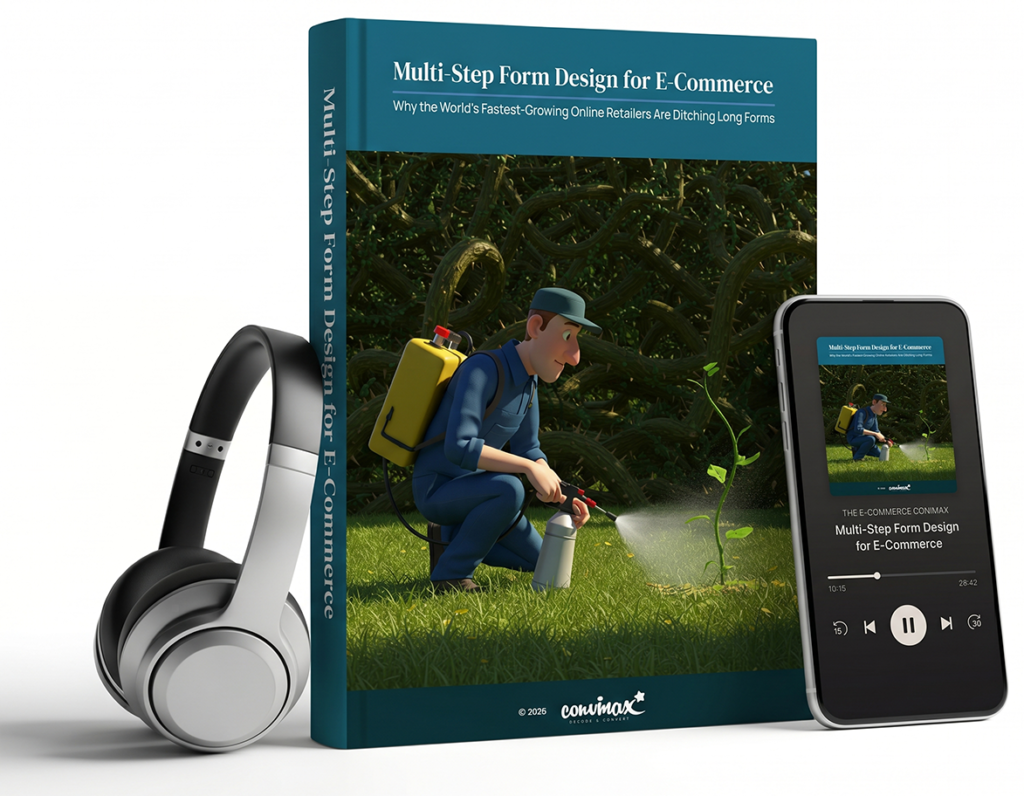
This booklet and podcast pull together the data, the psychology, and the case studies that explain exactly why – and what to do about it.

What You’ll Discover in This Article:
  • The article reveals exactly how much completion rates change when a long-form is restructured into steps – and why the gap is bigger than most CRO managers expect.
  • It uncovers the psychological “trigger” that makes people far more likely to finish a form once they’ve started it – and how to activate it deliberately.
  • It names the one design mistake that quietly costs mobile retailers more in lost sales than almost any other checkout error.
  • It reveals the case study behind a 743% conversion improvement, and the specific sequence of changes that produced it – not a one-off fluke, but a repeatable method.
  • It challenges the most common objection to multi-step forms (“it adds friction”) with data that shows the opposite is usually true – and explains exactly why.
  • It sets out realistic, sector-specific improvement targets, so you know what “good” actually looks like for a business like yours.
Your complete bundle includes:
  • Audio Podcast
    Listen anywhere. Perfect for learning on the go.
  • Blog Article
    A quick, engaging summary of the key ideas.
  • Detailed Booklet
    A deeper dive with examples and academic findings.

This isn’t theory. Every recommendation is backed by academic research, field studies, and real-world case studies. You’ll get the full academic citations, the industry benchmarks, and the practical frameworks you need to implement this tomorrow.

This booklet synthesises findings from:
  • Di Fatta, D., et al. (2018).The determinants of conversion rates in SME e-commerce websites: A qualitative comparative analysis. Journal of Retailing and Consumer Services.
  • Li, X., et al. (2025).Cognitive load theory application in e-commerce environments. Journal of Electronic Commerce Research.
  • Pignatiello, G. A., et al. (2018).Decision fatigue: A conceptual-level review of a decade of research. PMC / National Institutes of Health.
  • Pratesi, A., et al. (2021).Cross-cultural analysis of form completion behaviour using CFA and SEM. Journal of Business Research.
  • Sweller, J., et al. (2019).Cognitive load theory: A 2019 review. SpringerLink.
  • Baymard Institute. (2024). Checkout UX Best Practices / Cart & Checkout Usability. Based on 150,000+ hours of UX research.
  • Dynamic Yield.The Economics of E-commerce Conversion Optimisation: Benchmarks and Device Performance.
  • Formstack Research.Form Conversion Report: Single vs. Multi-page Performance.
  • Comparative Analysis of Form Completion Rates.
  • Interaction Design Foundation. Principles of Progressive Disclosure.
  • Nielsen Norman Group (NNg). (2016). Website Forms Usability: Top 10 Recommendations.
  • Nielsen Norman Group (NNg). Usability Testing 101: Identifying 85% of Issues with 5 Users.
  • Kohavi, R., Tang, D., & Xu, Y. (2020).Trustworthy Online Controlled Experiments: A Practical Guide to A/B Testing. Cambridge University Press / experimentguide.com.
  • Miller, Evan. Sample Size Calculator and Statistical Tools for A/B Testing. evanmiller.org.
  • Elastic Path. Single-page checkout performance vs. multi-step flows in E-commerce.
  • Obama Campaign Donation Experiment: The impact of multi-step vs. long forms.
  • PayU Fintech. Field reduction and its impact on conversion rates.
  • Venture Harbour. Lead form optimisation: A 743% conversion improvement case study.
  • com. Multi-step lead generation performance.
  • Zalora Fashion. Product page and checkout flow optimisation.

Common Objections

  • “I can probably find this information for free elsewhere.
    You can find fragments of it – a blog post here, a stat there. What you won’t easily find is all of it pulled together, cross-checked against 50+ studies and named academic sources, and turned into a usable framework in under an hour of listening or reading. This saves you the hours of digging and the risk of acting on a single, unverified stat.
  • “I’m not sure this applies to my industry.” The booklet breaks down conversion benchmarks and drivers by sector – from personal care to fashion to electronics – so you can see exactly where your industry sits and what a realistic improvement target looks like for you specifically, not a generic average.
  • “I don’t have time to read a full research report.” That’s exactly why it comes as an audio podcast as well as a PDF. Listen while you commute, cook, or walk, and absorb the key findings without blocking out reading time.
  • “How do I know this is credible, and not just recycled opinion?” Every finding is drawn from named academic research, industry bodies such as the Baymard Institute, and documented case studies – all listed in full at the end of the booklet, so you can verify the sources yourself.
  • “Is this going to be all theory with no practical steps?” No. Alongside the data and the psychology, you get a step-by-step implementation framework and a testing methodology, so you leave with a plan you can actually put into action – not just interesting facts.

Copyright © 2026

Privacy policy | Terms of Service