1
Shipping
Where to ship it?
Your cart is currently empty.Continue shopping
Subtotal £0.00
Total £0.00 GBP

Your Information

Order Summary

Product
Total
Subtotal £0.00
Total £0.00 GBP

Payment Information

All transactions are secured and encrypted.

Your personal data will be used to process your order, support your experience throughout this website, and for other purposes described in our privacy policy.

Please note: Results may vary and are not guaranteed.
Due to the digital nature of this product, we do not offer refunds.

  • 256-Bit Bank Level Security
  • 100% Secure Payments
Who This Is For

This article will be most valuable if you:

  • Manage conversion rates for an e-commerce site or digital product
  • Design user experiences and need psychological frameworks that actually work
  • Run a small business and handle your own website optimisation
  • Work as a freelance CRO consultant and need evidence-based strategies for clients
  • Build side projects or digital products and want to maximise every visitor
  • Lead growth for a startup where every percentage point matters
ConviMax Logo

Search Bar Optimisation

Most e-commerce sites are actively making it harder for their highest-intent customers to buy. Not through broken links or slow servers, but through a fundamental misunderstanding of how people actually shop online.
The visitors who convert at 2-6x higher rates than everyone else? You’re putting obstacles in their way. The customers who spend 2.6x more per transaction? You’re forcing them to work harder than they should.
This isn’t theory. This is based on research analysing over 609 million searches, £9.8 billion in revenue, and usability testing across 325 leading e-commerce sites.

What You’ll Discover in This Article:
  • The “24% Traffic” Goldmine
    Most visitors browse, but a tiny 24% segment of your audience is doing something different—and it’s driving a staggering 44% of total site revenue
    . Discover the “Intent Gap” and why these specific users are 2.5x more likely to convert than anyone else
  • The “Magnifying Glass” Trap
    Think hiding your search bar behind a sleek icon looks professional? It’s actually a conversion killer. Research shows this “hidden” design increases “Interaction Cost” and delays product discovery by a specific, measurable percentage that leads to immediate abandonment. We’ll show you the “F-Pattern” layout that aligns with human biology
  • The “7-9 Option” Cognitive Wall
    There is a precise number of product options where a shopper’s brain simply… stops. Cognitive fatigue sets in much earlier than you think, depleting “decision bandwidth” and causing visitors to bounce. Learn how to bypass this psychological limit before your customers experience “Choice Paralysis”
  • The “Blue Button” Mobile Secret
    Mobile typing is prone to errors, but there is a one-line HTML “search trigger” that changes the physical keyboard on a user’s smartphone. This tiny technical tweak provides a powerful visual call to action that most mobile sites completely ignore
  • The “Zero Results” Revenue Pivot
    The “No results found” page is usually a dead end—a “trap” that kills the customer journey. We’ve uncovered the 4-step “Safety Net” used by industry leaders to turn a failed search into a successful sale
  • The EEG Biosensor Revelation
    Using advanced brain-monitoring technology, researchers have mapped exactly how cognitive load spikes when a search bar is hard to find. Discover the “Cognitive Shortcut” that reduces mental effort and makes purchasing feel effortless for your customers
  • The Industry Controversy: The “Evidence Gap”
    In a shocking twist, one major systematic review of e-commerce research claims the “evidence base” for search bar prominence might be a total illusion. We dive into why this controversial study challenges every major CRO framework and what it means for your next A/B test
  • Common implementation mistakes that are costing you conversions right now
  • A phased action plan – immediate wins you can implement this week
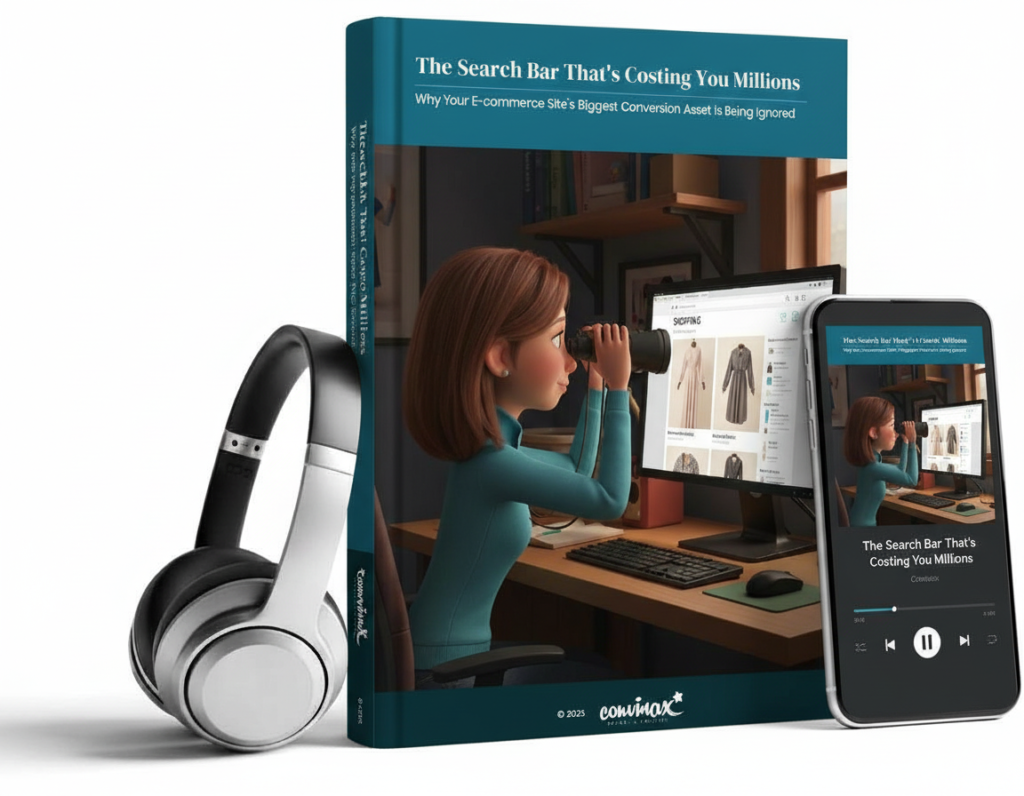
Your complete bundle includes:
  • Audio Podcast
    Listen anywhere. Perfect for learning on the go.
  • Blog Article
    A quick, engaging summary of the key ideas.
  • Detailed Booklet
    A deeper dive with examples and academic findings.
Search Bar Optimisation

This isn’t theory. Every recommendation is backed by academic research, field studies, and real-world case studies. You’ll get the full academic citations, the industry benchmarks, and the practical frameworks you need to implement this tomorrow.

This booklet synthesises findings from:
  • Academic and Peer-Reviewed Research
    The findings are deeply rooted in psychological and behavioural science. Behavioural Psychology | Neurological Studies | Attention Economics
  • Usability Authorities and Benchmarks
    Longitudinal research from recognised UX (User Experience) authorities provides specific design standards. Baymard Institute | Nielsen Norman Group (NN/g)
  • Industry Reports and Platform Data
    Massive data aggregations from e-commerce technology providers offer a “macro” view of search performance. Vendor Statistics | Platform Benchmarks
  • Real-World Case Studies
    The sources analyse performance data from established global retailers to demonstrate ROI. Retail Giants | Specialised Retailers
  • Controlled Experiments (A/B Testing)
    Findings are validated through direct, measurable experiments. CRO Agencies | Specific Design Tests
  • Cross-Platform and Multi-Device Analytics
    Extensive analysis comparing mobile versus desktop performance identifies how device constraints (like limited screen real estate) affect search behaviour and abandonment rates

Common Objections

  • “I’ve already spent money on CRO advice that didn’t work. Why will this be different?”
    Fair question. Most CRO content focuses on tactics in isolation – “change your button colour,” “add urgency,” “improve your headlines.” This article focuses on the one element that research proves drives 1.8-6x higher conversion rates for the customers who use it. It’s backed by analysis of 609 million searches and £9.8 billion in revenue, plus case studies showing 37% to 550% improvements. The data is from Baymard Institute, Nielsen Norman Group, and Algolia – not marketing blogs recycling the same tired advice.
  • “I don’t have time to implement complex changes. I need quick wins.”
    That’s exactly why this matters. Some recommendations can be implemented in under an hour (repositioning, restyling, increasing visibility). Others are phased over weeks or months. The article explicitly breaks down immediate wins (this week), quick improvements (this month), and advanced optimisation (next quarter). You choose based on your resources.
  • “My site is different. Will this work for my industry/platform/audience?”
    The article includes industry-specific calibration for fashion, electronics, home décor, B2B, specialty retail, and more. It covers mobile vs desktop differences (critical, since they behave completely differently). It explains when and why these strategies work, so you can assess fit for your specific situation. The research covers 325 sites across 8 verticals – chances are your category is represented.
  • “I’m not technical. Will I be able to actually use this?”
    Yes. The recommendations include exact specifications (size, position, contrast requirements) that you can hand to a designer or developer. Many changes require no coding – just repositioning existing elements. If you can edit your site’s header or work with someone who can, you can implement these changes.
  • “What if I implement this and it doesn’t work for my site?”
    The article includes the exact metrics to track (search usage rate, first-query success rate, search-to-conversion rate, revenue per search user) so you’ll know quickly whether it’s working. It also explains why 72% of sites fail at this – so you can avoid the common mistakes. Implementation isn’t magic; it requires testing and measurement, which the article guides you through.
  • “I’m just starting out. Is this too advanced for my stage?”
    Actually, this is ideal for early-stage businesses. You’re not optimising a 50-page checkout flow – you’re making one element highly visible and functional. The smaller your site, the faster you’ll see results. And getting this right from the start means you’re not leaving money on the table as you grow.
  • “Can’t I just find this information for free online?”
    You could spend hours searching through scattered research papers, industry reports, and case studies across multiple sources. This article synthesises research from Nielsen Norman Group, Baymard Institute (200,000+ hours of usability testing), Algolia’s analysis of 609 million searches, peer-reviewed cognitive psychology studies, and dozens of verified case studies – all in one place, with clear implementation guidance. Your time has value. This consolidates months of research into a single, actionable resource.
  • “I’m worried this is just another tactic that won’t move the needle.”
    This isn’t a tactic. It’s a strategic focus on the element that research proves drives 44% of revenue from 24% of traffic. Sites that get this right see search users converting at 1.8-6x higher rates. Wallmonkeys saw a 550% conversion increase. Lacoste saw 37%. Decathlon saw 50%. These aren’t outliers – they’re what happens when you remove friction for your highest-intent customers.
  • “What if I need help implementing or have questions?”
    The article provides a phased action plan with specific milestones, metrics, and success indicators. It’s written to be immediately actionable, whether you’re implementing yourself or briefing a team. The research sources are cited so you can dive deeper into any area if needed.

Copyright © 2026

Privacy policy | Terms of Service