1
Shipping
Where to ship it?
Your cart is currently empty.Continue shopping
Subtotal £0.00
Total £0.00 GBP

Your Information

Order Summary

Product
Total
Subtotal £0.00
Total £0.00 GBP

Payment Information

All transactions are secured and encrypted.

Your personal data will be used to process your order, support your experience throughout this website, and for other purposes described in our privacy policy.

Please note: Results may vary and are not guaranteed.
Due to the digital nature of this product, we do not offer refunds.

  • 256-Bit Bank Level Security
  • 100% Secure Payments
Who This Is For

This article will be most valuable if you:

  • Manage conversion rates for an e-commerce site or digital product
  • Design user experiences and need psychological frameworks that actually work
  • Run a small business and handle your own website optimisation
  • Work as a freelance CRO consultant and need evidence-based strategies for clients
  • Build side projects or digital products and want to maximise every visitor
  • Lead growth for a startup where every percentage point matters
ConviMax Logo

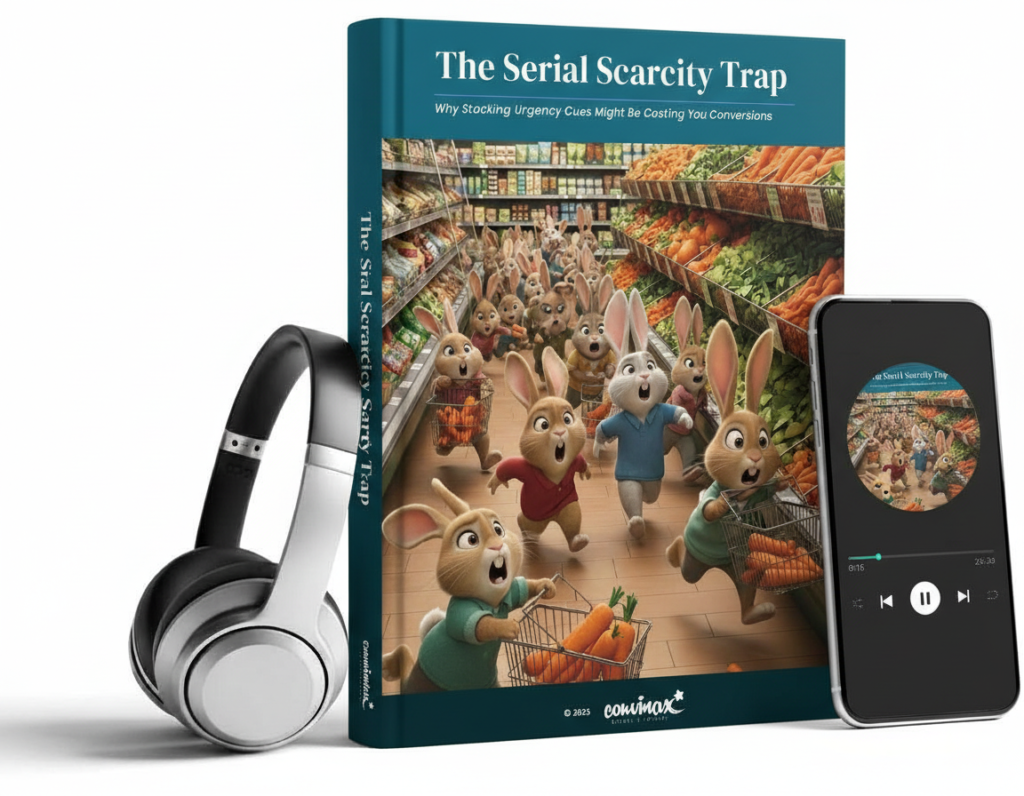
The Serial Scarcity Trap

Stop Stacking Scarcity: Why “Only 2 Left” is Secretly Killing Your Sales
Every conversion expert and their dog will tell you the same thing: “Add scarcity cues. Show low stock. Display viewer counts. Stack them for maximum impact.”
So you did. You added “Only 3 left!” next to “12 people viewing this right now!” Maybe you threw in a countdown timer for good measure.
And now? Your conversion rate is… fine. Not great. Just fine.
Here’s what nobody’s telling you: those multiple urgency cues you’re testing might be actively repelling your best customers.

What You’ll Discover in This Article:
  • Why 90% of A/B tests show less than 1.2% effect on revenue (and what that means for your urgency experiments)
  • The exact sample sizes you need for statistically valid scarcity tests (spoiler: it’s probably 10x what you’re currently running)
  • Why mobile users – who drive ~60% of your traffic but convert at half the rate – respond differently to urgency cues
  • The “credibility paradox”: how adding a second cue to validate the first actually effects trust
  • What 19% of shoppers do when they detect fake scarcity (and the long-term cost to your brand)
  • Which scarcity types work for which product categories (demand-based shows 195% greater effectiveness than supply-based for specific products)
  • The Booking.com exception – and the three critical reasons you can’t copy their playbook
  • A practical, research-backed framework for strategic scarcity that actually works
  • The “Sophistication” Repulsion
  • The 6% Decision Trap
  • The “Zero Effect” Reality
  • The “Uncertainty” Backfire: For consumers with “high uncertainty avoidance,” seeing multiple cues simultaneously can actually reduce the perceived time pressure
Your complete bundle includes:
  • Audio Podcast
    Listen anywhere. Perfect for learning on the go.
  • Blog Article
    A quick, engaging summary of the key ideas.
  • Detailed Booklet
    A deeper dive with examples and academic findings.
Serial Scarcity Trap

This isn’t theory. Every recommendation is backed by academic research, field studies, and real-world case studies. You’ll get the full academic citations, the industry benchmarks, and the practical frameworks you need to implement this tomorrow.

This booklet synthesises findings from:
  • Meta-Analyses: Large-scale reviews of existing literature, including a significant study encompassing 416 effect sizes from 131 different studies
  • Specialised Journals: Research is cited from top-tier publications such as the Journal of Consumer Research, Journal of Marketing Research, Marketing Science, and Psychological Science
  • Psychological Frameworks: The sources apply established theories like Cognitive Load Theory, Commodity Theory, the Stimulus-Organism-Response (S-O-R) model, and Competitive Arousal models to explain consumer behaviour
  • UX Research Giants: Insights are drawn from the Baymard Institute (over 150,000 hours of UX research) and the Nielsen Norman Group (20+ years of usability research)
  • Conversion Benchmarks: Data is synthesised from industry leaders like Dynamic Yield, Smart Insights, Retail Touchpoints, and Adobe for Business
  • Platform-Specific Data: Trends and benchmarks from platforms like Shopify, Klaviyo, and Omnisend are used to establish baseline conversion and add-to-cart rates
  • Aggregated A/B Test Data: One analysis includes a meta-analysis of over 6,700 individual A/B tests to determine average conversion lifts
  • Main Academic Research Title
    Paragraph here. Resources | Resources
  • Statistical Tools: The methodology for these tests often references established statistical calculators like those from Evan Miller and Optimizely to ensure 95% confidence levels
  • Experimental Metrics: Findings are based on primary metrics such as bounce rate, add-to-cart rate, and revenue per session, often segmented by device (mobile vs. desktop)
  • Booking.com & Expedia: Frequent analysis of their “multi-cue stacks” used in travel booking
  • Retail Giants: Case studies from Amazon, Walmart, ASOS, Nike, Sephora, and IKEA demonstrate how scarcity affects different product categories
  • SaaS and Tech: Examples from companies like HubSpot, Apple, and Netflix illustrate how urgency impacts lead generation and product launches
  • “Dark Pattern” Audits: References to investigations by Wired and Princeton researchers that expose deceptive countdown timers and fake stock numbers
  • Regulatory Warnings: Analysis of how deceptive tactics may attract attention from regulatory bodies
  • Eye-Tracking Studies: Measuring exactly where users look on a page when exposed to different urgency signals
  • EEG and Physiological Studies: Using brain activity measurements to gauge cognitive load and arousal levels in shoppers

Common Objections

  • “I can probably find this information for free online.”
    You could. I spent three months reading academic journals, meta-analyses, and industry reports to compile it. You’d need access to research databases, the ability to interpret statistical analysis, and weeks of reading time.
    This report synthesises everything into actionable insights you can use today. Your time is worth more than £20.
  • “My business is different – will this apply to me?”
    The research covers multiple product categories (utilitarian vs hedonic), price points, customer segments, and device types. The frameworks are designed to help you determine which strategies apply to your specific context.
    If you sell anything online to anyone, this research is relevant to your decisions.
  • “I don’t have traffic for proper A/B testing anyway.”
    Perfect. This report will save you from implementing tactics blindly. It includes guidance on what works without testing, which tactics to avoid entirely, and alternative optimisation strategies that don’t require massive traffic.
  • “Won’t this information become outdated?”
    Consumer psychology doesn’t change as fast as marketing tactics. The research in this report spans studies from 2015-2025, but the underlying principles are timeless: cognitive load, trust, authenticity, and attention economics.
    These findings will be relevant for years.
  • “What if I don’t agree with the conclusions?”
    Every finding is cited to its original source. You’ll see where the data comes from, what the sample sizes were, and what the limitations are. You can verify everything yourself.
    This isn’t opinion. It’s evidence. Form your own conclusions.
  • “I’m worried I’ll buy it and never read it.”
    Fair concern. The report is structured for skimming – each chapter ends with key takeaways, there are callout boxes for critical findings, and data is presented in tables for quick reference.
    You can extract value in 15 minutes if that’s all you have.

Copyright © 2026

Privacy policy | Terms of Service