1
Shipping
Where to ship it?
Your cart is currently empty.Continue shopping
Subtotal £0.00
Total £0.00 GBP

Your Information

Order Summary

Product
Total
Subtotal £0.00
Total £0.00 GBP

Payment Information

All transactions are secured and encrypted.

Your personal data will be used to process your order, support your experience throughout this website, and for other purposes described in our privacy policy.

Please note: Results may vary and are not guaranteed.
Due to the digital nature of this product, we do not offer refunds.

  • 256-Bit Bank Level Security
  • 100% Secure Payments
Who This Is For

This article will be most valuable if you:

  • Manage conversion rates for an e-commerce site or digital product
  • Design user experiences and need psychological frameworks that actually work
  • Run a small business and handle your own website optimisation
  • Work as a freelance CRO consultant and need evidence-based strategies for clients
  • Build side projects or digital products and want to maximise every visitor
  • Lead growth for a startup where every percentage point matters
ConviMax Logo

Tiered Discount Progress Bar

The “Slow Bar” Trap: Why Your Progress Bar Might Be Killing Your Sales (And the 200% Profit Hack)
You’ve spent months perfecting your product pages. You’ve A/B tested headlines until your eyes bled. You’ve optimised load times, tweaked button colours, and obsessed over every pixel of your checkout flow.
And yet your average order value hasn’t moved.
Meanwhile, brands like Sephora are generating over £2 billion using a single conversion mechanism you’ve probably dismissed as “too simple” or “not relevant to my business.”

What You’ll Discover in This Article:
  • The exact tweak that helped a small Shopify store double their average order value overnight… and what happened the moment they removed it
  • Why most “free shipping” strategies quietly leak revenue and what actually captures the missed spend
  • The hidden reason your progress bar works on desktop but quietly kills conversions on mobile
  • Real-world benchmarks across industries revealing which reward structures consistently outperform
  • How to increase order value without eroding your margins or training customers to wait for discounts
  • The simple psychological triggers that make customers spend more… without feeling pushed
  • A counterintuitive “head start” effect that nudges customers to complete purchases faster
  • The overlooked design mistakes that can increase abandonment instead of reducing it
  • Why a well-placed free gift can outperform discounts… even when it’s worth less
  • The fastest AOV lift you’ll likely ever see from a single on-site change
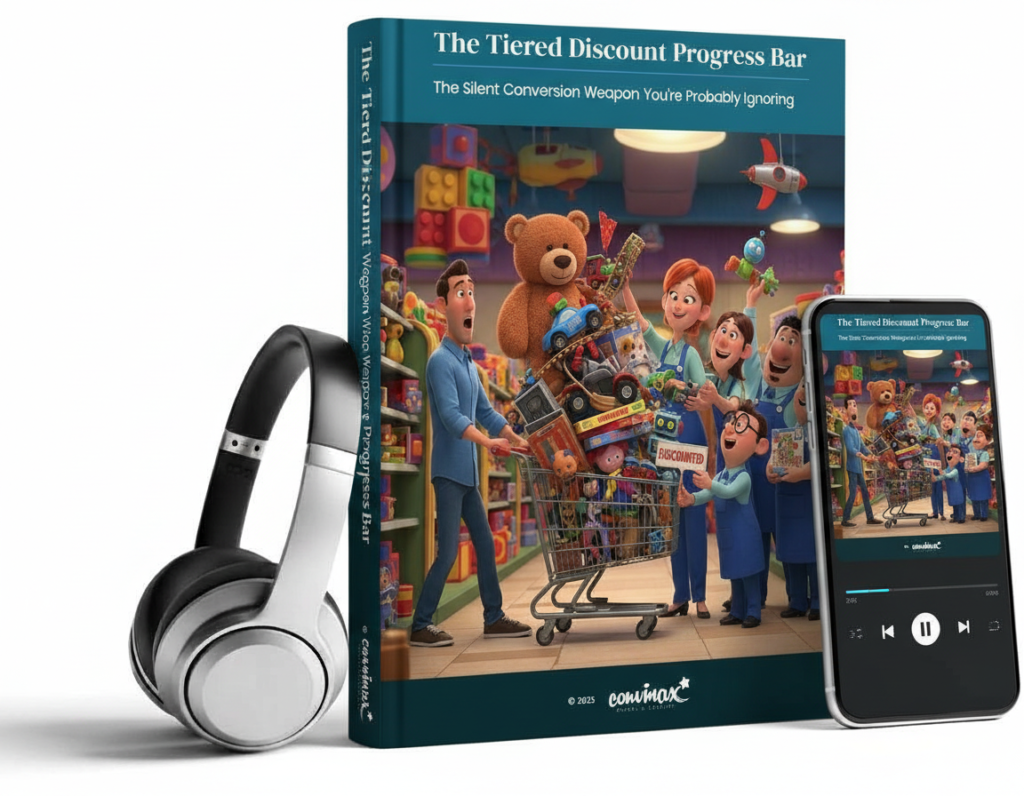
Your complete bundle includes:
  • Audio Podcast
    Listen anywhere. Perfect for learning on the go.
  • Blog Article
    A quick, engaging summary of the key ideas.
  • Detailed Booklet
    A deeper dive with examples and academic findings.
Tiered Discount Progress Bar

This isn’t theory. Every recommendation is backed by academic research, field studies, and real-world case studies. You’ll get the full academic citations, the industry benchmarks, and the practical frameworks you need to implement this tomorrow.

This booklet synthesises findings from:
  • Foundational Psychology: Research dates back to behaviourist Clark Hull’s work in the 1930s on the Goal-Gradient Hypothesis
  • Modern Marketing Studies: Key insights are pulled from the Journal of Marketing Research, Marketing Science, and the Journal of Consumer Research
  • Cognitive and Industrial Research: Studies from Frontiers in Psychology and the International Journal of Industrial Ergonomics provide data on visual attention patterns, eye-tracking, and cognitive load
  • Baymard Institute, Nielsen Norman Group
    Cart abandonment, checkout usability, and mobile UX trends
  • McKinsey & Company, Google Analytics
    Attention economics and global cross-platform performance
  • Shopify Plus, BigCommerce, Dynamic Yield
    Aggregate conversion benchmarks and merchant performance data
  • Meta-Analyses: Evaluation of dozens of randomised controlled trials (RCTs) regarding progress indicators in web surveys and digital tasks (e.g., Villar et al., 2013)
  • Gamification Experiments: Research on how badges and progress cues motivate behaviour in digital environments
  • Practitioner A/B Testing: Data from optimisation platforms like VWO and Optimizely provides evidence from thousands of live website variations
  • Retail Giants: Large-scale implementations from brands like ASOS, Sephora, and Philips
  • Niche DTC Brands: Performance data from smaller merchants such as NuFace (beauty), Arbor Made (home goods), and Feey (plants)
  • Agency Audits: Detailed reporting from e-commerce agencies (e.g., Swanky, Red Door Interactive) that manage multi-month optimisation cycles for clients

Common Objections

  • “Will this actually work for my specific business?”
    The research in this article spans fashion, beauty, food, pet supplies, home goods, SaaS, and general retail. The core psychology (Goal Gradient Effect, loss aversion, cognitive load reduction) applies universally, but the implementation varies by industry. You’ll get specific case studies and benchmarks for each sector so you can adapt the framework to your context rather than copying someone else’s exact setup.
  • “I’m not technical. Can I actually implement this?”
    Yes. The article includes both technical and non-technical paths. If you’re on Shopify, WooCommerce, or BigCommerce, there are apps that handle this in minutes. If you’re on a custom platform, the article breaks down the logic and user flow so you can brief a developer. No coding knowledge required to understand and plan the implementation.
  • “Won’t discounting hurt my brand and train customers to wait for deals?”
    This is addressed directly in the article with examples from premium brands like Glossier and Sephora who use tiered systems without damaging brand equity. The key is in the structure – you’re not running random discount codes, you’re creating behaviour-based progression. There’s also a full section on margin protection so you’re not giving away profitability to chase vanity metrics.
  • “I don’t have time to read another long article. Will I actually use this?”
    The article is structured for scanning – bolded subheadings, bullet points, clear frameworks, and real examples. You can read the entire thing in 15 minutes, or jump straight to the industry section relevant to you. More importantly, the implementation frameworks are actionable immediately. You could set up a basic test within an hour of reading.
  • “How do I know this isn’t just cherry-picked success stories?”
    Because the article also includes the failures, the margin risks, the industries where it doesn’t work as well, and the specific conditions required for success. It cites peer-reviewed academic research on cognitive load theory and behavioural economics, not just vendor case studies. The data comes from 97+ sources including Baymard Institute, Nielsen Norman Group, university research, and documented A/B tests with statistical methodology.
  • “I’ve tried ‘tactics’ before and they didn’t move the needle. Why is this different?”
    Because this isn’t about adding a countdown timer or changing your button from orange to green. This is about understanding the psychological mechanisms that actually drive purchase behaviour at scale – mechanisms backed by decades of research and billions in e-commerce revenue. The article gives you the ‘why’ behind the ‘what’ so you can adapt it intelligently rather than copying tactics blindly.
  • “What if I buy this and still don’t see results?”
    Then you’ve learned something valuable about your specific audience and business model for less than the cost of a single failed paid ad. But more likely, you’ll implement the framework, run a proper test (with the statistical parameters outlined in the article), and get data you can actually use to make decisions. Worst case: you’ve eliminated a strategy that doesn’t work for you. Best case: you’ve unlocked a new growth lever.

Copyright © 2026

Privacy policy | Terms of Service