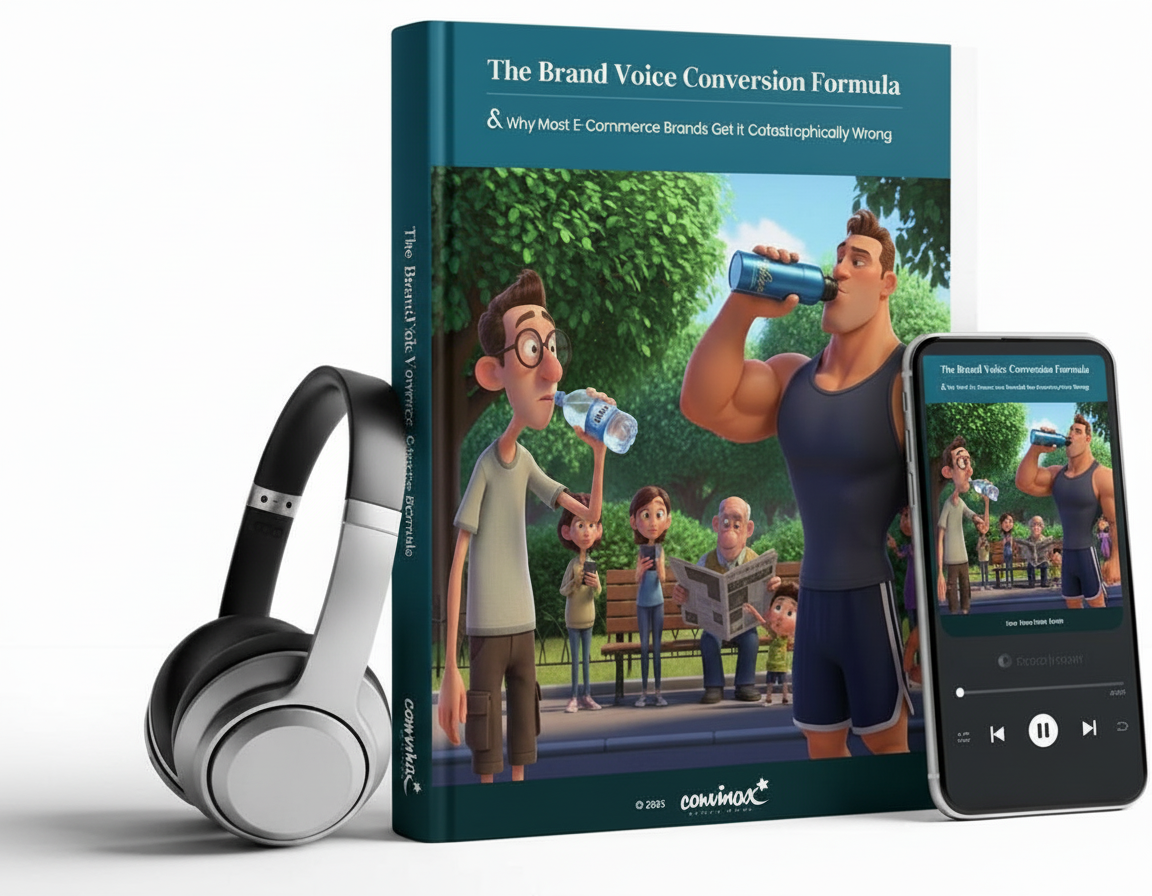
Brand Voice Conversion Formula

Original price was: £17.50.Current price is: £7.45.

This booklet synthesises findings from: 1. Academic Studies and Peer-Reviewed Journals The sources draw heavily from academic literature in the fields of consumer psychology, linguistics, and behavioural economics. Targeted Journals: Key insights are extracted from publications such as the Journal of Consumer Research, Journal of Marketing Research, Journal of Retailing, and the International Journal of Research in Marketing. Foundational Theories: Research synthesises concepts like Cognitive Load Theory, Grounded Cognition, and Social Presence Theory to explain how brand voice affects the human brain. 2. Industry Research and Benchmarking Reports Insights are gathered from leading UX research firms and e-commerce platforms to…

Category:
Tags: ,

Right now, 70% of shoppers are abandoning their carts on your site. Not because your product is wrong or your price is too high – but because every inconsistent message, every unclear label, and every jarring tone shift is creating cognitive frictionย in their brains.

And cognitive friction kills conversion.

What you will find in this article:

  • Discover how brand voice taps into behavioural science, triggering real physiological responses that increase perceived value and willingness to pay

  • See why a consistent brand voice reduces friction, builds trust, and quietly drives higher conversions across every touchpoint

  • Learn how to adapt your brand voice for mobile, where you have less than a quarter of a second to capture attention and communicate value

  • Uncover the messaging patterns at checkout that reduce hesitation and help recover otherwise lost purchases

  • Explore how language style impacts conversion, from sensory descriptions to simplicity and tone, and how to match it to your category

  • Find out why high-income audiences are often harder to reach online, and how to optimise your messaging for limited attention

  • Get ready-to-use voice variations across CTAs, product descriptions, and emails that are designed to be tested and refined

  • Understand how to run clean, reliable experiments on your messaging, so you can measure what actually drives results and scale with confidence

Every claim is cited. Every statistic is sourced. Every recommendation is testable.

This booklet synthesises findings from:

Academic Studies and Peer-Reviewed Journals

The sources draw heavily from academic literature in the fields of consumer psychology, linguistics, and behavioural economics.

  • Targeted Journals: Key insights are extracted from publications such as the Journal of Consumer Research, Journal of Marketing Research, Journal of Retailing, and the International Journal of Research in Marketing.
  • Foundational Theories: Research synthesises concepts like Cognitive Load Theory, Grounded Cognition, and Social Presence Theory to explain how brand voice affects the human brain.

Industry Research and Benchmarking Reports

Insights are gathered from leading UX research firms and e-commerce platforms to provide global conversion standards.

  • Specialised UX Research: Extensive use is made of the Baymard Institute for checkout and findability benchmarks, and the Nielsen Norman Group for quantifying the impact of tone on trust and desirability.
  • Industry Trends: Reports from organisations like McKinsey & Company on personalisation, Adobe on digital trends, and Shopify on conversion benchmarks are central to the analysis.
  • Brand Consistency Data: Surveys from firms like Marq (formerly Lucidpress) and Demand Metric quantify the “consistency dividend” in terms of revenue growth.

Controlled Experiments and Placebo Studies

Several articles highlight controlled, pre-registered experiments that isolate the effect of language from physical product attributes.

  • Water Labelling Experiments: Multiple studies, including the “AquaCharge” placebo study published in PLOS ONE and representational shift research in BMC Public Health, demonstrate that brand messaging can trigger measurable physiological and psychological responses.
  • Linguistic Sound Symbolism: Research into how phonetic structures (voiced vs. voiceless consonants) on labels influence perceptions of carbonation and purity.

Real-World Case Studies and Industry A/B Testing

Practical evidence is derived from the documented performance of major global brands and specialised testing agencies.

  • Retail Giants: The synthesis analyses Amazon’s conversion-optimised structure, Nike’s member-first digital voice, and Sephora’s A/B testing on notification messaging.
  • Conversion Optimisation Agencies: Data is pulled from compilations by Optimizely, VWO, and SaleCycle, showing specific uplifts from CTA word swaps and abandoned cart recovery campaigns.

Specialised Neuroscience and Behavioural Research

To understand the “why” behind consumer actions, the articles synthesise findings from specialised scientific methodologies:

  • Neuroscience: The reports cite fMRI studies (e.g., the Max Planck Institute’s cola experiment) and EEG measurements to track reward processing and cognitive load during shopping tasks.
  • Attention Economics: Research from the National Bureau of Economic Research (NBER) provides an economic modelling framework for how households allocate limited online attention.
  • Eye-Tracking: Visual attention patterns, such as the F-shaped and Z-shaped reading patterns, are synthesised from lab studies to determine which textual elements (bullets, titles) users actually read.

Every claim is cited. Every statistic is sourced. Every recommendation is testable.

Related products
0