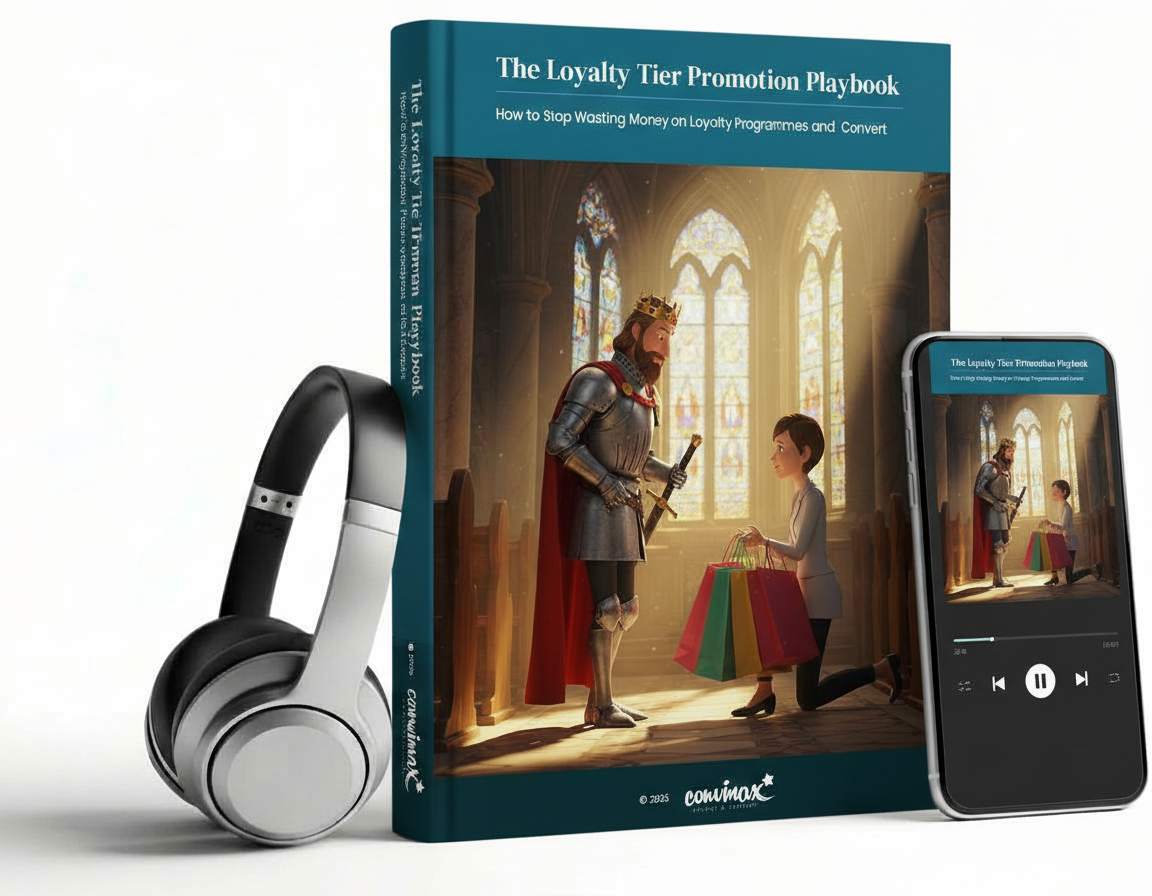
Loyalty Tier Optimisation

£17.50

This booklet synthesises findings from: Academic and Peer-Reviewed Research The articles rely heavily on scholarly work published in major business and marketing journals. Literature Reviews: A comprehensive 30-year systematic review of loyalty programs (Chen et al., 2021) provides the foundational evidence for program effectiveness. Behavioural Economics & Psychology: Sources cite studies from Columbia University on choice paralysis and cognitive load. They also reference peer-reviewed work on “Status Signalling” and the “Goal-Gradient Hypothesis” from journals like the Journal of Consumer Researchย and Marketing Science. Longitudinal Studies: One specific study from PMC (PubMed Central) tracked 31,746 purchases over 13 years to analyse the…

You’ve built the tiers. You’ve written the benefits. You’ve launched the emails.

And yet – the numbers aren’t moving the way they should.

Customers sign up, collect a few points, then carry on spending exactly as before. Your programme exists. It just isn’t working.

Here’s what most e-commerce brands get completely wrong: they confuse having a loyalty programme with running one. The structure isn’t the strategy. The tiers aren’t the tactic. And the research – drawn from three decades of peer-reviewed studies and data from hundreds of millions of sessions – confirms that the gap between a programme that generates passive costs and one that drives compounding revenue comes down to a single, overlooked mechanic.

This article explains exactly what that mechanic is, how it works psychologically, and how to implement it with the kind of rigour that produces results you can defend in a boardroom.


What this article reveals

The findings here aren’t opinion. They’re drawn from academic journals, including Marketing Scienceย and the Journal of Consumer Research, a 13-year longitudinal study tracking over 31,000 purchases, and industry benchmarks from platforms analysing hundreds of millions of e-commerce sessions.

Here’s a taste of what the research uncovers – and what might surprise you:

  • The article reveals why 72% of consumers buy more frequently from loyalty programmes – but only under one specific condition that most brands never meet. Are you meeting it?
  • The article reveals the exact conversion rate gap between mobile and desktop that should reshape how you display tier promotions – and why fixing your desktop experience first may be the wrong priority.
  • The article reveals what a 13-year academic study found changes actually when customers join a loyalty programme – and it’s almost certainly not what you’re currently measuring.
  • The article reveals why one of the world’s most recognisable brands scrapped points entirely, and what happened to their revenue in the five years that followed.
  • The article reveals the specific percentage uplift in purchase likelihood that paid loyalty tiers produce over free ones – and why most brands are leaving this lever completely untouched.
  • The article reveals how much of the average e-commerce conversion improvement is achievable simply by changing where and how you display tier status – no new tech required.
  • The article reveals why most A/B tests run on loyalty promotions are statistically worthless – and the minimum you need to run a test that actually tells you something.
  • The article reveals the psychological trigger that causes customers to accelerate their spending as they approach a tier threshold – and how to design for it deliberately.

In depth:

  • Does The “More Tiers” Myth Sabotage Sales
  • Nike’s ยฃ700 Million “Points-Free” Strategy
  • The “Subordinate Tier” Psychological Hack
  • Do Paid Loyalty Programs Outperform Free Ones
  • The Mobile Conversion “Terror” Statistic
  • Discounts are Not What Customers Actually Want
  • Most “Loyalty Successes” are Actually Statistical Luck


This isn’t about adding more tactics to your already overwhelming to-do list. It’s about understanding which lever actually moves the needle – and having the data to prove it to stakeholders.

This booklet synthesises findings from:

Academic and Peer-Reviewed Research

The articles rely heavily on scholarly work published in major business and marketing journals.

  • Literature Reviews: A comprehensive 30-year systematic review of loyalty programs (Chen et al., 2021) provides the foundational evidence for program effectiveness.
  • Behavioural Economics & Psychology: Sources cite studies from Columbia University on choice paralysis and cognitive load. They also reference peer-reviewed work on “Status Signalling” and the “Goal-Gradient Hypothesis” from journals like the Journal of Consumer Researchย and Marketing Science.
  • Longitudinal Studies: One specific study from PMC (PubMed Central) tracked 31,746 purchases over 13 years to analyse the long-term impact of loyalty membership on purchase frequency.

Industry Research and Global Benchmarks

Findings are supported by data from global consultancies and e-commerce platform providers.

  • Global Consultancies: Reports from McKinsey & Companyย are used to demonstrate the superior performance of paid loyalty programs over free ones.
  • Platform Data: Benchmarks from Shopify, Klaviyo, Adobe, and Dynamic Yieldย provide real-world conversion rates across different industry sectors and devices.
  • Sector-Specific Performance: Data from IRP Commerceย and Speedcommerceย is used to provide the 2024โ€“2025 conversion benchmarks for different industries, such as Food & Beverage and Fashion.

UX and Usability Research

A significant portion of the articles focuses on “Attention Economics,” drawing from specialised usability testing.

  • Eye-Tracking Studies: Research from the Baymard Instituteย (based on 71,000+ hours of research) and the Nielsen Norman Groupย (NN/g) provides evidence for visual hierarchy, F-pattern reading, and the impact of cognitive load on mobile vs. desktop conversion.
  • Heatmap Analysis: The sources reference heatmap data to show that areas with high “fixation density” see 3x higher engagement.

Real-World Case Studies

The synthesis includes high-profile examples of brands that have successfully implemented these strategies.

  • Brand Performance: Investor releases and case studies from Starbucks, Nike, and Sephoraย are used to illustrate how simplified tiers (Starbucks) or points-free models (Nike) lead to massive revenue growth.
  • Cultural Comparisons: A comparative study of Starbucks Rewards in the UK and Chinaย is cited to show how program effectiveness can vary across different geographic markets.

Controlled Experiments and A/B Testing

The articles provide specific frameworks based on rigorous experimental design.

  • Statistical Standards: The sources define the “Statistical Significance Standard” required for credible testing, citing a need for a 95% confidence levelย and 80โ€“90% statistical power.
  • Testing Methodologies: Strategies for randomised and stratified A/B testing are synthesised from professional testing resources like CXL, VWO, and AB Tasty

Every claim is cited. Every statistic is sourced. Every recommendation is testable.

0