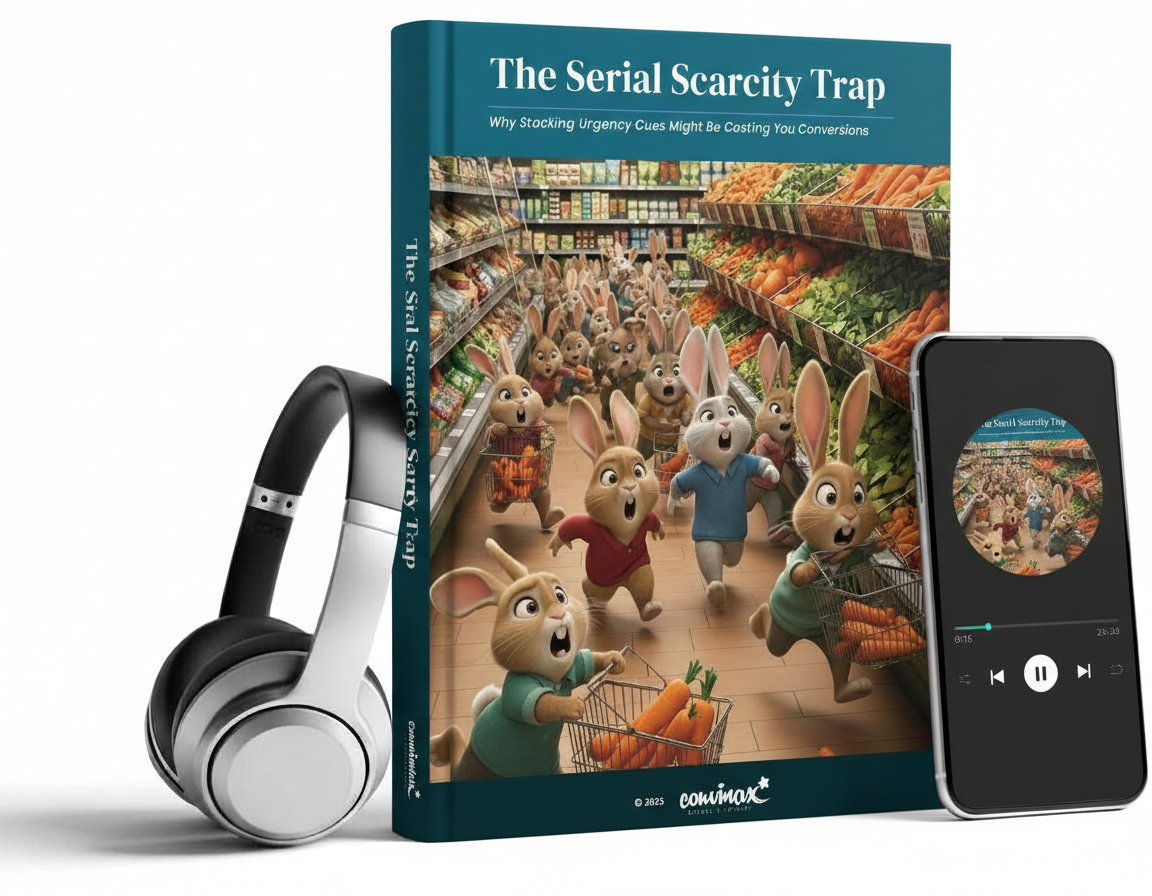
Stop Stacking Scarcity: Why “Only 2 Left” is Secretly Killing Your Sales
Every conversion expert and their dog will tell you the same thing: “Add scarcity cues. Show low stock. Display viewer counts. Stack them for maximum impact.”
So you did. You added “Only 3 left!” next to “12 people viewing this right now!” Maybe you threw in a countdown timer for good measure.
And now? Your conversion rate is… fine. Not great. Just fine.
Here’s what nobody’s telling you: those multiple urgency cues you’re testing might be actively repelling your best customers.
The inconvenient truth hiding in the research
Meta-analyses covering 416 effect sizes. Industry data from Baymard Institute and Nielsen Norman Group. Academic research from marketing and psychology journals. Case studies from global brands.
What emerged wasn’t what the conversion optimisation industry wants you to hear.
The research on serial scarcity – those stacked urgency messages you see everywhere – is inconclusive at best. And for certain customer segments (hint: the sophisticated, educated buyers you actually want), it’s damaging at worst.
What you’re about to discover
This isn’t another blog post promising you “300% conversion lifts with one weird trick.”
This is a comprehensive, evidence-based analysis that will save you from wasting time, money, and customer trust on tactics that don’t work – or worse, actively harm your business.
Inside this report, you’ll learn:
- Why 90% of A/B tests show less than 1.2% effect on revenue (and what that means for your urgency experiments)
- The exact sample sizes you need for statistically valid scarcity tests (spoiler: it’s probably 10x what you’re currently running)
- Why mobile users – who drive 60% of your traffic but convert at half the rate – respond differently to urgency cues
- The “credibility paradox”: how adding a second cue to validate the first actually destroys trust
- What 19% of shoppers do when they detect fake scarcity (and the long-term cost to your brand)
- Which scarcity types work for which product categories (demand-based shows 195% greater effectiveness than supply-based for specific products)
- The Booking.com exception – and the three critical reasons you can’t copy their playbook
- A practical, research-backed framework for strategic scarcity that actually works
Additionally:
- The “Sophistication” Repulsion
- The 6% Decision Trap
- The “Zero Effect” Reality
- Demand Outperforms Supply by 195%
- The “Uncertainty” Backfire
- The Loyalty Tax
- The Booking.com Myth
This isn’t about adding more tactics to your already overwhelming to-do list. It’s about understanding which lever actually moves the needle – and having the data to prove it to stakeholders.
This booklet synthesises findings from:
Academic and Peer-Reviewed Research
The articles heavily rely on formal academic studies to establish the psychological foundations of scarcity:
- Meta-Analyses: Large-scale reviews of existing literature, including a significant study encompassing 416 effect sizes from 131 different studies.
- Specialised Journals: Research is cited from top-tier publications such as the Journal of Consumer Research, Journal of Marketing Research, Marketing Science, and Psychological Science.
- Psychological Frameworks: The sources apply established theories like Cognitive Load Theory, Commodity Theory, the Stimulus-Organism-Response (S-O-R) model, and Competitive Arousal models to explain consumer behaviour.
Industry Benchmarks and Expert Reports
To provide real-world context, the sources utilise data from major e-commerce platforms and research firms:
- UX Research Giants: Insights are drawn from the Baymard Institute (over 150,000 hours of UX research) and the Nielsen Norman Group (20+ years of usability research).
- Conversion Benchmarks: Data is synthesised from industry leaders like Dynamic Yield, Smart Insights, Retail Touchpoints, and Adobe for Business.
- Platform-Specific Data: Trends and benchmarks from platforms like Shopify, Klaviyo, and Omnisend are used to establish baseline conversion and add-to-cart rates.
Controlled Experiments and A/B Testing
Practical evidence is derived from rigorous testing methodologies:
- Aggregated A/B Test Data: One analysis includes a meta-analysis of over 6,700 individual A/B tests to determine average conversion lifts.
- Statistical Tools: The methodology for these tests often references established statistical calculators like those from Evan Miller and Optimizely to ensure 95% confidence levels.
- Experimental Metrics: Findings are based on primary metrics such as bounce rate, add-to-cart rate, and revenue per session, often segmented by device (mobile vs. desktop).
Real-World Case Studies
The articles examine the practical application of scarcity tactics by global industry leaders:
- Booking.com & Expedia: Frequent analysis of their “multi-cue stacks” used in travel booking.
- Retail Giants: Case studies from Amazon, Walmart, ASOS, Nike, Sephora, and IKEA demonstrate how scarcity affects different product categories.
- SaaS and Tech: Examples from companies like HubSpot, Apple, and Netflix illustrate how urgency impacts lead generation and product launches.
Investigative Journalism and Regulatory Analysis
The sources also look at the ethical and legal risks of these tactics:
- “Dark Pattern” Audits: References to investigations by Wired and Princeton researchers that expose deceptive countdown timers and fake stock numbers.
- Regulatory Warnings: Analysis of how deceptive tactics may attract attention from regulatory bodies.
Specialised Methodological Research
Some findings come from advanced technical studies, including:
- Eye-Tracking Studies: Measuring exactly where users look on a page when exposed to different urgency signals.
- EEG and Physiological Studies: Using brain activity measurements to gauge cognitive load and arousal levels in shoppers
Every claim is cited. Every statistic is sourced. Every recommendation is testable.