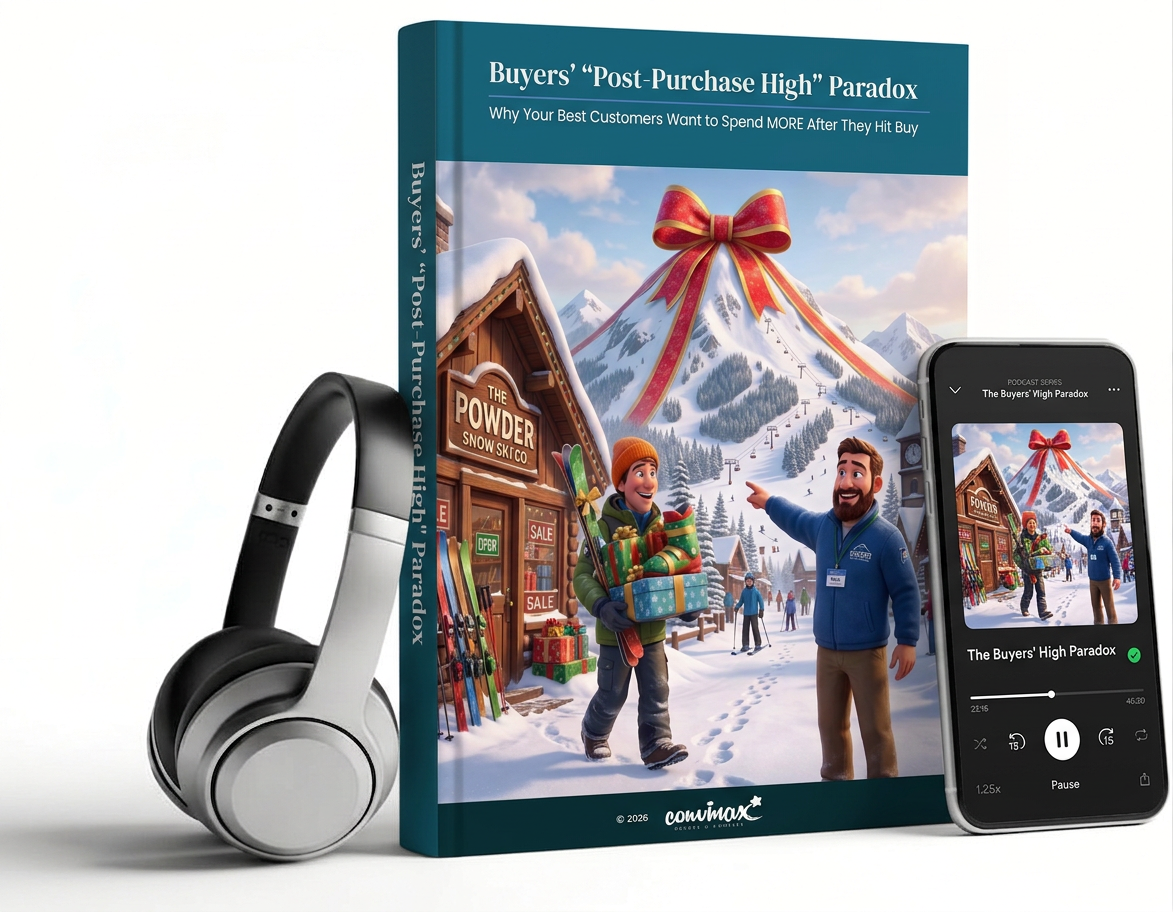
You already paid to get this customer. You already won the sale. So why does your thank-you page do nothing but say “cheers” and point at the door?
There’s a 60-second window, right after checkout, where customers are measurably more likely to buy again than at almost any other point in their relationship with you. Most stores waste it completely. This research booklet shows you exactly what’s happening in that window, what it’s worth, and how to capture it without annoying a single customer.
Rising ad costs. Shrinking margins. Every extra pound of revenue getting harder to earn from cold traffic.
And the whole time, there’s a moment sitting inside your own checkout flow that converts at multiples of your best marketing email – and you’re not using it.
Most merchants either ignore this moment entirely, or get it badly wrong: bolting on random offers, discounting too hard, or interrupting the customer at exactly the wrong point in the journey. Both mistakes cost real money. One wastes an opportunity. The other actively damages trust.
The problem isn’t that this tactic doesn’t work. It’s that almost nobody implements it using the evidence. This booklet gives you the evidence.
This is a research-backed breakdown of the post-purchase upsell moment – the psychology behind it, the real numbers behind it, and the exact way to implement it without annoying a single customer.
What the article reveals:
- The article reveals why a customer who’s just paid is, counter-intuitively, in the most persuadable state they’ll be in for weeks– and the exact psychological mechanism behind it.
- Find out how much higher a well-placed post-purchase offer can price itself compared to anything you’d dare show mid-checkout – and why the discount you’re probably offering is too deep.
- The data shows what happens to your checkout conversion rate when you add a post-purchase offer– and it isn’t what most merchants assume.
- Discover which one of four common objections to this tactic actually holds up under scrutiny– and which three are simply wrong.
- See the named case studies and benchmark ranges for acceptance rate, AOV lift and customer lifetime value– including one randomised experiment with a revenue lift most marketers would assume is a typo.
- Learn the single design mistake that quietly caps your acceptance rate on mobile, where most of your traffic already lives.
This booklet synthesises findings from:
Academic Research & Scientific Studies
- Fagerstrøm, A., Arntzen, E., & Volden, M. (2021). “Motivating Events at the Point of Online Purchase: An Online Business-to-Business Retail Experiment.” Procedia Computer Science, 181, 702-708. This field study demonstrates that up-sell offers can yield conversion rates of approximately 39% and increase revenue by 87.94% in a B2B context.
- Freedman, J. L., & Fraser, S. C. (1966). “Compliance without pressure: The foot-in-the-door technique.” Journal of Personality and Social Psychology. This foundational research establishes that small initial commitments significantly increase the likelihood of agreeing to larger, related follow-on requests.
- Isenberg, N., & Brauer, M. (2022).“Commitment and Consistency.” The Routledge Companion to Consumer Behaviour Analysis. This review synthesises decades of replication studies regarding behavioural consistency as a judgment heuristic used to ease decision-making.
- Li, S., Sun, B., & Montgomery, A. L. (2011). “Cross-Selling the Right Product to the Right Customer at the Right Time.” Journal of Marketing Research. This study provides a quantitative foundation for the importance of matching product, customer profile, and timing to maximise cross-sell success.
- MDPI (2026). “From Click to Regret: The Link Between Impulsive Online Buying and Post-Purchase Cognitive Dissonance.” This study uses the Stimulus-Organism-Response (S-O-R) model to show how utilitarian value and FOMO drive impulsive buying, which can predict later regret.
- ScienceDirect (Various Dates). “Promoting product returns? The impact of at-purchase and post-purchase discounts on customers’ return behaviour.” Large-scale transaction research found that post-purchase discounts exceeding 25% non-linearly increase return rates.
- Zhao, Y., et al. (2021). “A Meta-Analysis of Online Impulsive Buying and the Influencing Factors.” PMC. This meta-analysis of 258 citations concludes that frictionless checkout and prominent recommendation widgets significantly increase impulse purchases.
Industry Benchmark Reports
- Baymard Institute (2023-2026).“6 Ways to Get More Out of Your Order Confirmation Page” and “Cross-Sells Checkout Benchmarks.” This UX research finds that 66% of users feel frustration when forced into cross-sells during checkout, recommending post-payment placement instead.
- BigCommerce (2024). “Fiscal Year 2024 Financial Results and B2B Growth Analysis.” Reports that B2B Gross Merchandise Volume (GMV) grew over 50% year-over-year, highlighting the expansion of upsell functionality in the sector.
- EasyApps Ecommerce (2026). “Shopify Upsell Conversion Benchmarks 2026.” Reports that one-click post-purchase upsells achieve 5–12% acceptance and increase AOV by 12–22%.
- Focus Digital (2025). “Average Upsell Conversion Rate: 2025 Report.” Finds that mobile apps outperform mobile web upsell acceptance by 68% due to stored payment credentials.
- McKinsey & Company (2025). “Ecommerce Revenue Optimisation Report.” Identifies automated post-purchase flows as the “single highest-ROI automation” available to e-commerce brands, often delivering a 20% AOV increase.
- Nielsen Norman Group. “Commitment and Consistency Principle in UX.” Explains how behavioural consistency functions as a heuristic that brands can leverage to ease decision-making for existing buyers.
- SamCart (2026). “The State of Digital Commerce: Analysis of $7B+ Processed Sales.” Data shows that adding a single one-click upsell results in an average 68% increase in AOV.
- Louis Federal Reserve. “Loss Aversion and the Endowment Effect Research.” Documents how ownership bias reduces price sensitivity for add-on items that enhance a primary purchase.
Merchant Case Studies & Implementation Data
- 310 Nutrition. “Post-Purchase Scaling Case Study.” Achieved a 25% boost in AOV and a 30% acceptance rate by offering complementary supplements immediately after checkout.
- BombTech Golf. “AOV and Conversion Optimisation.” Reported a $60+ improvement in AOV and a 45% increase in website conversion rates through post-purchase accessory funnels.
- Calm Strips. “Mystery Upsell Innovation.” Used gamification and curiosity to achieve a 57% conversion rate on mystery items, generating $16,000 in incremental revenue over three months.
- “Two Ecommerce Upsell A/B Tests.” Documented a furniture store test that increased AOV by $55, translating to a projected $2 million in extra annual revenue.
- Kettle & Fire. “Revenue Per Customer Scaling.” Reported a 41% increase in average revenue per customer by deploying one-click flavour and subscription upgrades.
- “Targeted Upsell Case Study.” Increased AOV from $45 to $73 using a single, well-timed post-purchase offer.
- “Skincare Revenue Synthesis.” Documented a single brand adding $27,860 in incremental revenue in 30 days at a 9.46% conversion rate.
- US Tech Automations. “ROI Analysis of Post-Purchase Loops.” Calculated an ROI of 1,133% in Year 1 for an evidence-based upsell program.
- “Post Purchase Upsell: Best Practices & Merchant Insights.” Benchmarks indicate that customers who accept offers have 2.4x higher CLV.