Why a 10-Second “Fake” Delay Actually Triples Your Sales: The Dark Psychology of Assessment Funnels
You’re getting visitors. You’re spending on ads. You’re tweaking headlines, testing buttons, and shuffling layouts.
And your conversion rate? Still stubbornly stuck somewhere between “fine” and “frustrating.”
Here’s what nobody tells you: the gap between a 2.5% conversion rate and a 30%+ one isn’t about better copy or a cleaner checkout. It’s about a fundamental shift in how you structure the experience – one that most businesses haven’t made yet.
This article explains exactly what that shift looks like, why it works, and how to apply it to your own funnel – whether you’re running a side hustle, a subscription product, a coaching offer, or a full e-commerce operation.
What You’re Getting
- The effect of “waiting” before showing results.
- How a little mental effort can make users value their outcome differently.
- The critical time window that can make or break a conversion.
- Does having too many options affect sales?
- The device that secretly drives higher conversions for complex purchases.
- The subtle psychological triggers that push users to act fast.
This isn’t about adding more tactics to your already overwhelming to-do list. It’s about understanding which lever actually moves the needle – and having the data to prove it to stakeholders.
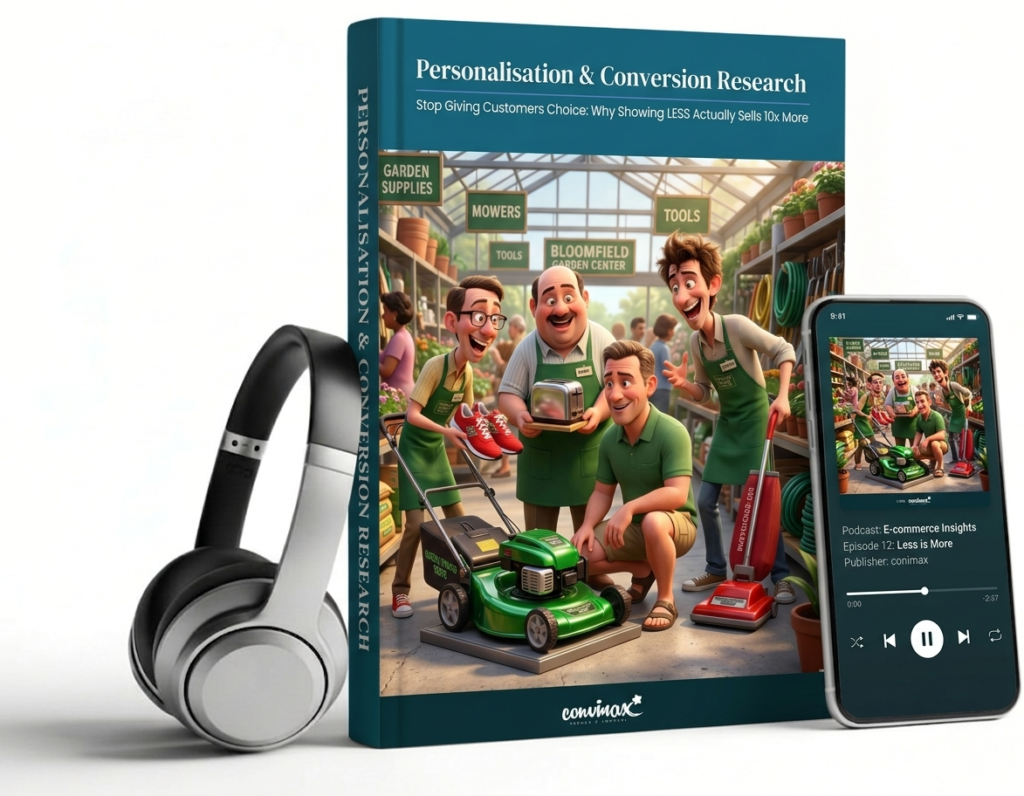
This booklet synthesises findings from:
- Peer-Reviewed Academic Studies: The research incorporates data from high-impact journals such as ScienceDirect, Journal of Consumer Psychology, and Psychological Science. These studies provide the theoretical foundation for concepts like Cognitive Load Theory, Choice Overload, and Self-Determination Theory.
- Industry Research and Benchmarks: Findings are heavily supported by aggregated data from leading marketing platforms and e-commerce analysts, including Interact, Outgrow, HubSpot, and Klaviyo. These sources provide real-world conversion benchmarks, such as the 1% lead capture rate common in quiz funnels.
- Controlled Experiments (A/B Testing): The articles reference large-scale online controlled experiments (RCTs) and meta-analyses of thousands of A/B tests. This includes methodological guidance from researchers at Microsoft and Stanford to ensure statistical significance in funnel optimisation.
- Real-World Case Studies: Practical evidence is drawn from major brands that utilise assessment-driven psychology, such as Lumosity (brain training), Stitch Fix (fashion subscriptions), and Sephora (Colour IQ). These cases demonstrate how the “IKEA Effect” and personalised recommendations translate into 3–4x higher conversion rates.
- UX Research and Eye-Tracking Data: Strategic design recommendations are pulled from specialised usability institutions like the Baymard Institute and Nielsen Norman Group. This research highlights how visual hierarchies and frictionless checkout flows impact user attention and abandonment rates.
- Behavioural Economics and Attention Economics: The synthesis includes an analysis of the “Sunk Cost Fallacy” and “Endowment Effect” to explain user commitment after completing a test. It also examines the “Attention Economy,” focusing on how limited cognitive capacity influences purchase decisions.
- Cross-Platform Performance Data: The articles analyse performance disparities between mobile and desktop using 2024–2025 e-commerce data to identify why desktop conversion rates remain roughly 52% higher than mobile for complex tasks
Every claim is cited. Every statistic is sourced. Every recommendation is testable.