
Optimising Ecommerce Information Architecture

Original price was: £17.50.Current price is: £7.45.

This booklet synthesises findings from: Industry-Leading UX and Usability Research Baymard Institute: These articles rely heavily on Baymard’s 2024 and 2025 studies, which involve over 5,550 research hours and more than 4,400 moderated usability sessions across hundreds of e-commerce sites. Nielsen Norman Group (NN/g): The sources draw on NN/g’s foundational usability principles and longitudinal expert reviews (updated through 2024) regarding information scent and eye-tracking data. Controlled Production A/B Experiments Walmart (2024): A production tail-traffic A/B test that proved reducing clicks before an add-to-cart event directly improved conversion rates. com (2025): A live-traffic experiment testing AI-generated dynamic facets against static category…

Flat vs Deep Navigation? You’re Both Arguing About the Wrong Thing

The debate that’s quietly costing you sales – and it’s not the one you’ve been having.

You’ve spent months on your checkout. New button colours. Fewer form fields. Trust badges above the fold. And your conversion rate hasn’t moved.

Here’s the uncomfortable bit: the leak probably isn’t at checkout at all. It’s happening earlier – before a single item reaches the cart – when a motivated shopper tries to find what they came for and quietly gives up. No bounce event. No abandoned-cart email trigger. Just a customer who concludes you don’t stock what they need, and leaves.

Meanwhile, most teams are stuck arguing whether their navigation should be “flat” or “deep,” as if that’s the decision that determines whether people buy. It isn’t. And treating it like it is means you’re optimising the wrong thing, indefinitely.

This research booklet lays out what the evidence – large-scale usability testing, peer-reviewed studies, and live production A/B tests from major retailers – actually says about why navigation fails, why it’s a bigger conversion lever than most checkout work, and what to do about it.

What the article reveals:

  • Why the “three-click rule” your team probably still quotes in meetings has been directly contradicted by usability research – and what actually predicts whether a shopper gives up.
  • How many motivated shoppers fail to find a product that’s genuinely on your site, and why they blame the retailer, not themselves.
  • What one online retailer discovered when they deliberately removed navigation from a page altogether, and why that finding isn’t the loophole it sounds like.
  • Why almost seven in ten mobile sites are getting a specific navigation habit wrong, and how it hits mobile shoppers harder than desktop ones.
  • Why “we already have breadcrumbs” doesn’t settle the argument, and what breadcrumbs were never designed to fix.
  • What happened to click-through and sales when a major online retailer ran a live test replacing rigid categories with smarter filtering.
  • The psychology experiment behind why giving shoppers more choice can make them less likely to buy, and where the tipping point sits.

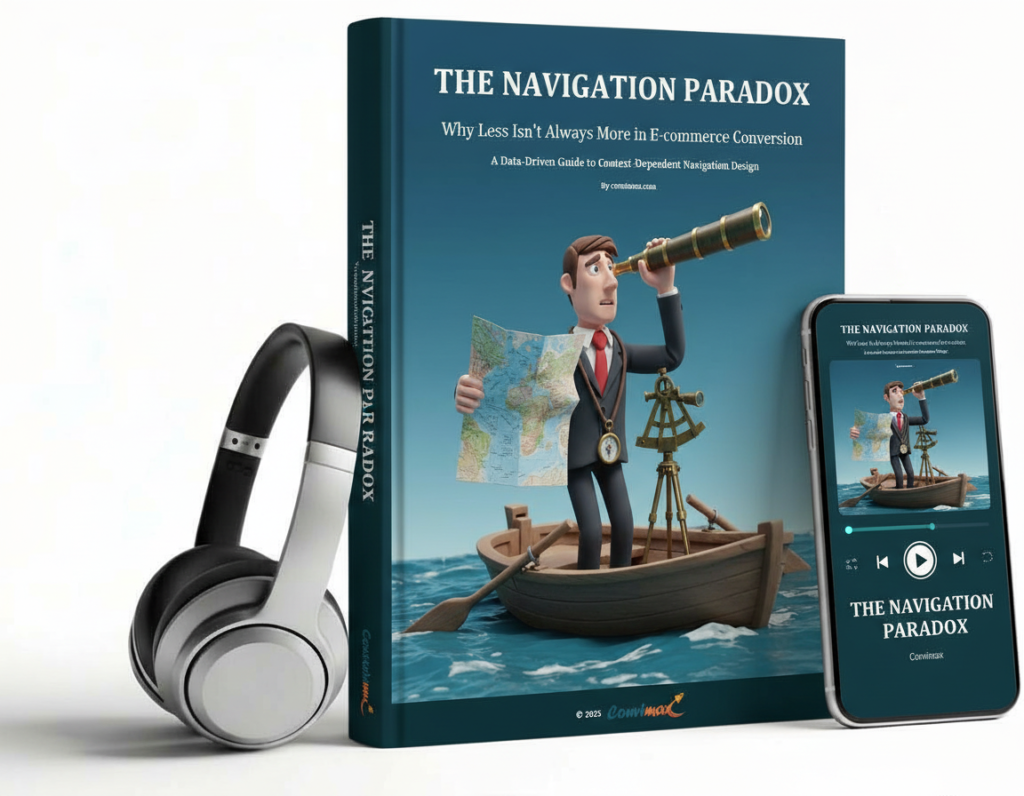
This booklet synthesises findings from:

  1. Industry-Leading UX and Usability Research
  • Baymard Institute: These articles rely heavily on Baymard’s 2024 and 2025 studies, which involve over 5,550 research hours and more than 4,400 moderated usability sessions across hundreds of e-commerce sites.
  • Nielsen Norman Group (NN/g): The sources draw on NN/g’s foundational usability principles and longitudinal expert reviews (updated through 2024) regarding information scent and eye-tracking data.
  1. Controlled Production A/B Experiments
  • Walmart (2024): A production tail-traffic A/B test that proved reducing clicks before an add-to-cart event directly improved conversion rates.
  • com (2025): A live-traffic experiment testing AI-generated dynamic facets against static category trees, showing a 42% increase in click-through rates.
  • Google/SOASTA: A massive study involving 30 million sessions across 37 brands that correlated 0.1-second speed improvements with an 8.4% conversion lift.
  1. Peer-Reviewed Academic Studies
  • Cognitive Psychology: Findings are rooted in Cognitive Load Theory (John Sweller), working memory capacity (George Miller’s 7±2 rule), and Behavioural Economics (Iyengar & Lepper’s “paradox of choice” jam experiment).
  • Human-Computer Interaction (HCI): Specific studies such as Zaphiris et al. (2002)and Kurtenbach et al. are cited for measuring precise navigation depth and response time.
  • Specialised Journals: Research is pulled from the Journal of Electronic Commerce Research (2025), Marketing Science, and Computers in Human Behaviour.
  1. Real-World Brand Case Studies
  • Retail Giants: The specific navigation strategies of Amazon (hybrid taxonomy), Alibaba/Taobao.com (category refinement), and Wayfair (faceted navigation).
  • Vertical-Specific Leaders: Case studies include ASOS (gender-first hierarchy), IKEA (physical store logic mirroring), and Netflix (network/associative taxonomy).
  • Platform-Specific Successes: CRO results from platforms like VWO (SlideShop, Yuppiechef) and Shopify (Jackson’s).
  1. Global Industry Benchmarks
  • Market Data: Conversion and abandonment benchmarks are synthesised from IRP Commerce, Dynamic Yield, Statista, and Oberlo.
  • Regional Trends: Analysis of regional performance differences in markets like the UK, Europe, North America, and Asia-Pacific.
Related products
0