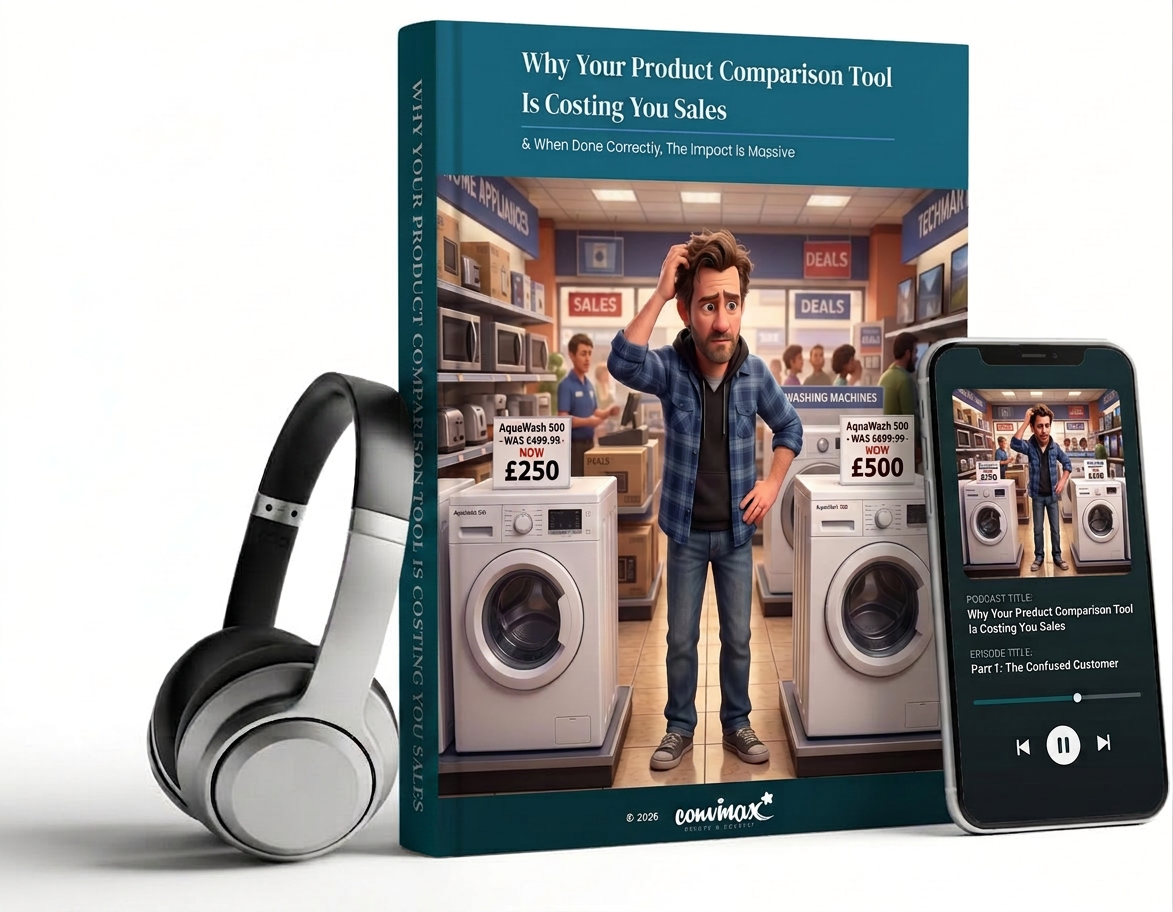
Your Product Comparison Tool Might Be Losing You Sales, Not Winning Them
The feature almost every e-commerce site builds – and almost nobody tests properly
You added a product comparison tool because it felt obvious. Customers compare things before they buy, so surely giving them a table to do it on helps.
Here’s the uncomfortable part: the research says that’s often wrong. A badly built comparison tool doesn’t sit there quietly being useful. It adds friction at the exact moment a customer is closest to buying – and on some sites, it’s actively pushing the conversion rate down.
This pack pulls together the psychology research, UX studies, device-level data and real case studies that explain when comparison tools help, when they quietly sabotage your conversion rate, and how to tell the difference on your own site before you spend another hour building or “improving” one.
What the article reveals:
- Why a well-known choice experiment found that showing people fewer options multiplied purchase rate by roughly ten times – and what that means for how many products you should ever let someone compare
- The precise number of items a comparison table can hold before your customers stop being able to properly weigh them up (most sites blow straight past it)
- Why well over half of leading e-commerce sites either don’t offer a comparison tool at all, or are missing one that their own customers clearly need
- Which device is your comparison tool quietly failing on, and why is the gap in conversion rate between that device and the rest bigger than most teams assume
- Why the categories most people think need a comparison tool are often exactly the ones where it makes no difference at all – and which categories it’s genuinely worth building for
- How much traffic do you actually need before you can trust the result of an A/B test on a feature like this (the number surprises most site owners)
- Two real case studies where getting this right produced triple-digit percentage lifts in conversion, and what specifically they did differently
- The “Decision Torture” Threshold
- The 10x Conversion Gap (Paradox of Choice)
- The “Beautiful Prison” of Content
- The Mobile Conversion Trap
- The “Digital Fatigue” Crisis
- Implicit vs. Explicit Comparison
This booklet synthesises findings from:
Industry UX and Usability Research
-
Baymard Institute. (2024). Product Finding 2024 Launch: Comparison Features for Spec-Driven Products.
-
Baymard Institute. (2025, April). Usability Study: How Users Scan, Evaluate, Filter, and Sort Products Within Listing Pages.
-
Baymard Institute. (2026). 2026 Roadmap: Retail Mobile Apps, Health and Beauty, Insurance and Groceries.
-
Nielsen Norman Group. (2024, February). Comparison Tables for Products, Services, and Features.
-
Nielsen Norman Group. (2026). E-commerce Conversion Rates and UX Guidelines.
Academic Journals and Technical Papers
-
International Journal of Research Publication and Reviews. (2025). Online E-commerce Price Comparison Tool using Python and Machine Learning.
-
Kakaria, S. (2023). Cognitive Load in Online Shopping. ScienceDirect.
-
Tandon, S., & Garkoti, S. (2024). An Approach to Optimise Conversion Rate using Behavioural Economics. ResearchGate.
-
Vedula, N., et al. (2023). Generating Explainable Product Comparisons for Online Shopping. Amazon Science.
-
Wang, Y. (2025). Cognitive Load in Online Shopping. ScienceDirect.
-
Wu, B., & Chen, J. (2018). Predictive Analytics of E-Commerce Search Behaviour for Conversion. CORE (Walmart.com dataset).
Market Analysis and Industry Benchmarks
-
Adobe. (2023). Average Ecommerce Conversion Rate Benchmarks: Q2 2022–2023.
-
Alexander Jarvis. (2026). Mobile vs Desktop Revenue in Ecommerce.
-
Forbes. (2026). UK E-commerce Statistics: Social Commerce and Consumer Trends.
-
Invespcro. (2025). Conversion Rate by Industry Benchmarks.
-
Retail Economics. (2025). E-commerce Delivery Benchmark Report 2025.
-
Shopify. (2026). UK Guidance on Price Comparison Websites and Apps.
-
SmartInsights. (2025). E-commerce Conversion Rate Benchmarks – 2025 Update.
-
Symend. (2025). Decision Fatigue in Digital Environments.
Case Studies and Platform Research
-
Bazaarvoice. (n.d.). Hobbycraft Success Story: The Impact of User-Generated Content on Conversion.
-
ConvertMate. (2025). Is Product Comparison the Secret to Higher Conversions?
-
Optimizely. (2024). 101 A/B Testing Ideas to Improve Conversions in 2024.
-
VWO. (n.d.). Flos USA Conversion Optimisation Case Study: Funnel Restructuring Results.
-
YouGov. (2024). Online Travel Portals and the American Consumer’s Journey.