Why Telling Customers “Don’t Buy Yet” Can Skyrocket Your Sales by 349%
Here’s a question that should keep you up at night: What if the words on your site are actively pushing customers away at the exact moment they’re ready to buy?
Not because your product isn’t good enough. Not because your prices are wrong. But because the way you’re talking to people – the tone, the pressure, the urgency – is triggering every anxiety alarm in their heads.
Most e-commerce businesses operate on a dangerous assumption: that customers need convincing. That if you just push harder, create more urgency, add another countdown timer, they’ll crack and buy.
The research says you’ve got it backwards.
What You’re About To Get Access To
This isn’t another “10 tips to boost conversions” listicle. This is a comprehensive breakdown of actual, peer-reviewed research – plus real case studies from companies that tested supportive messaging against traditional sales tactics.
Inside, you’ll find:
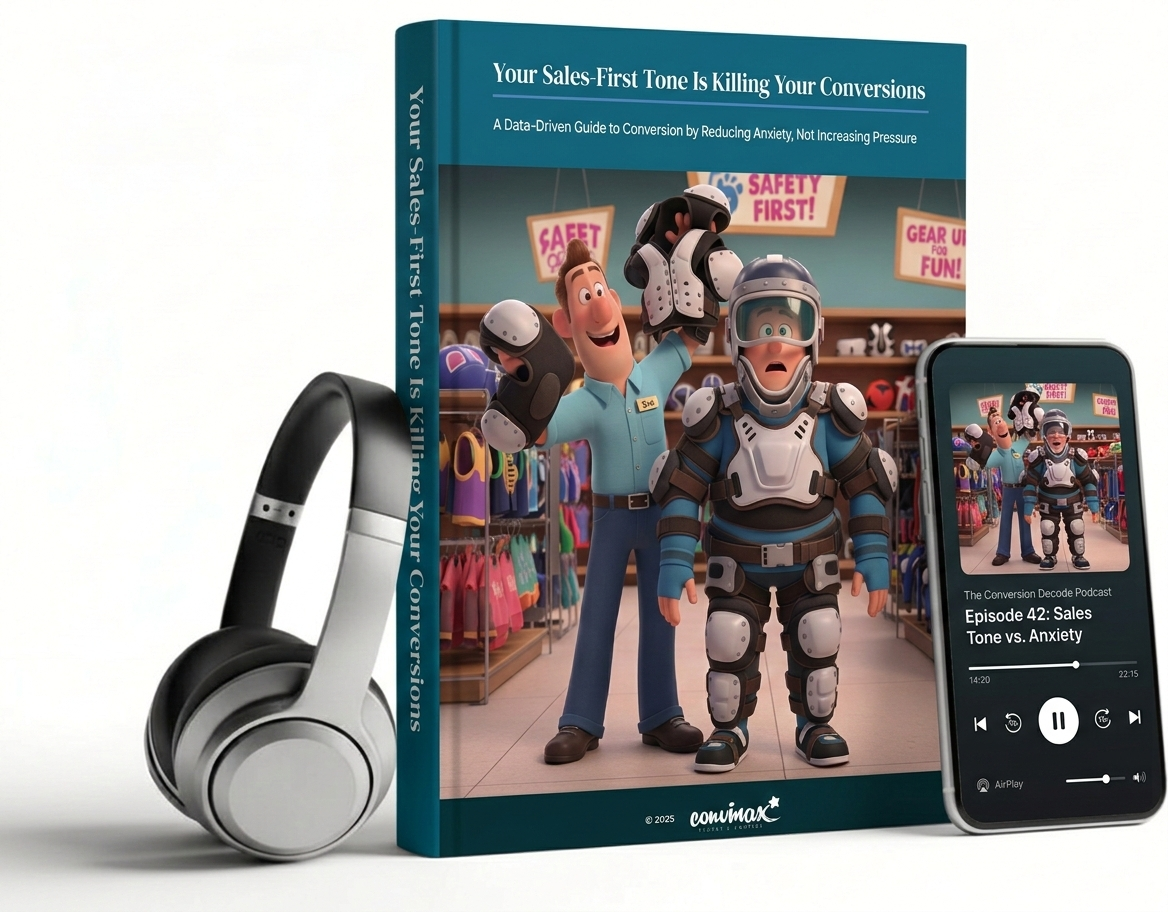
The Active Network case study documented a 349% increase in conversions simply by changing email tone from pushy to supportive. (Yes, that’s three hundred and forty-nine per cent. From changing words.)
The neuropsychology behind why certain messaging literally activates your customer’s threat response, while other messaging activates reward centres. This isn’t marketing theory – it’s brain scans.
Specific, tested frameworks for identifying customer anxiety at each stage of your funnel and addressing it with precision. Product page. Cart. Checkout. Abandoned cart emails. The works.
Platform-specific benchmarks showing exactly how trust signals, supportive copy, and anxiety-reduction tactics perform across mobile versus desktop, email versus on-site, and different industries.
The proximity principle that increased one company’s conversions by 78% just by moving content to where anxiety peaks. (This one change alone could transform your product pages.)
Sample copy and messaging frameworks you can adapt immediately, based on what actually worked in controlled tests across thousands of e-commerce stores.
But more importantly, you’ll understand why it works. Because once you grasp the psychology, you can apply it to every element of your business – not just copy the examples.
In Addition:
- Sales Pitch type that triggers a “Fear” Response in the Brain
- The “Non-Binding” Add-to-Cart Hack
- The 349% Supportive Lift
- Price is Rarely the Problem
- The Power of “No Pressure” Confirmations
- The Tone Type That Wins the Long Game
This isn’t about adding more tactics to your already overwhelming to-do list. It’s about understanding which lever actually moves the needle – and having the data to prove it to stakeholders.
This booklet synthesises findings from:
Peer-Reviewed Academic Research
The articles draw heavily on academic studies from prestigious journals to explain the psychological and neurological drivers of consumer behaviour:
- Marketing and Consumer Journals: Insights are pulled from the Journal of Marketing Research, Journal of Consumer Research, Marketing Science, and the Journal of the Academy of Marketing Science.
- Psychology and Behavioural Science: Research is cited from Psychology & Marketing, Journal of Consumer Psychology, and the Journal of Experimental Psychology.
- Neuroscience/Neuromarketing: The sources utilise fMRI neuroimaging and EEG studies to map brain activity, such as the activation of the amygdala (threat detection) during high-pressure sales versus the ventral striatum (reward anticipation) during supportive interactions.
- Technology and E-Commerce Journals: Findings are synthesised from ScienceDirect, Electronic Commerce Research and Applications, and the Journal of Electronic Commerce Research.
- Industry Research and Benchmarks
The sources incorporate data from leading UX research organisations and marketing platforms that analyse thousands of websites and millions of interactions:
- UX Research Giants: Data from the Baymard Institute (over 88,000+ hours of UX research) and the Nielsen Norman Group (NN/g) provides the foundation for findings on cart abandonment and trustworthiness.
- Platform Benchmarks: Aggregate data is pulled from e-commerce and email leaders like Shopify, Klaviyo, Mailchimp, and Campaign Monitor to establish industry-standard conversion rates and performance lifts.
- Specialised Industry Surveys: Reports from Software Advice (surveying 5,500+ consumers) and Supermetrics provide insights into consumer expectations for brand empathy.
Controlled Experiments and A/B Testing
The findings are supported by thousands of documented split tests that isolate the impact of messaging tone:
- Practitioner Platforms: Insights from Optimizely, CXL, Dynamic Yield, and Contentsquare are used to rank “tone/copy” as a high-impact variable.
- Specific Experimental Data: The sources cite io’s experiment of 4,500 B2B emails comparing aggressive versus polite tones, and MarketingExperiments’ tests on product page anxiety.
- Statistical Validation: The research emphasises the use of minimum detectable effects (MDE), 95% confidence intervals, and randomised traffic splits to ensure findings are not anecdotal.
Real-World Case Studies
Landmark studies from specific companies provide concrete evidence of the “supportive tone” uplift:
- The Active Network Study: A central piece of evidence showing a 349% increase in lead inquiries by shifting to an anxiety-reduction email tone.
- Security and Trust Implementations: Success stories from McAfee Secure (7.8% lift), TRUSTe (20% lift), and Norton (12.2% lift) demonstrate the power of trust signals.
- Global Brand Examples: Behavioural outcomes from major brands like Amazon, Nike, Apple, Booking.com, and IKEA are synthesised to show how supportive tones speed up product discovery.
Systematic Reviews and Multi-Source Syntheses
Some sources utilise semantic search engines and meta-analyses to aggregate findings across millions of academic papers and web pages to confirm the universal nature of these psychological triggers
Every claim is cited. Every statistic is sourced. Every recommendation is testable.