STOP SHOWING MORE PRODUCTS: The Controversial Psychology Killing Your E-Commerce Sales!
You installed the widget. You followed the playbook. So why aren’t conversions moving?
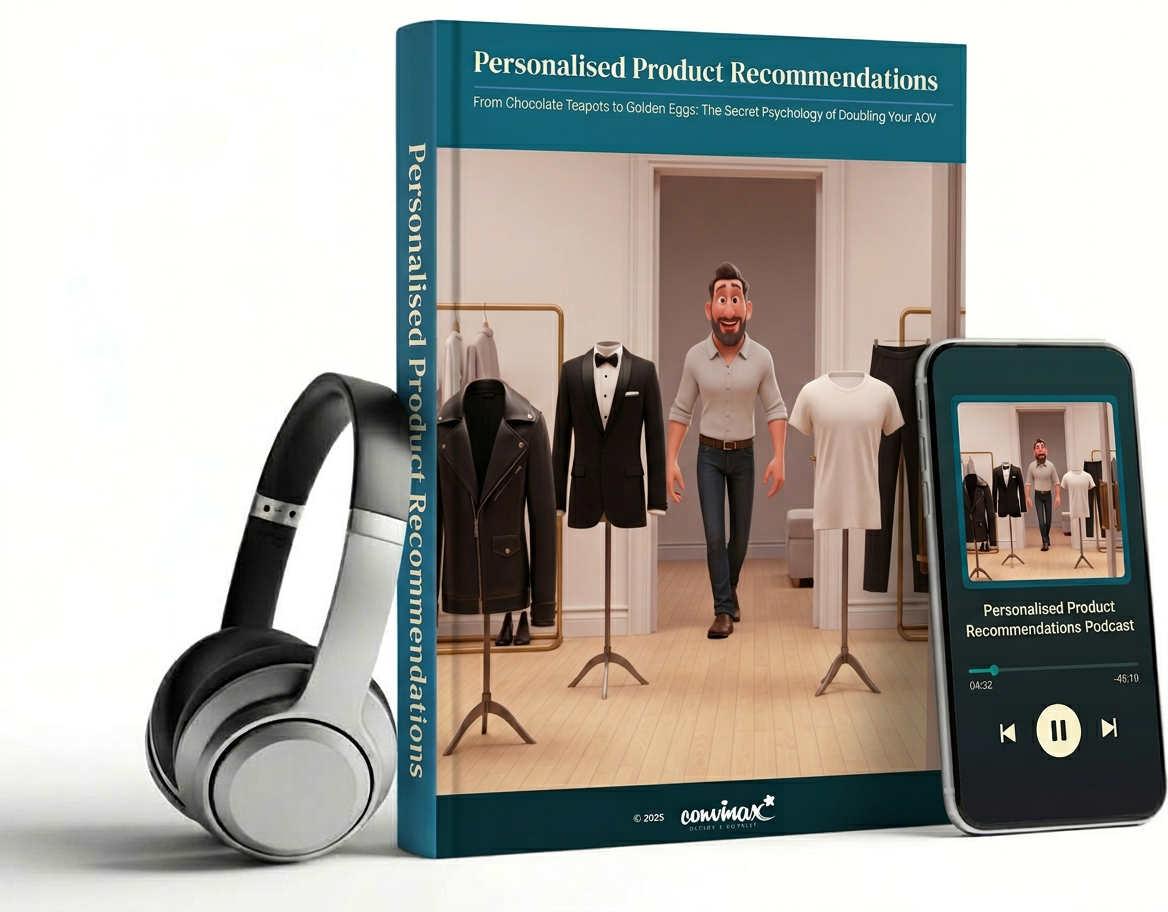
You’re not alone in this. E-commerce owners, CRO managers and growth marketers spend thousands on recommendation engines, AI-powered widgets and “customers also bought” sections – then watch their average order value flatline.
It’s not the technology that’s broken. It’s the thinking behind it.
Most sites make the same handful of mistakes – and they’re doing it right now, confidently, with data dashboards open and A/B tests running. The problem is that they’re optimising for the wrong things, in the wrong places, on the wrong devices, for the wrong reasons.
This article – and the accompanying audio overview – cuts through the noise.
It draws on peer-reviewed research, large-scale field studies and real-world case data to show you exactly what’s going wrong, and what actually works.
What the Article Reveals
A specific case study shows a 259% increase in AOV within a single month. The article reveals why this result had almost nothing to do with the technology used – and everything to do with one fundamental shift in approach.
One metric that most CRO teams obsess over is essentially meaningless as a measure of cross-sell performance. The article reveals which metric to track instead, and why the popular alternative is leading teams to the wrong conclusions.
A landmark study of 184,375 users found that a specific type of cross-selling algorithm produced a 192.9% increase in cross-sell conversion rate. The article reveals what that algorithm did differently – and how smaller sites can apply the same logic without enterprise-level budgets.
There is a precise moment in the customer journey where a cross-sell suggestion costs you zero friction. The article reveals exactly when it is, why it works psychologically, and why the majority of e-commerce sites skip it entirely.
Desktop versus mobile conversion rates are not as far apart as most industry benchmarks suggest – but the behaviour patterns are dramatically different. The article reveals what that means for how, where and when you should be showing recommendations on each device.
Cognitive psychology research establishes a specific threshold for how many recommendations you should ever show at once. The article reveals the number, why exceeding it actively harms conversions, and the neuroscience behind it.
A study of 243,000 consumers found a content-based intervention that outperformed a direct price reduction. The article reveals what that intervention was, why it works, and how to apply it to your own product pages.
The world’s most successful recommendation engine – responsible for over 80% of engagement on its platform – does not work the way most e-commerce owners think it does. The article reveals the principle behind it that any site, at any scale, can be borrowed immediately.
Diving deep into:
- The “Magic Number Seven” Trap
- The Tablet Conversion Secret
- The 1.4-Second “Scan” Rule
- The “Review Reordering” Cheat Code
- The Mobile “Research” Paradox
- The Adidas “Gold Standard”
- The “Thumb-Friendly” Rule
- Post-Purchase is the “Hidden” Profit Zone
- Does Relevance Trump Popularity
This isn’t about adding more tactics to your already overwhelming to-do list. It’s about understanding which lever actually moves the needle – and having the data to prove it to stakeholders.