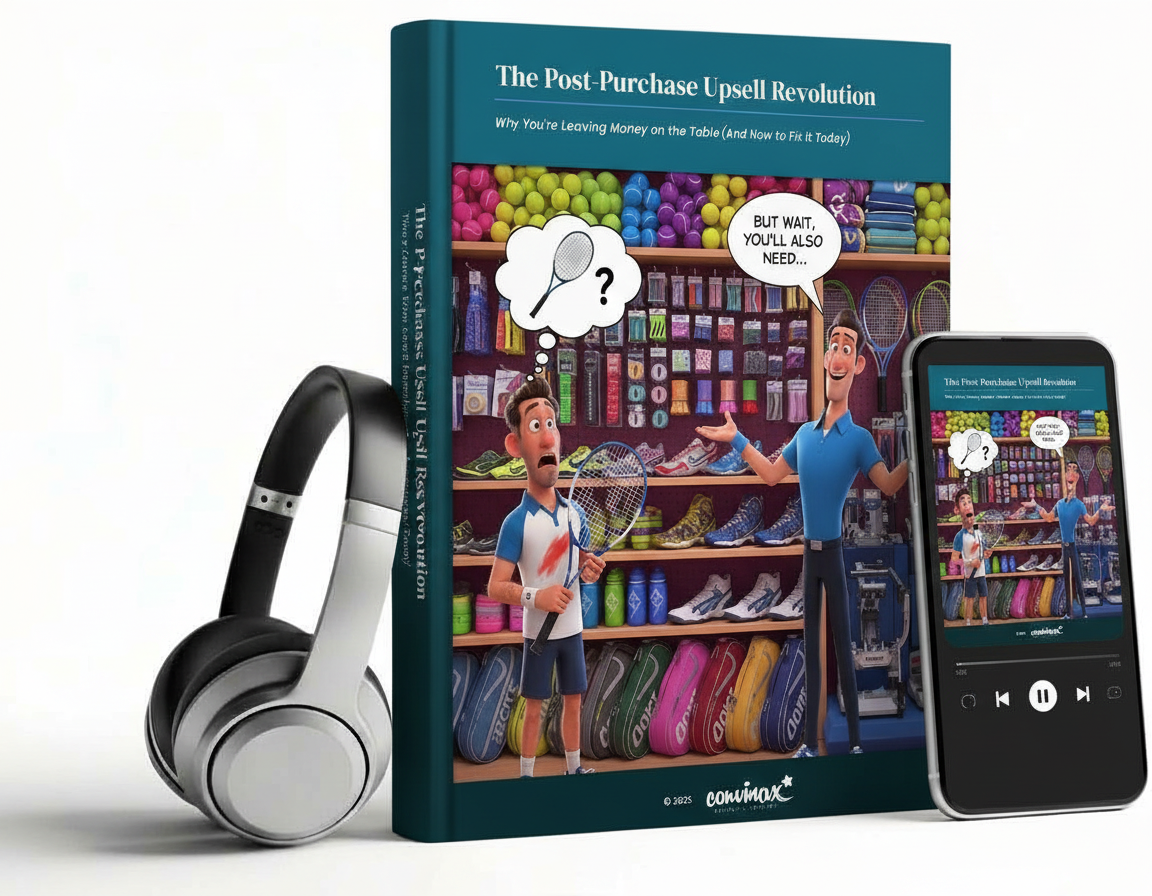
Complementary Upsell Strategies

£17.50

This booklet synthesises findings from: Peer-Reviewed Academic Research The articles draw heavily on academic journals and databases such as ScienceDirect, JSTOR, and PubMed. Key academic contributions include: Meta-Analyses: Comprehensive reviews of existing research, such as the Chernev, Bรถckenholt & Goodmanย meta-analysis of 99 observations regarding choice overload. Behavioural Economics and Psychology: Studies in journals like the Journal of Consumer Researchย and the Journal of Marketing Researchย explore principles like Nudge Theory, Ego Depletion, and Commitment Bias. Cognitive Science: Research into Cognitive Load Theory, including studies utilising electroencephalography (EEG)ย to measure brain activity during shopping scenarios. Technical Papers: Systematic reviews from arXiv analysing over 142…

The Problem No One’s Talking About

Here’s what’s actually happening on your site right now:

You’re hitting customers with modal popups duringย checkout – when their cognitive load is already maxed out. You’re asking them to make more decisions when they’re mentally exhausted from filling out forms and reviewing their order.

Or worse: you’re not presenting complementary offers at all because you’ve heard they “hurt conversion rates.”

Both approaches are costing you money. Real money. The kind that compounds month after month.

The truth? There’s a specific moment in the customer journey where upsells convert at 5-6 times the typical rate. Where acceptance rates hit 28% instead of 5%. Where you can increase Average Order Value by 30-50% without touching your primary conversion rate.

Most brands never find it. Most marketing advice on upselling is either outdated, anecdotal, or flat-out wrong.

The article covers:

  • The exact psychological window where upsells convert at 5-6x normal rates (with the neuroscience explaining why)
  • Why desktop and mobile require completely different upsell strategies (and what to do on each)
  • The cognitive load research shows why your current checkout upsells are probably killing conversions
  • Platform-specific implementation plans (desktop e-commerce, mobile web, apps, SaaS/subscriptions)
  • The pricing and relevance thresholds that determine whether customers say yes or bounce
  • Real numbers: conversion rates, acceptance rates, and AOV impacts from documented tests
  • Bundle strategies that reduced decision complexity while increasing revenue by 55-86%
  • The modal overlay timing framework (when they work vs when they destroy trust)
  • Device-specific conversion data and what it means for your upsell placement

The highlights:

  • The “Dopamine Window” is Real
  • Why Pre-Purchase Modals are “Conversion Suicide”
  • The 28.3% Acceptance Rate
  • The “Asymmetry” Rule
  • The 100 Sweet Spot
  • Why More Choice = Less Money
  • Are Form Fields Deadlier than Steps

This isn’t about adding more tactics to your already overwhelming to-do list. It’s about understanding which lever actually moves the needle – and having the data to prove it to stakeholders.
This booklet synthesises findings from:

Peer-Reviewed Academic Research

The articles draw heavily on academic journals and databases such as ScienceDirect, JSTOR, and PubMed. Key academic contributions include:

  • Meta-Analyses: Comprehensive reviews of existing research, such as the Chernev, Bรถckenholt & Goodmanย meta-analysis of 99 observations regarding choice overload.
  • Behavioural Economics and Psychology: Studies in journals like the Journal of Consumer Researchย and the Journal of Marketing Researchย explore principles like Nudge Theory, Ego Depletion, and Commitment Bias.
  • Cognitive Science: Research into Cognitive Load Theory, including studies utilising electroencephalography (EEG)ย to measure brain activity during shopping scenarios.
  • Technical Papers: Systematic reviews from arXiv analysing over 142 million products to model recommendation algorithms via graph neural networks.

Industry Research Organisations and UX Labs

Findings are corroborated by organisations that specialise in large-scale usability and market intelligence:

  • UX Research Labs: Extensive data from the Baymard Instituteย (based on over 200,000 hours of testing) and the Nielsen Norman Groupย regarding modal fatigue and checkout friction.
  • Market Intelligence Firms: Reports and benchmarks from Forrester Research, Gartner, McKinsey & Company, and Statistaย provide global e-commerce statistics and conversion benchmarks.

E-commerce Platform Analytics and Industry Reports

The sources integrate aggregated data from major service providers and marketing platforms:

  • Platform-Specific Data: Aggregated analytics from Shopify, BigCommerce, and Salesforce.
  • App and Vendor Reports: Real-world performance data from specialised tools like ReConvert, Zipify, and Klaviyo, which report on millions of actual transactions to establish “one-click” conversion benchmarks.

Controlled Experiments and A/B Testing

A significant portion of the evidence is derived from structured testing methodologies:

  • Experimental Frameworks: Randomisedย controlled trials (RCTs) and A/B tests with a 95% confidence levelย gold standard.
  • Variant Testing: Comparative analyses between different presentation methods, such as modal vs. on-page displaysย or monthly vs. annual plan nudges.

Real-World Case Studies

Insights are validated through the documented successes and failures of global brands:

  • Retail Giants: The “Amazon Playbook” is frequently cited, noting that 35% of their revenueย stems from recommendation engines.
  • Global Corporations: Documented results from Apple, Nike, Walmart, Booking.com, and Alaska Airlines.
  • DTC and Niche Brands: Quantifiable ROI increases from brands like DockATotย (55% AOV lift), Toy Shades, and Just Sunnies.
  • SaaS/Subscription Services: Implementation data from Netflix, Spotify, and Slack.

Every claim is cited. Every statistic is sourced. Every recommendation is testable.

0