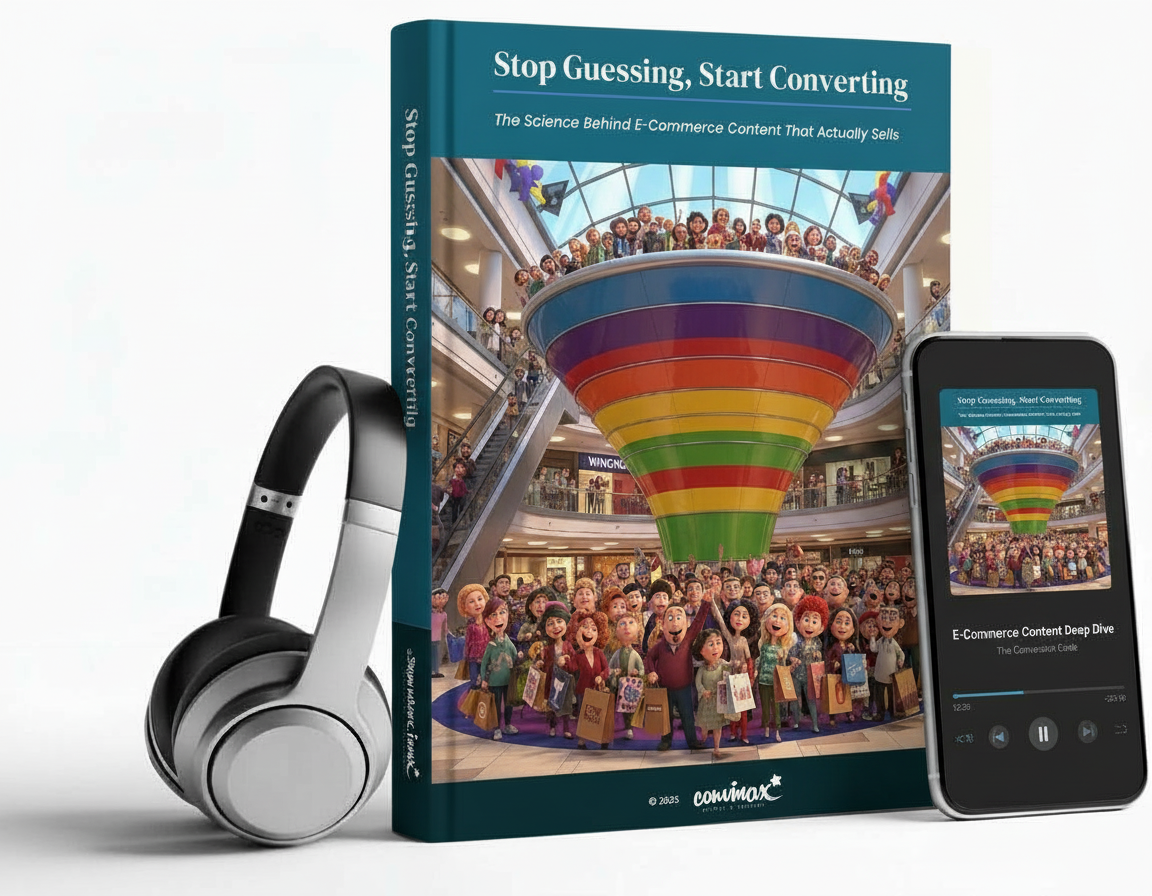
Stop Giving Customers Choice! The £260 Billion Error Killing Your Sales
The Problem Nobody’s Solving Properly
Most conversion advice falls into two camps:
Camp One: Vague platitudes about “creating value” and “building trust” that sound good in a keynote but give you nothing actionable to implement on Monday morning.
Camp Two: Hyper-technical optimisation tactics – change this button colour, test this headline – that might move the needle 0.2% if you’re lucky.
Neither approach addresses the fundamental issue: your customers are at different stages of awareness, yet you’re speaking to them all the same way.
You’re serving educational content to people ready to buy. You’re hitting browsers with aggressive sales copy. You’re asking for the sale before you’ve built trust. Or you’re building trust so long that ready-buyers get bored and leave.
The result? A conversion rate that’s mediocre at best, and haemorrhaging revenue at worst.
What This Article Delivers
Inside this research-backed deep dive, you’ll discover:
- The science behind why 70% of shoppers abandon their carts – and the specific friction points you can fix today to recover up to 35% of those lost sales
- The Progressive Amplification Effect: why optimisation at different funnel stages delivers wildly different returns (and which stage gives you 2.3x better results than the others)
- The Mobile Traffic Paradox: why 60-73% of your traffic converts at half the rate of desktop users – and the device-specific content strategy that closes this gap
- Real conversion data from 90+ studies: including the exact tactics that generated 96.63% conversion increases, 66% lifts from single changes, and consistent 25-40% improvements across tested implementations
- The cognitive load principle that explains why simplification beats sophistication every time – backed by eye-tracking studies, EEG measurements, and 10+ years of checkout usability research
- A week-by-week implementation framework showing you exactly where to start, what to test, and what results to expect at each stage
This isn’t theory. It’s a synthesis of academic research, industry benchmarks from the Baymard Institute and Nielsen Norman Group, and documented case studies from brands that have already done the hard work of testing what converts.
This isn’t about adding more tactics to your already overwhelming to-do list. It’s about understanding which lever actually moves the needle – and having the data to prove it to stakeholders.
This booklet synthesises findings from:
Academic and Peer-Reviewed Research.
The articles draw heavily on theoretical frameworks and empirical studies from behavioural economics, cognitive psychology, and marketing science:
- Cognitive Load Theory: Research by John Sweller and others is cited to explain how finite mental resources affect decision-making and task abandonment.
- Behavioural Economics: Findings from Daniel Kahneman (Thinking Fast and Slow) and Richard Thaler (Nudge Theory) are used to validate psychological triggers like loss aversion and scarcity.
- Neuroscientific Studies: Insights are derived from EEG biosensor research measuring brain activity to compare cognitive load in planned versus unplanned shopping.
- Specialised Journals: Data is pulled from the Journal of Marketing Research, Journal of Consumer Research, Marketing Science, and the Journal of Retailing regarding online reviews and consumer attention patterns.
- Eye-Tracking Research: Studies measuring visual attention patterns, such as the F-pattern, are used to optimise content layout and visual hierarchy.
Industry Research and UX Benchmarks
Extensive data is synthesised from leading usability and e-commerce research firms:
- Baymard Institute: Sources cite over 200,000 hours of UX research and thousands of test sessions focused on checkout usability and cart abandonment.
- Nielsen Norman Group (NN/g): Research from this group provides the basis for guidelines on minimising cognitive load and effective navigation.
- Global Consulting and Tech Firms: Insights from McKinsey & Company (personalisation ROI), Google (mobile speed impact), and Salesforce (conversion benchmarks) are utilised.
- Platform-Specific Benchmarks: Data aggregated from Shopify, Klaviyo, Mailchimp, Dynamic Yield, and HubSpot provide sector-specific conversion rates and email marketing performance.
Controlled Experiments and A/B Testing
The articles rely on the “gold standard” of testing to prove the effectiveness of specific interventions:
- Statistical Meta-Analysis: Aggregate findings from platforms like Optimizely, VWO, and Unbounce document conversion lifts from changes in CTAs, page load speeds, and visual hierarchy.
- Specific Brand Experiments: Documented A/B tests for brands like Rappi (shipping fee placement), Clarks Shoes (free shipping prominence), and SmartWool (image grid optimisation) illustrate measurable revenue gains.
Real-World Case Studies
Implementation results from global retailers and niche platforms serve as practical proof points:
- Retail Giants: The “content-driven” approaches of Amazon and Walmart are analysed as benchmarks for high-intent conversion.
- Specialised Platforms: Success stories from Sephora (social proof), Booking.com (urgency and context), and Mindbody (frictionless re-booking) are synthesised to show stage-specific funnel optimisation.
- Systematic Reviews: One report specifically notes a semantic search of over 138 million academic papers to identify empirical evidence for funnel-stage interventions.
Regional and Seasonal Data
Finally, the research incorporates market data from Statista, IRP Commerce, and SmartInsights to account for regional differences (e.g., UK vs. US conversion rates) and seasonal shifts like Black Friday/Cyber Monday (BFCM) performance
Every claim is cited. Every statistic is sourced. Every recommendation is testable.