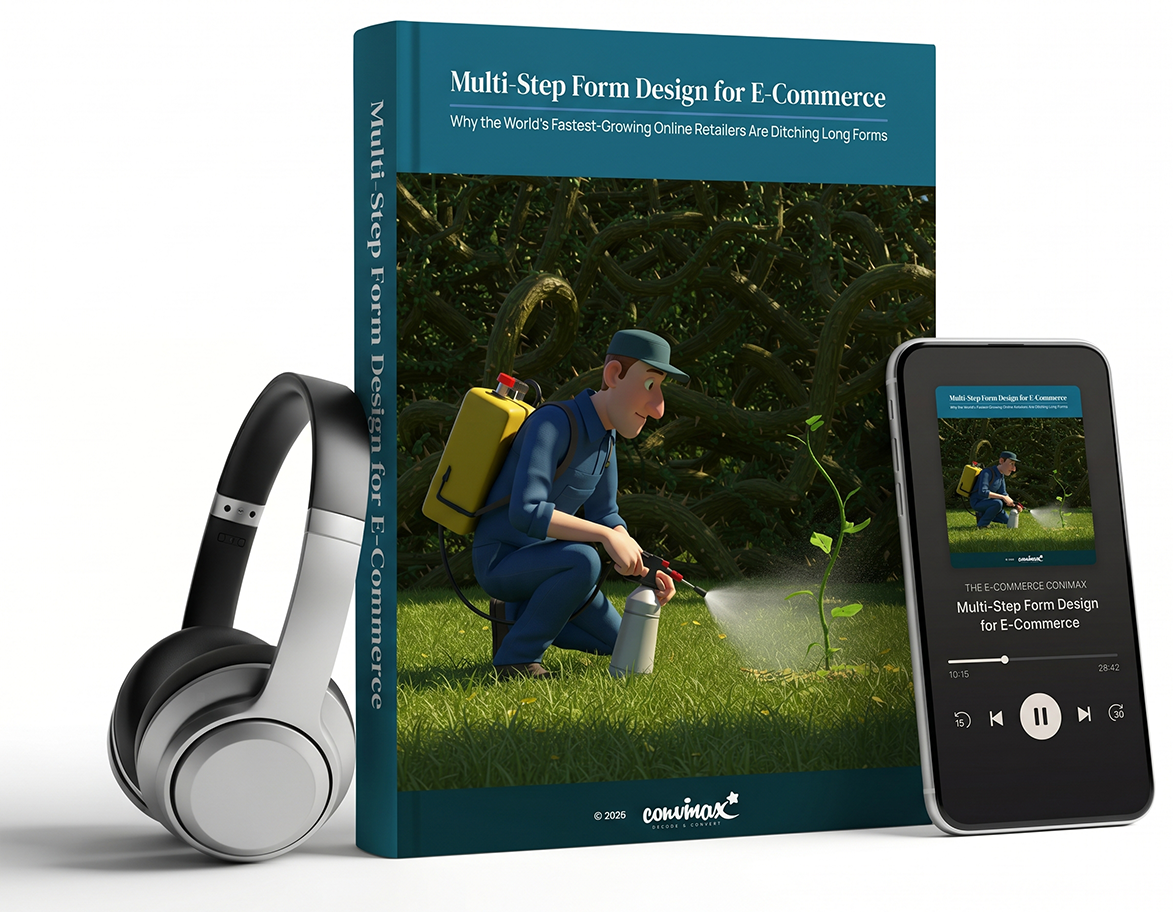
We Analysed 50+ Conversion Studies on Checkout Forms – One Company Found a 743% Increase
Every day, your checkout or lead form is quietly deciding who buys and who leaves.
Not your pricing. Not your product photos. Not your ad spend. The form.
Most businesses treat form design as an afterthought – a box to tick once the “real” marketing work is done. But the research tells a different story. Across more than 50 studies and real-world case studies, the way a form is structured is one of the single biggest levers on conversion rate available to any e-commerce business – and most people are getting it wrong without realising it.
This booklet and podcast pull together the data, the psychology, and the case studies that explain exactly why – and what to do about it.
What the article reveals:
- The article reveals exactly how much completion rates jump when a long form is restructured into steps – and why the gap is bigger than most CRO managers expect.
- It uncovers the psychological “trigger” that makes people far more likely to finish a form once they’ve started it – and how to activate it deliberately.
- It names the one design mistake that quietly costs mobile retailers more in lost sales than almost any other checkout error.
- It reveals the case study behind a 743% conversion improvement, and the specific sequence of changes that produced it – not a one-off fluke, but a repeatable method.
- It challenges the most common objection to multi-step forms (“it adds friction”) with data that shows the opposite is usually true – and explains exactly why.
- It sets out realistic, sector-specific improvement targets, so you know what “good” actually looks like for a business like yours.
This booklet synthesises findings from:
Academic & Peer-Reviewed Research
- Di Fatta, D., et al. (2018).The determinants of conversion rates in SME e-commerce websites: A qualitative comparative analysis. Journal of Retailing and Consumer Services.
- Li, X., et al. (2025).Cognitive load theory application in e-commerce environments. Journal of Electronic Commerce Research.
- Pignatiello, G. A., et al. (2018).Decision fatigue: A conceptual-level review of a decade of research. PMC / National Institutes of Health.
- Pratesi, A., et al. (2021).Cross-cultural analysis of form completion behaviour using CFA and SEM. Journal of Business Research.
- Sweller, J., et al. (2019).Cognitive load theory: A 2019 review. SpringerLink.
Industry Research & UX Benchmarks
- Baymard Institute. (2024). Checkout UX Best Practices / Cart & Checkout Usability. Based on 150,000+ hours of UX research.
- Dynamic Yield. The Economics of E-commerce Conversion Optimisation: Benchmarks and Device Performance.
- Formstack Research. Form Conversion Report: Single vs. Multi-page Performance.
- Comparative Analysis of Form Completion Rates.
- Interaction Design Foundation. Principles of Progressive Disclosure.
- Nielsen Norman Group (NNg). (2016). Website Forms Usability: Top 10 Recommendations.
- Nielsen Norman Group (NNg). Usability Testing 101: Identifying 85% of Issues with 5 Users.
Books & Experimentation Guides
- Kohavi, R., Tang, D., & Xu, Y. (2020).Trustworthy Online Controlled Experiments: A Practical Guide to A/B Testing. Cambridge University Press / experimentguide.com.
- Miller, Evan. Sample Size Calculator and Statistical Tools for A/B Testing. evanmiller.org.
Case Studies & A/B Testing Results
- Elastic Path. Single-page checkout performance vs. multi-step flows in E-commerce.
- Obama Campaign Donation Experiment: The impact of multi-step vs. long forms.
- PayU Fintech. Field reduction and its impact on conversion rates.
- Venture Harbour. Lead form optimisation: A 743% conversion improvement case study.
- com. Multi-step lead generation performance.
- Zalora Fashion. Product page and checkout flow optimisation.