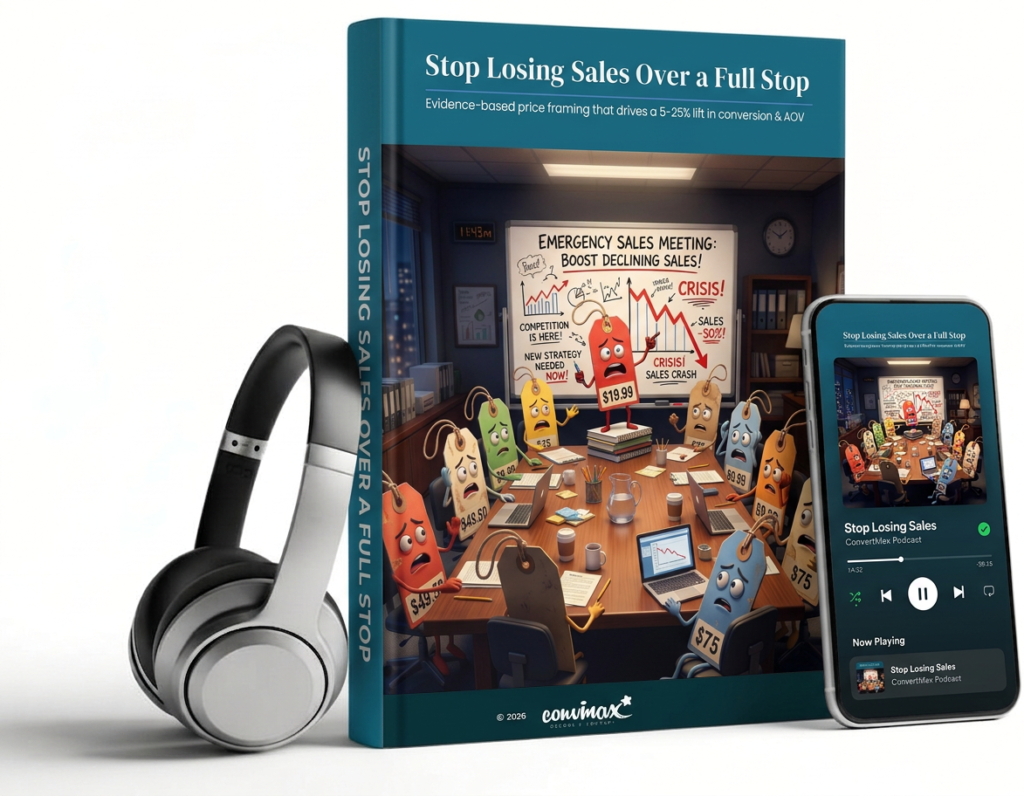
Price Anchoring Strategy

£17.50

This booklet synthesises findings from: Anderson, E. T., & Simester, D. I. (2003). Effects of $9 price endings on retail sales: Evidence from field experiments. Quantitative Marketing and Economics, 1(1), 93–110. Ariely, D. (2008). Predictably irrational: The hidden forces that shape our decisions. HarperCollins. Ariely, D., Loewenstein, G., & Prelec, D. (2003). Coherent arbitrariness: Stable demand curves without stable preferences. Quarterly Journal of Economics, 118(1), 73–106. Bassellier, G., & Ramaprasad, J. (2018). The impact of price anchoring on consumers’ valuation of digital goods. Bassellier, G., & Ramaprasad, J. (2023). All external reference prices are not the same: How magnitude, source, and fairness shape payment for…

Category: ,
Tags:

Your “Was £99, Now £49” Price Tag Might Be Losing You Money. Here’s the Research Nobody in CRO Wants to Admit.

You’re not short of pricing tactics. You’re short of proof any of them work on your store.

Every product page you’ve ever admired is running the same handful of pricing tricks. The crossed-out “was” price. The middle plan with a “Most Popular” badge stuck on it. The “85p a day” subscription pitch. You’ve copied at least one of them, because a bigger brand was doing it and it looked like it was converting.

Here’s the uncomfortable bit: looking like it’s working and actually moving revenue are two very different claims. And most of the advice floating around CRO blogs quietly assumes they’re the same thing.

This booklet doesn’t. It goes through some of the most common anchoring tactics in e-commerce and checks each one against the actual evidence, peer-reviewed meta-analyses, field experiments with real payments, and live A/B tests run by real subscription businesses. Not opinion. Not “best practice.” What genuinely happened when someone tested it.

Some of what you’re currently doing on your pricing page will hold up. Some of it won’t. You won’t know which is which until you’ve read this.

What the article reveals:

  • Why the single most copied pricing trick in e-commerce, the crossed-out “was” price, lost more often than it won when tested head-to-head across 22 live experiments by real subscription businesses, including two brands with well-resourced growth teams.
  • The exact moment “free” stops behaving like a discount and starts behaving like something else entirely, and why the gap between “almost free” and “free” moved orders at genuine commercial scale, not just in a lab.
  • The one tiered-pricing move with some of the strongest evidence in all of behavioural science, and why it’s not the tactic most people reach for first.
  • A single-word change to how a subscription price is framed that swung acceptance by 22 percentage points, for the exact same amount of money.
  • Why the decoy-pricing trick everyone quotes from that famous Economist magazine study has struggled to reproduce outside a classroom and what that means for the version sitting on your pricing page right now.
  • Where the legal ground has already shifted underneath “was” pricing in the US, EU and UK, and which retailers have already been sued over getting it wrong.
  • The article reveals which pricing move can lift revenue simply by changing the order in which products are shown, with nothing else touched.


 

This booklet synthesises findings from:

Anderson, E. T., & Simester, D. I. (2003). Effects of $9 price endings on retail sales: Evidence from field experiments. Quantitative Marketing and Economics, 1(1), 93–110.

Ariely, D. (2008). Predictably irrational: The hidden forces that shape our decisions. HarperCollins.

Ariely, D., Loewenstein, G., & Prelec, D. (2003). Coherent arbitrariness: Stable demand curves without stable preferences. Quarterly Journal of Economics, 118(1), 73–106.

Bassellier, G., & Ramaprasad, J. (2018). The impact of price anchoring on consumers’ valuation of digital goods.

Bassellier, G., & Ramaprasad, J. (2023). All external reference prices are not the same: How magnitude, source, and fairness shape payment for digital goods. Information Systems Research.

Baymard Institute. (2022). How to display price discounts on the product page: Avoid these 4 pitfalls.

Bucchianeri, G. W., & Minson, J. A. (2013). A homeowner’s dilemma: Anchoring in residential real estate transactions. Journal of Economic Behaviour & Organisation, 89, 76–92.

Frederick, S., Lee, L., & Baskin, E. (2014). The limits of attraction. Journal of Marketing Research, 51(4), 487–507.

Gourville, J. T. (1998). Pennies-a-day: The effect of temporal reframing on transaction evaluation. Journal of Consumer Research, 24(4), 395–408.

Gourville, J. T. (2003). The effects of monetary magnitude and level of aggregation on the temporal framing of price. Marketing Letters, 14(2), 125–135.

Huber, J., Payne, J. W., & Puto, C. (1982). Adding asymmetrically dominated alternatives: Violations of regularity and the similarity hypothesis. Journal of Consumer Research, 9(1), 90–98.

Jung, M. H., Perfecto, H., & Nelson, L. D. (2016). Anchoring in payment: Evaluating a judgmental heuristic in field experimental settings. Journal of Marketing Research, 53(3), 354–368.

Kahneman, D., & Tversky, A. (1979). Prospect theory: An analysis of decision under risk. Econometrica, 47(2), 263–291.

Kalyanaram, G., & Winer, R. S. (1995). Empirical generalisations from reference price research. Marketing Science, 14(3_supplement), G161–G169.

Li, L., Maniadis, Z., & Sedikides, C. (2021). Anchoring in economics: A meta-analysis of studies on willingness-to-pay and willingness-to-accept. Journal of Behavioural and Experimental Economics, 90, 101629.

Mazumdar, T., Raj, S. P., & Sinha, I. (2005). Reference price research: Review and propositions. Journal of Marketing, 69(4), 84–102.

Northcraft, G. B., & Neale, M. A. (1987). Experts, amateurs, and real estate: An anchoring-and-adjustment perspective on property pricing decisions. Organisational Behaviour and Human Decision Processes, 39(1), 84–97.

Priester, A., Robbert, T., & Roth, S. (2020). A special price just for you: Effects of personalised dynamic pricing on consumer fairness perceptions. Journal of Revenue and Pricing Management.

Rao, A. R., & Monroe, K. B. (1989). The effect of price, brand name, and store name on buyers’ perceptions of product quality: An integrative review. Journal of Marketing Research, 26(3), 351–357.

Schley, D. R., & Weingarten, E. (2025). 50 years of anchoring effects: A theoretical re-integration and meta-analysis. SSRN. (Referenced earlier as Schley, 2023).

Shampanier, K., Mazar, N., & Ariely, D. (2007). Zero as a special price: The true value of free products. Marketing Science, 26(6), 742–757.

Simonson, I. (1989). Choice based on reasons: The case of attraction and compromise effects. Journal of Consumer Research, 16(2), 158–174.

Simonson, I., & Tversky, A. (1992). Choice in context: Tradeoff contrast and extremeness aversion. Journal of Marketing Research, 29(3), 281–295.

Thaler, R. H. (1985). Mental accounting and consumer choice. Marketing Science, 4(3), 199–214.

Thaler, R. H. (1999). Mental accounting matters. Journal of Behavioural Decision Making, 12(3), 183–206.

Thomas, M., & Morwitz, V. (2005). Penny wise and pound foolish: The left-digit effect in price cognition. Journal of Consumer Research, 32(1), 54–64.

Tversky, A., & Kahneman, D. (1974). Judgment under uncertainty: Heuristics and biases. Science, 185(4157), 1124–1131.

Tversky, A., & Kahneman, D. (1981). The framing of decisions and the psychology of choice. Science, 211(4481), 453–458.

Xia, L., Monroe, K. B., & Cox, J. L. (2004). The price is unfair! A conceptual framework of price fairness perceptions. Journal of Marketing, 68(4), 1–15.

Yang, S., & Lynn, M. (2014). More evidence challenging the robustness and usefulness of the attraction effect. Journal of Marketing Research, 51(4), 508–513.

Related products
0