The Discount Trap: Why Your 50% Off Sale Is Killing Your Conversions
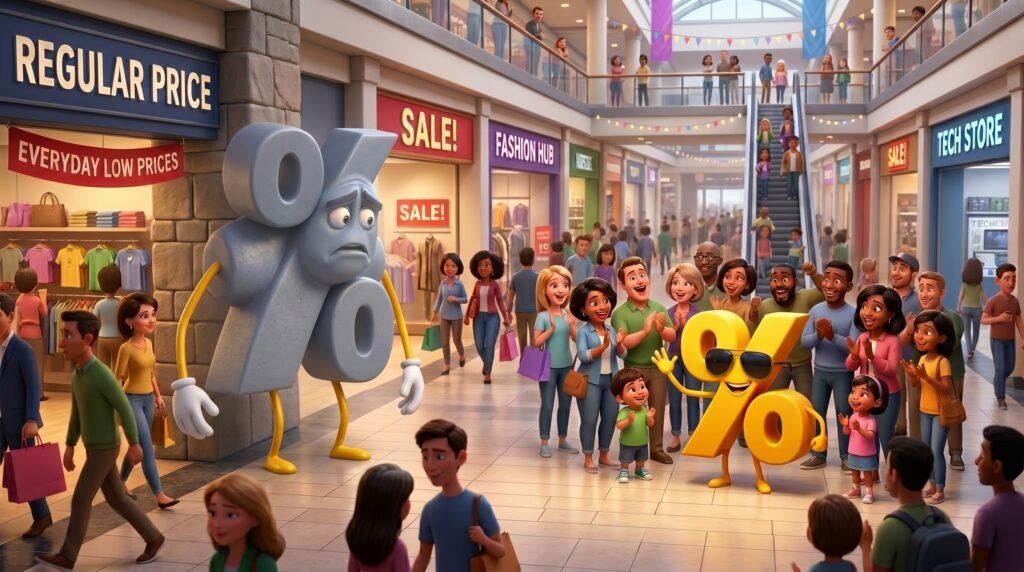
Stop. Before you launch that flash sale with eye-watering discounts, read this.
We’ve watched countless e-commerce directors make the same costly mistake: assuming that bigger discounts automatically mean better conversions. It’s the marketing equivalent of shouting louder when someone doesn’t understand you – often counterproductive and always expensive.
After analysing over 100 academic studies, platform datasets covering 325 billion emails, and real-world A/B tests from companies like Amazon and Booking.com, we’ve uncovered something that will challenge everything you think you know about discount strategy.
The brutal truth? Your 50%-off sale might be costing you more customers than it’s bringing in.
The Myth That’s Bleeding Your Margins Dry
Here’s the prevailing wisdom that’s absolutely wrong: “If 20% off works, then 40% off must work twice as well.”
This linear thinking has infected boardrooms across the country. Finance teams love it because it’s simple. Marketing teams embrace it because it feels safe. But customers? They’re far more complex than this crude formula suggests.
The research reveals something fascinating – and counterintuitive. Discount effectiveness follows a U-shaped curve, not a straight line. There’s a sweet spot around 20-30% where conversions peak, and then something interesting happens: they start to decline.
The Science Behind Your Customer’s Brain
Let me share what’s actually happening in your customer’s mind when they see that massive discount.
The Cognitive Load Problem
When shoppers encounter large discounts, their brains don’t just think “brilliant deal.” Instead, they start working overtime. Neurological studies using EEG monitoring show that percentage discounts create significant cognitive load – your customer’s brain is literally working harder to process the information.
Here’s what excessive discounts trigger:
- Quality scepticism – “What’s wrong with this product?”
- Urgency anxiety – “Am I being manipulated?”
- Decision paralysis – “This feels too good to be true”
Research from behavioural economics reveals that consumers will pay 37-57 pence to use an extra pound of coupon value, but when discounts become extreme, this psychological value actually diminishes.
The Reference Price Trap
Your customers aren’t mathematical calculators. They’re pattern-matching machines influenced by what psychologists call “reference pricing.”
When you consistently offer 50% discounts, you’re not just reducing your margins – you’re training customers to expect unrealistic value. Worse, you’re making them question your regular prices. If you can afford to sell at half price, what was that full price really worth?
The Platform Reality Check
The data doesn’t lie, and it’s more nuanced than most realise.
Mobile vs Desktop: A Tale of Two Conversions
Platform Performance Breakdown:- Desktop: 2.8-3.9% average conversion rate- Mobile: 1.8-2.8% average conversion rate – Tablet: 3.1% average conversion rate
But here’s where it gets interesting: mobile users show a 3.61% lift in conversion with percentage discounts compared to only 2.22% on desktop. The smaller screen creates additional cognitive constraints, making simple, clear discount communication even more critical.
The Cross-Platform Optimisation Reality
A fashion retailer’s A/B test across 700,000 visitors revealed something crucial: showing discount percentages alongside “was/now” pricing achieved a 2.57% lift in conversion rate – but only when products had different discount levels across categories.
When everything was uniformly discounted, the effect disappeared entirely.
What the Big Players Actually Do (And Why It Works)
Let me tell you what Amazon, Booking.com, and other conversion champions have learned through billions of transactions.
Amazon’s Threshold Strategy
Amazon doesn’t randomly discount. They’ve discovered that products priced above £25 (their free shipping threshold) show higher conversion rates among non-Prime customers. They’re not competing on discount size – they’re optimising for psychological triggers.
Booking.com’s Genius Programme
Instead of aggressive promotional codes, Booking.com’s Genius programme offers 10-20% instant discounts after 2-5 bookings. This targeted approach outperforms Expedia’s scatter-gun strategy of 3.4 promotional codes monthly.
The difference? Booking.com creates earned value. Expedia creates a discount expectation.
The Email Marketing Revelation
Klaviyo’s analysis of 325 billion emails during Black Friday and Cyber Monday period revealed the optimal range: 20-29% discounts converted best across all industries.
The most common discounts were 30%, 20%, and 25% in that order. But here’s the kicker – the highest discounts didn’t lead to the highest conversions.
The Sweet Spot: Why 20-30% Rules
After analysing hundreds of studies and real-world tests, a clear pattern emerges. The 20-30% discount range hits multiple psychological triggers simultaneously:
Why This Range Works:
- Cognitive ease – Easy to process, doesn’t trigger scepticism
- Perceived value – Substantial enough to feel meaningful
- Quality preservation – Doesn’t signal desperation or defects
- Urgency balance – Creates action without panic
The Loss Aversion Factor
Research shows consumers respond to markups versus discounts at a 5:1 ratio. A 10% perceived markup causes a 20.4 percentage point decrease in purchases, while a 10% discount only increases purchases by 3.8 percentage points.
This asymmetry explains why moderate discounts work better – they trigger a positive response without activating loss aversion mechanisms.
Addressing the Sceptics: “But Our 40% Sales Always Work!”
We hear this objection constantly. Let’s address it directly.
“Our big discount events drive massive traffic and sales.”
Yes, they drive volume. But at what cost? Fashion retailers typically spend 20-50% of net sales on markdowns. More telling: research shows that retailers associated with everyday low prices consistently outperform those known for sales and promotions in stock price, revenue, and operating margin.
“Our competitors offer bigger discounts.”
Playing the discount game is a race to the bottom. When every brand offers 50% off, nobody has an advantage. You’re competing on margin destruction, not value creation.
“Customers expect big discounts now.”
This is exactly the problem. You’ve trained them to expect unsustainable value. The solution isn’t bigger discounts – it’s better value communication and strategic discount deployment.
The Testing Framework That Actually Works
Here’s how to implement this intelligently:
1. Start With the Sweet Spot
Begin testing in the 20-30% range. Use this as your baseline, not your minimum.
2. Segment Ruthlessly
- Mobile users: Prefer simplified discount presentations
- Desktop users: Can process more complex offers
- Product categories: High-ticket items favour percentage, low-value items favour pound amounts
- Customer segments: New customers vs. loyal customers respond differently
3. Test Properly
- Minimum sample size: 50,000+ visitors per variation
- Test duration: Minimum 2 weeks, ideally encompassing full business cycles
- Metrics focus: Track conversion rate, revenue per visitor, AND customer lifetime value
4. Consider Context
- B2B vs B2C: B2B deals can involve discounts up to 80% for enterprise customers, while B2C benefits from transparency
- Regional differences: 65% of consumers gravitate toward brands that align with cultural values
- Seasonal factors: Account for natural buying patterns and market conditions
The Mindset Shift That Changes Everything
Stop thinking about discounts as a volume lever. Start thinking about them as a psychological tool.
Your discount strategy should answer these questions:
- What behaviour am I trying to encourage?
- How does this align with my brand positioning?
- What’s the long-term customer value impact?
- Am I creating or destroying perceived value?
The Conversion Philosophy That Wins
Here’s what separates the conversion champions from the margin destroyers: they understand that optimisation isn’t about finding the biggest lever to pull. It’s about finding the right combination of psychological triggers that create sustainable, profitable growth.
The best discount strategies:
- Build brand value while driving sales
- Create urgency without desperation
- Reward loyalty without devaluing products
- Generate profit while growing market share
Your Next Move
Before you launch your next discount campaign, ask yourself: “Am I optimising for this quarter’s revenue or next year’s profit?”
The companies winning the long game have learned that moderate, strategic discounts consistently outperform aggressive, reactive ones. They’ve stopped competing on discount size and started competing on discount intelligence.
Your challenge: Test the 20-30% sweet spot against your current strategy. Measure not just conversion rates, but customer lifetime value and brand perception metrics.
The data is clear. The psychology is proven. The question is: are you brave enough to leave money on the table today to build a more profitable tomorrow?
Because in e-commerce, as in life, the biggest discount isn’t always the best deal.
The sources synthesise findings from a diverse range of evidence, spanning rigorous academic theory to real-world commercial applications. The key areas of synthesis include:
- Academic Studies and Peer-Reviewed Journals
The articles frequently cite rigorous, peer-reviewed research to establish the psychological and economic foundations of discounting. Specific journals and fields mentioned include:
Marketing and Consumer Research: Studies from the Journal of Marketing Research, Journal of Consumer Research, Marketing Science, and the Journal of Retailing
. Business and Economics: Research published in the Journal of Business Research and the Journal of Behavioural Economics
. Human-Computer Interaction (HCI): Insights regarding website complexity and cognitive load from journals like ScienceDirect and Hindawi - Neurological and Behavioural Research
To understand the “why” behind consumer actions, the sources utilise advanced scientific methodologies:
Neurological Monitoring: Research using EEG monitoring, Event-Related Potentials (ERP), and brain imaging to track how discounts affect cognitive conflict and neural efficiency
. Eye-Tracking Studies: Analysis of visual attention patterns, fixation durations, and the “Attention-Withdrawal” (AW) effect to determine how shoppers visually process discount badges
. Behavioural Economics: Findings related to loss aversion (the 5:1 ratio of response to markups vs. discounts), transaction utility, and reference price theory - Industry Research and Platform Datasets
The sources leverage massive data sets from major e-commerce platforms and industry leaders to provide real-world benchmarks:
Global Platform Data: Analysis of 325 billion emails via Klaviyo and data from 28,000+ SMS/push notifications
. Industry Reports: Benchmarks from Adobe Analytics, Shopify, BigCommerce, Dynamic Yield, and the Baymard Institute
. Data Science Modelling: Use of Machine Learning (ML) and SHAP value analysis to isolate the specific impact of discounts on conversion - Controlled Experiments and A/B Testing
Much of the actionable advice is derived from large-scale testing environments:
Massive Sample A/B Tests: Meta-analyses of thousands of tests (e.g., 2,732 tests) and specific fashion retailer experiments involving over 700,000 visitors
. Platform-Specific Testing: Results from Amazon’s “Manage Your Experiments” tool and Booking.com’s journey optimisation tests - Real-World Case Studies and Practitioner Insights
The articles synthesise practical outcomes from established companies and industry experts:
Corporate Case Analysis: Longitudinal tracking of customer behaviour from companies like Amazon, Booking.com, Expedia, and Groupon
. Practitioner Evidence: Insights and “hard-won” lessons shared by e-commerce directors and experts on professional networks like X (formerly Twitter) - Regional and Meta-Analytic Research
The sources look at broader trends and syntheses across multiple dimensions:
Meta-Analyses: Statistical syntheses of hundreds of individual studies to identify universal patterns, such as the U-shaped curve of discount effectiveness
. Cross-Cultural/Regional Studies: Research into how discount reception varies across North America, Europe, and Asia-Pacific, accounting for cultural values and local economic conditions
- Why ‘Fast’ Websites Lose Money: The Counterintuitive Science of E-Commerce Speed

- The Homepage Carousel Myth: Why Static Beats Spinning for E-commerce Conversions

- Why 90% of Your A/B Tests Are Lying to You (And the Secret Top Tech Companies Use)

- The Headline Myth That’s Costing You Conversions (And What Actually Works)

- STOP Surveying Your Customers: The Controversial Truth Behind 30% More E-Commerce Sales

- The Second-Person Trap: Why “You” Isn’t Always the Answer in E-commerce Copy

Articles On Sale
-
Ask for Preferences Without Asking Too Soon
Original price was: £17.50.£7.45Current price is: £7.45. -
Does Your Brand Voice Build Trust or Kill It?
Original price was: £17.50.£7.45Current price is: £7.45. -
Is Your Search Bar Costing You Millions?
Original price was: £17.50.£7.45Current price is: £7.45. -
Make “Added to Cart” Feel Like a Win
Original price was: £17.50.£7.45Current price is: £7.45. -
Product Photos That Speak to the Right Buyer
Original price was: £17.50.£7.45Current price is: £7.45.