Psychological Triggers

£17.50

This booklet synthesises findings from: Academic and Scientific Studies Peer-Reviewed Journals: The sources cite specific systematic reviews and experimental studies from journals such as Decision Support Systems and Communication Research. Systematic Reviews: One source analysed findings from a semantic search of over 138 million academic papers through the Elicit search engine, which includes databases like Semantic Scholar and OpenAlex. Foundational Behavioural Economics: The articles draw on the work of Nobel-prize-winning researchers like Daniel Kahneman and Amos Tversky, who identified core biases like loss aversion and anchoring. They also reference Robert Cialdini’s research on the principle of consistency. Controlled Experiments and Field Tests Randomised…

Why 78% of Online Shoppers Buy Without Thinking – And How to Design For It

Here’s an uncomfortable truth about your online store: most of your visitors aren’t deciding with their heads.

Up to 78% of online purchases are impulsive, shaped by subconscious triggers that have nothing to do with your product photography, your page speed, or your carefully written copy. You could fix every “best practice” on your checklist and still watch conversion rates flatline, because the thing that’s actually stopping people from buying isn’t visible on a heatmap.

It’s psychological.

Every major retailer you admire – Amazon, Apple, Nike, Warby Parker – isn’t just executing good design. They’re engineering specific cognitive responses at specific moments in the customer journey. And once you can see the mechanics, you can’t unsee them in your own store’s blind spots.

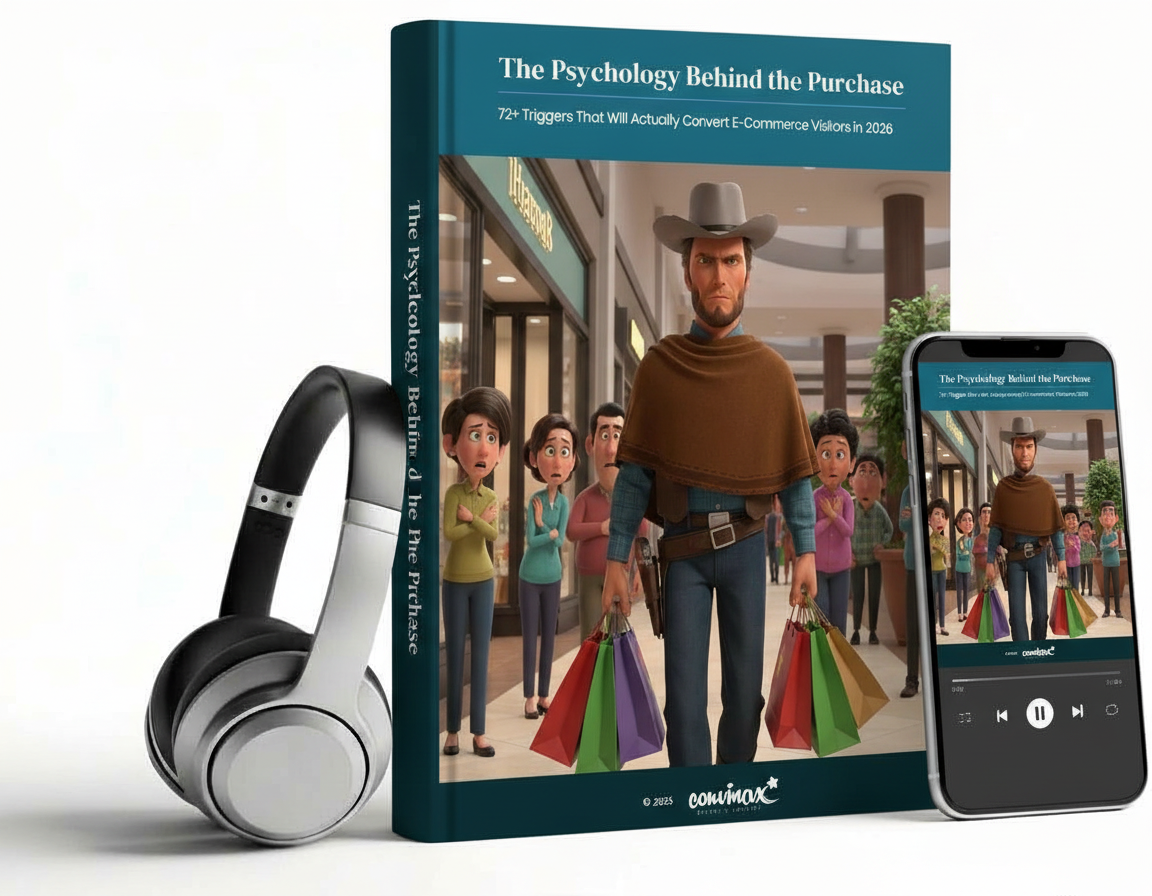
This research booklet breaks down 72+ documented psychological triggers used across the modern e-commerce journey, backed by peer-reviewed studies and real-world case data, not opinion or guesswork.


This is a deep, practical breakdown of the psychological triggers that sit behind every buying decision – the ones your competitors are already using, consciously or not.

You’ll understand how to design for the way your customers genuinely think – not how you’d like them to think. You’ll see which triggers to use, when to use them, and critically, which combinations to avoid (because some actively cancel each other out and quietly destroy conversions).

There’s no fluff. No 101-level advice you’ve already read ten times. This is the kind of material that shifts how you approach your entire site – from the first product page someone lands on to the moment they hit “place order.”

The article comes with a companion audio version, so you can listen on your commute, during a workout, or whenever you get five minutes away from a screen.

What You’re Getting

  • Why one well-known combination of two popular conversion tactics actually cancels out the benefit of both – and which pairing does the opposite, amplifying results well beyond what either trigger achieves alone
  • The precise interactivity threshold a product page must cross before it has any measurable effect on conversion – fall short of it and you’re wasting development budget for nothing
  • Why background music and “energetic” page design, two things many brands assume help, can quietly sabotage the same interactive features they’re meant to support
  • The real reason losses and gains aren’t psychologically equal, and how reframing a single line of checkout copy can shift purchase behaviour
  • What one home try-on retailer discovered about the exact number of days it takes physical possession to override the impulse to return an item
  • Which of four common “everybody knows this” beliefs about psychological triggers is quietly costing stores money, and why the fix is nearly the opposite of what most CRO advice recommends

This isn’t about adding more tactics to your already overwhelming to-do list. It’s about understanding which lever actually moves the needle – and having the data to prove it to stakeholders.


This booklet synthesises findings from:

Academic and Scientific Studies

    • Peer-Reviewed Journals: The sources cite specific systematic reviews and experimental studies from journals such as Decision Support Systems and Communication Research.
    • Systematic Reviews: One source analysed findings from a semantic search of over 138 million academic papers through the Elicit search engine, which includes databases like Semantic Scholar and OpenAlex.
    • Foundational Behavioural Economics: The articles draw on the work of Nobel-prize-winning researchers like Daniel Kahneman and Amos Tversky, who identified core biases like loss aversion and anchoring. They also reference Robert Cialdini’s research on the principle of consistency.

Controlled Experiments and Field Tests

  • Randomised Controlled Trials (RCTs): The findings include data from large-scale field experiments, such as an onboarding study involving 475,495 participants.
  • Laboratory Experiments: Some data come from controlled “between-participants” experiments, such as a study on interactivity and arousal involving university students.
  • A/B Testing: Many of the conversion metrics, such as the finding that high interactivity can lead to 85% add-to-cart rates, are derived from controlled A/B testing.

Industry Research and Trend Reports

  • Market Research Firms: The sources cite data from major firms like NielsenIQ, McKinsey, and Salesforce to track consumer outlooks and experience optimisation trends for 2025-2026.
  • Specialised E-commerce Platforms: Research and best practices are drawn from major industry players like Shopify, Amazon, and Booking.com.
  • Conversion Optimisation Databases: Insights are synthesised from specialised conversion tools and databases like ConvertCart, Nudgify, and Crazy Egg.

Real-World Case Studies

  • Global Brands: The articles analyse specific strategies used by successful companies, including Nike’s customisation tools (Ikea Effect), Apple’s minimalist design (Cognitive Ease), Warby Parker’s home try-on program (Endowment Effect), and Dollar Shave Club’s subscription funnels (Progressive Commitment).

Practitioner and Expert Analysis

  • Behavioural Economics Portals: Findings are gathered from platforms dedicated to applying behavioural science to business, such as InsideBE and Neuroscience Marketing.
  • Expert Marketing Insights: Strategies are informed by veteran digital marketers and platforms like Neil Patel and Martech Zone

Every claim is cited. Every statistic is sourced. Every recommendation is testable.

0